
Your shopping cart is empty!
Welcome visitor you can login or create an account.
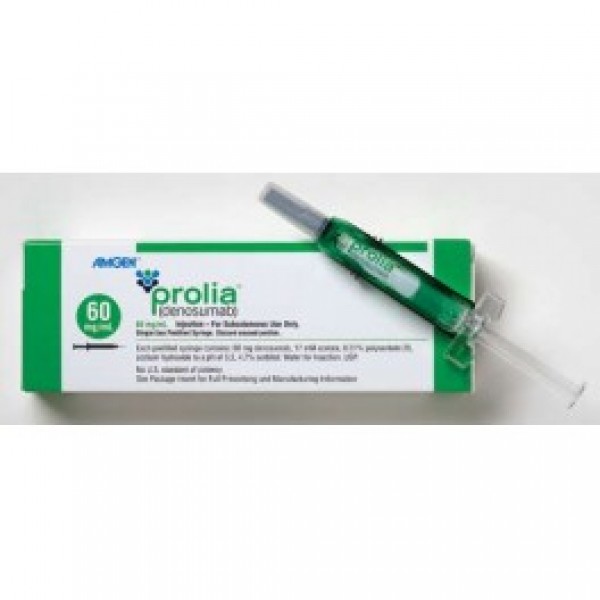
Prolia injection 60 mg. / Ml.
Product Code: Prolia injection 60 mg. / Ml.
Availability: In Stock
Product viewed: 2833


Prolia injection 60 mg. / Ml.

What Prolia is and what it is used for?
What is Prolia and how does it work?
Prolia contains denosumab protein (monoclonal antibody), which interferes with the action of another protein in order to treat bone loss and osteoporosis. Treatment with Prolia makes bone stronger and less prone to breakage.
Bone is a living tissue and is renewed. Oestrogen helps keep bones healthy. After menopause, estrogen levels fall, as a result of which the bones may become weaker and more brittle. This can eventually lead to a condition known as osteoporosis. Many women with osteoporosis have no symptoms but are at risk of breaking bones, especially the spine, hips and wrists.
Surgical operations or drugs that stop the production of estrogen or testosterone used for the treatment of patients with breast cancer or prostate cancer, may also result in loss of bone. Bones become weak and break more easily.
What is it used Prolia?
Prolia is used for treatment of:
• osteoporosis in women after menopause (postmenopausal), reducing the risk of spine and non-spine fractures (broken bones) and fractures of the hip bones.
• bone loss resulting from the decrease in the levels of the hormone (testosterone) caused by surgery or drug treatment for patients with prostate cancer.
2 What you should know before using Prolia?
Do not use Prolia
• if you have low blood calcium (hypocalcemia).
• if you are allergic to denosumab or any of the other ingredients of this medicine (listed in Section 6).
Warnings and Precautions
Talk to your doctor or pharmacist before using Prolia.
Please tell your doctor immediately if while on treatment with Prolia appear swollen, red area of skin, most commonly in the lower leg, that feels hot and tender (cellulitis), and may be accompanied by symptoms of increased temperature.
Please tell your doctor if you are allergic to latex (the needle cover of the prefilled syringe contains a derivative of latex).
Tell your doctor if you have or have had severe kidney problems, kidney failure or need for dialysis, which may increase your risk of developing low blood calcium, if you do not take calcium.
You should take calcium and vitamin D while you are on treatment with Prolia. Your doctor will discuss this with you.
Before starting treatment with Prolia should be considered examination by a dentist if you have cancer, are undergoing chemotherapy or radiotherapy, are taking corticosteroids, do not get regular dental care or have gum disease.
Tell your dentist that you are taking Prolia, if you undergo dental treatment or will undergo dental surgery.
It is important to maintain good oral hygiene when being treated with Prolia.
Children and adolescents
Prolia is not recommended for children and adolescents under 18 years of age. The use of Prolia in children and adolescents has not been studied.
Other medicines, Prolia
Tell your doctor or pharmacist if you are taking or have recently taken any other medicines, including medicines obtained without a prescription. It is particularly important to tell your doctor if you are taking another medicine containing denosumab.
You should not take Prolia together with another medicine containing denosumab.
Pregnancy and lactation
Prolia has not been tested in pregnant women. It is important to tell your doctor if you are pregnant, think you may be pregnant; or planning a pregnancy. Not recommended for use Prolia, if you are pregnant.
If you become pregnant during treatment with Prolia, please tell your doctor. May be directed to programs to Amgen tracking of pregnancy. Contact details of the local representative listed in section 6 of this leaflet.
It is not known whether Prolia is excreted into breast milk. It is important to tell your doctor if you are breastfeeding or plan to breastfeed. Your doctor will help you decide whether to discontinue nursing or to discontinue taking Prolia, taking into account the benefit of breastfeeding for baby and benefits of Prolia to the mother.
If you breast-feed during treatment with Prolia, please tell your doctor. May be directed to programs to Amgen tracking breastfeeding. Contact details of the local representative listed in section 6 of this leaflet.
Ask your doctor or pharmacist before taking any medicine.
Driving and using machines
Prolia has no or negligible influence on the ability to drive and use machines. Prolia contains sorbitol (E420)
If your doctor has told you that you have an intolerance to some sugars (sorbitol E420), contact before taking this medicine.
If you're on a diet with controlled sodium intake
This product contains less than 1 mmol sodium (23 mg) per 60 mg, contains virtually no sodium.
3 How to use Prolia?
The recommended dose is one pre-filled syringe of 60 mg, administered once every 6 months as a single injection under the skin (subcutaneous injection). The best places to inject are the upper thighs and abdomen. The person who cares about you, they can also use the outer part of your arm. Each pack of Prolia contains a reminder card with stickers that can be removed from the carton. Use the peel-off stickers to mark the next injection date on your personal calendar and / or reminder card, do not forget the date for the next injection.
You will also need to take calcium and vitamin D while you are being treated with Prolia. Your doctor will discuss this with you.
Your doctor may decide that it is best for you or the person who cares for you to inject Prolia. Your doctor or healthcare provider will show you or human carer how to use Prolia. Please read the section at the end of this leaflet for instructions on how to inject Prolia.
If you forget to use Prolia
If a dose is missed from Prolia, the injection should be administered as soon as possible. Thereafter, injections should be scheduled every six months from the date of the last injection.
If you stop using Prolia
To have the most benefit from your treatment, it is important to use Prolia as long as your doctor prescribes. Talk to your doctor before you consider stopping treatment.
4 Possible side effects
Like all medicines, this medicine can cause side effects, although not everybody gets them.
Uncommonly, patients receiving Prolia, may develop skin infections (predominantly cellulitis). Please tell your doctor immediately if you develop any of these symptoms while on treatment with Prolia: swollen, red area of skin, most commonly in the lower leg, that feels hot and tender (cellulitis) and can be accompanied by symptoms of fever.
Common side effects (affects 1 to 10 users in 100):
• painful urination, frequent urination, blood in urine, inability to hold urine
infection of the upper respiratory tract pbolka, numbness or tingling that spreads down the leg (sciatica), clouding of the lens of the eye (cataracts), constipation, rash, pain in arms or legs (limb pain). Uncommon side effects (affects 1 to 10 users in 1000):
• fever, vomiting and abdominal pain or discomfort (diverticulitis)
• ear infection,
• skin condition with itching, redness and / or dryness (eczema). Rare side effects (affects 1 to 10 users in 10,000):
• Persistent pain and / or non-healing sores of the mouth or jaw
• spasms, twitching or muscle cramps and / or numbness or tingling in the fingers, toes or around the mouth. These may be signs that you have low blood calcium (hypocalcemia)
• allergic reactions (eg. Swelling of the face, lips, tongue or other parts of the body, rash, itching or hives on the skin).
If you get any side effects, tell your doctor or pharmacist. This includes all listed in this leaflet.
5 How to store Prolia?
Keep out of reach of children.
Do not use this medicine after the expiry date stated on the label and carton after "EXP" and "EXP". The expiry date refers to the last day of that month.
Store in a refrigerator (2 ° C - 8 ° C). Do not freeze.
Store in the original package to protect from light. Do not shake excessively.
The pre-filled syringe may be left out of the refrigerator to reach room temperature (25 ° C) before injection. This will make the injection more comfortable. When the syringe is allowed to reach room temperature (25 ° C), it must be used within 30 days.
Do not dispose of medications in wastewater or household waste. Ask your pharmacist how to dispose of medicines no longer required. These measures will help to protect the environment.
6 Package Contents and more information
What does Prolia?
- The active substance is denosumab. Each pre-filled syringe of 1 ml contains 60 mg denosumab (60 mg / ml).
- The other ingredients are glacial acetic acid, sodium hydroxide, sorbitol (E420), polysorbate 20 and water for injections.
Prolia looks like and contents of the pack?
Prolia is a clear, colorless to pale yellow solution in a ready to use pre-filled syringe.
Each pack contains one pre-filled syringe with needle. Each pack contains one pre-filled syringe.
Write a review
Your Name:Your Review: Note: HTML is not translated!
Rating: Bad Good
Enter the code in the box below:
Related Products
OSSICA 3 mg. / 3 ml. 1 ampoule WHAT OSICCA AND WHAT IT IS US..
89.00€
IBANDRONIC Acid 3mg. / 3 ml. 1 vialWhat is Ibandronic acid T..
57.00€