
Your shopping cart is empty!
Welcome visitor you can login or create an account.
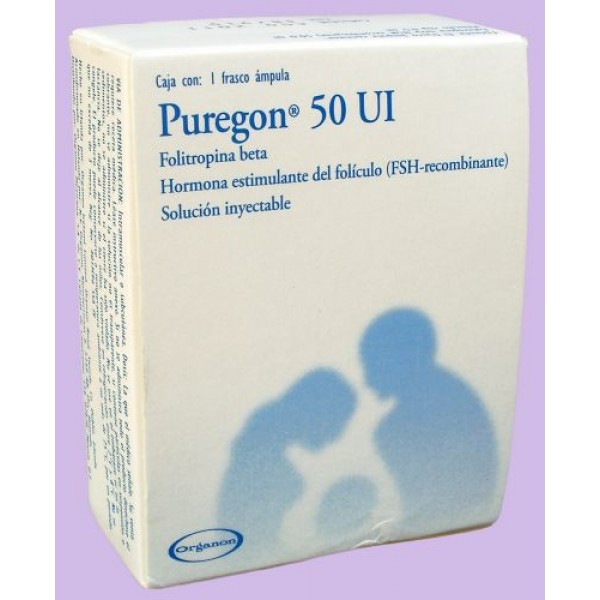
Puregon 50 IU 0.5 ml.
Product viewed: 3529


What Puregon is and what it is used for
Puregon solution for injection contains follitropin beta-hormone, also known as follicle-stimulating hormone (FSH).
FSH belongs to the group of gonadotropins, which play an important role in fertility and reproduction in humans. In women, FSH is necessary for the growth and maturation of follicles in the ovaries. The follicles are small round balls containing the oocytes. In men FSH is necessary for the production of semen.
Puregon is used to treat infertility in any of the following cases:
Women
Puregon can be used to induce ovulation in women who have no ovulation or who have not responded to clomiphene citrate treatment.
In women participating in assisted reproduction programs, including IVF and other methods, Puregon may cause multiple follicular development at the same time.
Men
In men who are infertile due to decreased hormone levels, Puregon can be used to stimulate sperm formation.
2. What you need to know before using Puregon
Do not use Puregon
If:
are allergic to follitropin beta or any of the other ingredients of Puregon (listed in section 6);
have a tumor of the ovaries, breast, uterus, testicles or brain (pituitary or hypothalamus);
have severe or irregular menstrual bleeding and the cause of this is not established;
your ovaries do not work because of a disease called primary ovarian failure;
you have ovarian cysts or enlarged ovaries that are not due to polycystic ovary syndrome (PCOS);
you have malformations of the sexual organs incompatible with normal pregnancy;
you have fibroid tumors of the uterus that are incompatible with normal pregnancy;
you are a man and you are sterile due to a disease called primary testicular failure.
Warnings and precautions
Talk to your doctor before using Puregon if:
you have ever had an allergic reaction to some antibiotics (neomycin and / or streptomycin);
you have untreated pituitary or hypothalamic problems;
you have suppressed thyroid function (hypothyroidism);
your adrenal glands do not work properly (adrenocortical insufficiency);
have high prolactin levels in the blood (hyperprolactinemia);
you have other illnesses (such as diabetes, heart disease or other chronic illness).
If you are a woman:
Ovarian Hyperstimulation Syndrome (OHSS)
Your doctor will regularly monitor the effects of the treatment in order to be able to choose the right dose of Puregon. Regular ultrasound screening of the ovaries will be performed. Your doctor may also examine the level of hormones in the blood. This is very important because the administration of a too high FSH dose can lead to rare but serious complications where the ovaries are over-stimulated and the developing follicles grow more than normal. This serious illness is called ovarian hyperstimulation syndrome (OHSS). In rare cases, acute OHSS can be life-threatening. OHSS may lead to a sudden build up of fluid in the stomach and chest area, and may cause blood clots to form. Contact your doctor immediately if you notice a severe abdominal pain, abdominal pain, nausea, vomiting, sudden weight gain due to fluid build-up, diarrhea, reduced urination or shortness of breath (see also section 4, "Possible side effects reactions ").
Regular monitoring of FSH treatment results helps to prevent ovarian hyperstimulation. If you experience abdominal pain and if you experience such a few days after the last injection, contact your doctor immediately.
Multiple pregnancy or congenital malformations
After treatment with gonadotropin-containing products, there is an increased likelihood of pregnancy being multiple, even if only one embryo is returned to the uterus. Multiple pregnancies carry an increased risk for the health of the mother and her babies around the time of birth. In addition, multiple pregnancies and characteristics of patients treated for infertility (eg, female age, sperm characteristics, the genetic background of both parents) may be associated with an increased risk of congenital malformations.
Complications in pregnancy
There is a slightly increased risk of ectopic pregnancy (ectopic pregnancy). Therefore, your doctor will perform an early ultrasound check to rule out the possibility of an ectopic pregnancy.
In women who have conceived after infertility treatment, the risk of miscarriage is slightly increased.
Blood clot (thrombosis)
Puregon treatment, as well as pregnancy itself, may increase the risk of developing a blood clot (thrombosis). Thrombosis is the formation of a blood clot in the blood vessels.
Blood clot (thrombosis)
Puregon treatment, as well as pregnancy itself, may increase the risk of developing a blood clot (thrombosis). Thrombosis is the formation of a blood clot in the blood vessels.
Blood clots can cause serious illness such as:
obstruction of blood vessels in the lungs (pulmonary embolism);
stroke;
heart attack;
problems with blood vessels (thrombophlebitis);
lack of blood flow (deep vein thrombosis), which can result in loss of the arm or leg.
Please discuss this with your doctor before starting treatment, especially:
if you already have an increased risk of developing thrombosis;
if you or your relative have ever had a thrombosis;
if you are significantly overweight.
Stroke of the ovaries
Ovarian irritation occurs after treatment with gonadotropins, including Puregon. Ovarian twitching is a twist of the ovary. Bending the ovary may cause a break in blood supply.
Talk to your doctor before using this medicine if:
you have ever had ovarian hyperstimulation syndrome (OHSS);
are pregnant or think you may be pregnant;
You have a stomach (abdominal) operation;
you've ever had a twist of an ovary;
you have or have ovarian cysts or ovarian cysts.
Tumors of the ovaries and other organs of the reproductive system
Ovarian tumors and other organs of the reproductive system have been reported in women who have been treated for infertility. It is not known whether treatment with concomitant medications increases the risk of these tumors in women with infertility.
Other diseases
In addition, tell your doctor before you start taking this medicine if:
you have been warned by a doctor that your pregnancy may be dangerous for you.
If you are a man:
Men with too high levels of FSH in the blood
Elevated FSH levels in the blood are signs of testicular damage. In such cases Puregon can not be effective. To track the effectiveness of your treatment, your doctor will recommend that you be given a sperm analysis 4 to 6 months after the start of treatment.
Other medicines and Puregon
Tell your doctor or pharmacist if you are taking or have recently taken any other medicines.
If Puregon is co-administered with clomiphene citrate, this may increase its effect. If a GnRH agonist (a medicine to prevent premature ovulation) is administered, higher doses of Puregon will be needed.
Pregnancy and breastfeeding
Ask your doctor or pharmacist for advice before taking any medicine. If you are pregnant or think you may be pregnant, you should not use Puregon.
Puregon may affect the production of milk. Puregon is unlikely to pass into breast milk. If you are breast-feeding, tell your doctor before using Puregon.
Driving and using machines
Puregon is unlikely to affect your ability to drive or use machines.
Important information about some of the ingredients of Puregon
This product contains less than 1 mmol of sodium (23 mg) per injection, ie. it practically does not contain sodium.
Children
Within the approved indication, Puregon is not suitable for use in children.
3. How to use Puregon
Always use this medicine exactly as your doctor has told you. If you are not sure, ask your doctor or pharmacist.
Dosage in women
Your doctor will determine your starting dose. It can be corrected during treatment. Further data on the course of treatment are given below.
The wide variety of ovarian responses to FSH treatment in different women makes it impossible to determine a universal dose appropriate for all. To determine the optimal dose, your doctor will monitor follicular growth by ultrasound screening and measurement of estrogen levels (female sex hormone) in the blood.
In women with no ovulation - The starting dose is determined by your doctor. It is applied for at least seven days. If there is no ovarian response, the daily dose increases gradually until follicular growth or plasma estradiol levels show adequate response. The dosed daily dose is maintained until at least one mature follicle of the appropriate size appears. Usually 7 to 14 days of treatment are sufficient. Puregon treatment is then stopped and ovulation induced by human chorionic gonadotropin (hCG);
Medical programs for assisted reproduction, such as UVA - The starting dose is determined by your doctor. It is mandatory for the first four days. Your dose can then be adjusted depending on your ovarian response. In the presence of sufficient follicles of adequate size, the final phase of follicular maturation is induced by the administration of hCG. Taking the oocytes takes place 34-35 hours afterwards.
Dosage in males
The usual prescribed dose of Puregon is 450 IU per week, most commonly as three 150 IU doses in combination with another hormone (hCG), for at least 3 to 4 months. The treatment period is equal to the time required for sperm formation and the time for which improvement may be expected. If semen has not begun after this period, treatment may last up to 18 months.
How to inject
The first injection of Puregon should only be done in the presence of a doctor or nurse.
Injections are slowly inserted into the muscles (for example, in the buttock, thigh or arm) or subcutaneously (for example, in the lower abdomen).
When the injection is injected intramuscularly, injection should only be performed by a doctor or nurse.
When injection is given subcutaneously, in some cases injection may be performed by you or your partner. Your doctor will instruct you when and how to do this. If you self-administer Puregon, follow the instructions for use in the next section to apply Puregon correctly and with minimal discomfort.
Instructions for use
Step 1 - Preparing the syringe
You must use disposable syringes and needles when using Puregon. The volume of the syringe should be small enough to allow maximum Puregon dosing.
Puregon solution for injection is supplied in a glass vial. Do not use the solution if it contains undissolved particles or is not clear. First you need to remove the vial cap. Put a needle on the syringe and pierce the rubber stopper on the vial. Draw the solution into the syringe and, after removing it from the vial, replace the needle with another sterile injection needle. Then, hold the syringe with the needle up and gently tap the reservoir. If there are air bubbles, they will move upwards; then press the plunger until these bubbles are removed from the syringe and only Puregon solution remains in it. If necessary, the plunger may be pressed further to adjust the amount of solution to be injected.
Step 2 - Injection site
The most appropriate place for subcutaneous injection is in the lower abdomen around the navel, where there is a large skin fold and very subcutaneous fat. The location of each subsequent injection should be slightly changed every time.
It is possible to do the injection elsewhere. Your doctor or nurse will inform you about this.
Step 3 - Preparing the place
Several slight patches at the injection site will stimulate the small nerve endings in the skin and reduce the needle puncture pain. Wash your hands and clean the injection site with a disinfectant (eg chlorhexidine 0.5%) to remove the surface bacteria. Clean the skin within a radius of 5 centimeters around the injection site, allowing the disinfectant to dry for at least 1 minute before injecting.
Step 4 - Inserting the needle
Squeeze a small skin fold. With the other hand, insert the needle at an angle of 90 degrees to the surface of the skin.
Step 5 - Check the correct needle position
If the needle position is correct, pulling the plunger back will be difficult. If blood is taken back into the syringe, it means that the needle has entered an intravenous or arterial vessel. If this happens, remove the syringe, cover the injection site with a swab, soak in a disinfectant, and squeeze; bleeding will cease after a minute or two. Do not use this solution anymore. Start again from Step 1 using a new needle and syringe and a new vial of Puregon.
Step 6 - Injecting the solution
Apply slow and steady pressure on the plunger to allow the solution to be injected correctly without injuring the skin tissues.
Step 7 - Remove the syringe
Remove the syringe quickly and press the injection site with a swab with a disinfectant. Without removing the swab, massage the injection site lightly, this will help to spread the Puregon solution and ease the discomfort of the injection.
Any unused solution should be discarded.
Do not mix Puregon with other medicinal products.
If you use more Puregon than you should
Tell your doctor immediately.
A too high dose of Puregon may cause ovarian hyperstimulation (OHSS). This can be a pain in the abdomen. If these stomach pains worry you, tell your doctor immediately. See also section 4. "Possible side effects".
If you forget to use Puregon
If you miss a dose, do not take a double dose to make up for the missed dose. Contact your doctor.
If you have any further questions on the use of this medicine, ask your doctor.
4. Possible side effects
Like all medicines, this medicine can cause side effects, although not everyone gets them.
Serious adverse reactions in women
Complication of FSH treatment is ovarian hyperstimulation. Over-stimulation of the ovaries may develop into a disease called ovarian hyperstimulation syndrome (OHSS), which can be a serious medical problem. The risk can be reduced by careful monitoring of follicular development during treatment. Your doctor will monitor your ovaries by ultrasound to closely monitor the number of ripening follicles. Your doctor may also examine the levels of hormones in the blood. The first symptoms are abdominal pain, nausea or diarrhea. In more severe cases, symptoms include ovarian enlargement, water in the abdominal cavity and / or chest (which can cause abnormal fluid accumulation) and the appearance of blood clots in the bloodstream. See Warnings and Precautions in Section 2.
Contact your doctor immediately if you experience abdominal pain or any of the other symptoms of ovarian hyperstimulation and if it happens a few days after the last injection.
If you are a woman:
Common side effects (may affect up to 1 in 10 people):
Headache;
Injection site reactions (such as bruising, pain, redness, swelling and itching);
Ovarian Hyperstimulation Syndrome (OHSS);
Pelvic pain;
Abdominal pain and / or swelling.
Uncommon side effects (may affect up to 1 in 100 people):
Chest related complaints (including sensitivity);
Diarrhea, constipation or abdominal discomfort
Enlargement of the uterus;
Nausea;
Hypersensitivity reactions (such as rash, redness, urticaria and itching);
Ovarian cysts or enlargement of the ovaries;
Ovarian torsion (twisting of the ovaries);
Vaginal bleeding.
Rare side effects (may affect up to 1 in 1,000 people):
Blood clots (this can also happen when there is no undesirable ovarian hyperstimulation, see Warnings and Precautions in Section 2).
There have also been reports of ectopic pregnancy (ectopic pregnancy), miscarriage or multiple pregnancies. These effects are thought to be unrelated to Puregon, but to assisted reproductive technology (ART) or subsequent pregnancy.
If you are a man:
Common side effects (may affect up to 1 in 10 people):
Acne;
Injection site reactions (such as hardening and pain);
Headache;
Rash;
Breast augmentation;
Testicles in testicles.
Reporting of side effects
If any of the side effects gets serious, tell your doctor or pharmacist. This includes all possible side effects not listed in this leaflet. You can also report side effects directly through the national reporting system. As you report side effects, you can contribute to getting more information on the safety of this medicine.
5. How to store Puregon
Keep out of the reach and sight of children.
Storage with the pharmacist
Store at 2 ° C - 8 ° C (in a refrigerator). Do not freeze.
Storage in Patient
You have two options:
1. Store at 2 ° C - 8 ° C (in a refrigerator). Do not freeze.
2. Store at 25 ° C (room temperature) once for a period of not more than 3 months.
Mark the date on which you start storing Puregon outside the refrigerator. Store the vial (s) in the carton.
The contents of the vial should be used immediately after drilling the rubber stopper.
Do not use Puregon after the expiry date which is stated on the label after "EXP" and on the carton after "EXP". The expiry date refers to the last day of that month.
Do not dispose of medicines in the sewage system or in the household waste container. Ask your pharmacist how to dispose of medicines you no longer use.
Packaging content and additional information
What Puregon contains
Each vial contains the active substance follitropin beta-hormone, known as follicle stimulating hormone (FSH), in the amount of 50 IU in 0.5 ml aqueous solution per vial.
The other ingredients are: sucrose, sodium citrate, L-methionine and polysorbate 20 in water for injections. Sodium hydroxide and / or hydrochloric acid may be used to adjust the pH.
What Puregon looks like and contents of the pack
Puregon solution for injection (injection) is a clear, colorless liquid. It is supplied in glass vials. It is available in packs of 1, 5 or 10 vials.
Not all pack sizes may be marketed.
Write a review
Your Name:Your Review: Note: HTML is not translated!
Rating: Bad Good
Enter the code in the box below:
Related Products
What ORGALUTRAN is and what it is used for
Orgalutran belon..
69.00€