Your shopping cart is empty!
Welcome visitor you can login or create an account.
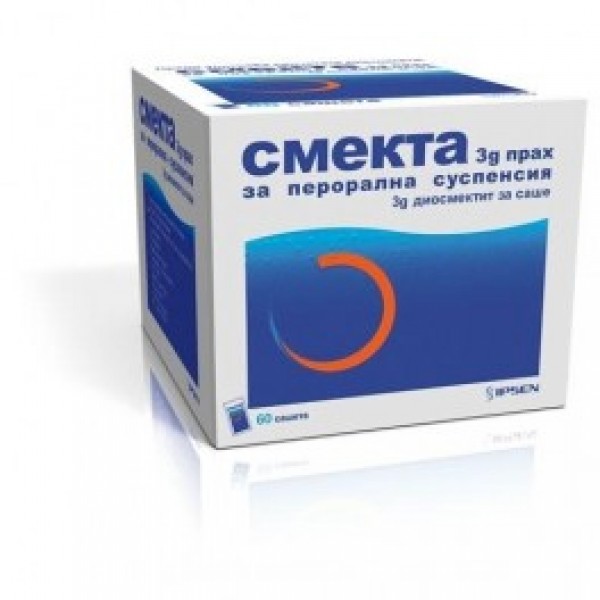
Smekta dust
Product Code: Smekta dust
Availability: In Stock
Product viewed: 1294


Smekta dust

QUALITATIVE AND QUANTITATIVE COMPOSITION
Diosmectite * (DCF) 3.000 g.
For a full list of excipients, see. Section 6.1 Dioctahedralsmectite (1.4 nm phyllite):
This is a natural double silicate of aluminum and magnesium, which differs from other silicates in its range of X-ray diffraction. Iron, magnesium and calcium in part replace the aluminum octahedron layer alumoksida.
PHARMACEUTICAL FORM
Powder for oral suspension in sachets. The medicinal product is light cream to light beige powder with a slight odor reminiscent of orange at reconstitution.
CLINICAL DATA
Terapevtichni evidence
Symptomatic treatment of painful symptoms associated with diseases of the esophagus, stomach, duodenum and colon. Treatment of acute and chronic diarrhea in children. (Including infants) and adults. For specific warnings and precautions for use see section 4.4. Treatment does not exclude the need for rehydration when required. Rehidrata volume and method of administration (oral or intravenous) is adapted to the age and condition of the patient and the severity of diarrhea.
Posology and method of administration.
Treatment of acute diarrhea.
In infants and children:
Under 1 year: 2 sachets daily for 3 days and then 1 sachet daily.
Over 1 years: 4 sachets daily for 3 days and then 2 sachets daily.
In adults:
The recommended daily dose is 6 sachets daily.
Treatment for other indications.
In children:
Under 1 year: 1 sachet daily
Between 1 and 2 years: 1 to 2 sachets daily
More than 2 years: 2 to 3 sachets a day
In adults:
An average of three sachets per day.
Method of application:
The contents of the sachet should be suspended immediately before use. Recommended the adoption of Diosmectite going after eating in patients with esophagitis and between meals indications.
In infants and children
The contents of the package can be dissolved in a pacifier or bottle with 50 ml water and given day or to mix well with viscous food: porridge, stewed fruit, vegetable purees and baby food.
In adults:
Average of 3 sachets daily dissolved in half a glass of water.
Contraindications
Hypersensitivity to Diosmectite or to any of the substances in the product.
It is advisable to apply:
After feeding for esophagitis
Between meals with other indications
Special warnings and precautions for use
Special warnings
Require a Diosmectite when treating patients with a background of severe chronic constipation. In children, the treatment of acute diarrhea Diosmectite should be given in combination with prior oral rehydration therapy (po) to avoid dehydration. In adults rehydration therapy is not necessary, except in special cases. The duration of oral or intravenous rehydration therapy should be tailored to the nature (severity) of the disease, age of the patient, as well as the clinical history of the disease.
Precautions for use
Miti should not be taken by patients with rare hereditary problems of fructose intolerance, poor absorption of glucose and galactose or failure of the enzyme complex sucrase-isomaltase.
Interaction with other medicinal products and other forms of interaction. Since the absorption properties of this product can affect the speed and / or the absorption of other substances, it is recommended not to apply other medicines together with miti
Pregnancy and lactation
Miti can be taken during pregnancy and lactation as it remains unchanged and the chemical is not absorbed.
Effects on ability to drive and use machines
No effects on ability to drive and use machines.
Reports of rare cases of development or worsening constipation. Treatment duration after dose reduction.
Adverse reactions observed in clinical trials were always minor and transient, affecting the gastrointestinal tract. Fix is as follows: Rare (> 1/1, 000 to <1/100): periods of constipation relieved after individual changes in modes of therapy
Further information on post-marketing study shows: rarely (not known): hypersensitivity reactions including urticaria, pruritus, or angioedema.
Overdose
Overdose can cause severe constipation.
Pharmacological Properties
Pharmacodynamic properties
Pharmacotherapeutic group: ATC antidiarrheal adsorbents A07VS05Poradi leaf structure and high viscosity miti has a powerful feature for coating the lining of the gastrointestinal trakt.Chrez interaction with mucus glycoproteins treble attenuation increases resistance of mucosal gel in response to aggressive agents. Through its action on mucosal barrier of the gastrointestinal tract due to the high binding capacity miti protect the gastrointestinal mucosa. Miti is transparent to X-rays, colored faeces in normal physiological doses does not change during gut passage.
The results of the combined data from two randomized, double-blind clinical studies involving 602 patients aged 1 to 36 months with acute profuse diarrhea. Patients received Smecta or placebo in combination with oral rehydration salts adopted. The results showed a significant reduction of the emitted feces during the first 72 hours. The mean (standard deviation) were 94.5 (74.4) g / kg group adopted Diosmectite against 104.1 (94.2) g / kg in the placebo group (p = 0.0016). In subpopulation (n = 91) - rotavirus positive values were 124.3 (98.3) in the adopted Diosmectite against 186.8 (147.2) in the placebo group (p = 0.0005). In a clinical randomized double-blind study involving 329 adult patients with acute profuse diarrhea patients received placebo or Smecta. The result showed a significant reduction in the duration of diarrhea Diosmectite group took a median of 54 hours (4 -167) vs. median of 69 hours (2-165 hours) in the placebo group (p <0.03).
Pharmacokinetic properties
As a result of their chemical structure diosmekit not absorbed or metabolized.
Preclinical safety data
Toxicological studies in different species have shown that there are no signs of systemic or local toxicity Diosmectite on the gastrointestinal tract.
PHARMACEUTICAL PARTICULARS
List of excipients
Glucose monohydrate, sodium saccharin, sucrose, flavor vanilov *, orange flavor **
Composition of vaniloviya taste:
Maltodextrin, sucrose, glyceryl triacetate (E1518), silicon dioxide (E551), ethyl alcohol, soya lecithin (E322), vanilla.
Composition of orange flavor:
Maltodextrin, sucrose, acacia gum, mono-and diatsetilov tartaric acid ester of mono and diglycerides of fatty acids (E472e), silicon dioxide (E551), orange oil.
Incompatibilities
None known.
Shelf Life
Three years.
Special precautions for storage
No special storage conditions.
Nature and contents of container
Sachets (paper Kraft, aluminum foil / PE) containing 3,760 g of powder for oral suspension. Cartons 30 and 60 sachets.
Write a review
Your Name:Your Review: Note: HTML is not translated!
Rating: Bad Good
Enter the code in the box below:
Related Products
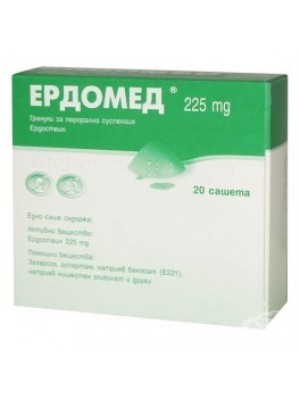
ERDOMED sachets 225 mg. 20 sachets Qualitative and quantitat..
18.00€