Your shopping cart is empty!
Welcome visitor you can login or create an account.
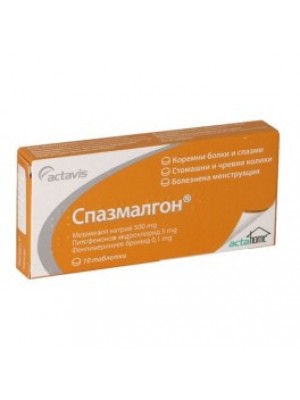
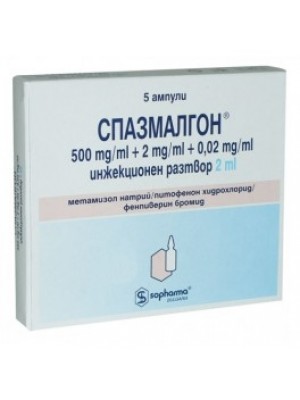
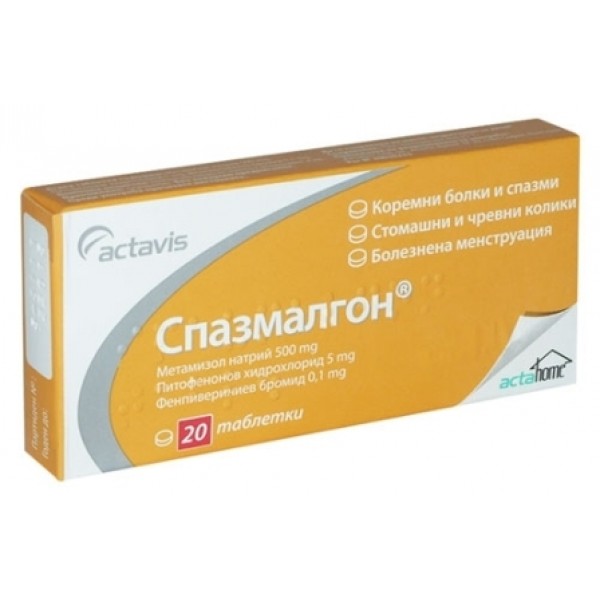
SPAZMALGON 20 tablets
Product viewed: 3310


What Spazmalgon is and what it is used for
Spazmalgon is a combined product that combines pain-relieving and relaxing smooth muscle action.
Spazmalgon is used for the symptomatic treatment of mild or moderate pain syndrome due to spasms of the smooth muscles of the internal organs:
Kidney stones disease and inflammatory urinary tract infections with pain and disturbances in the urination process;
Gastric and intestinal colic, biliary-stone disease, dyskinesia of bile ducts;
Painful menstruation.
2. BEFORE YOU USE Spazmalgon
Do not use Spazmalgon:
if you are allergic (hypersensitive) to any of the active or excipients of the product;
for gastrointestinal obstruction and megacolon (enlargement of the large intestine);
with difficulty emptying due to weakness of the musculature (atony) of the bile and bladder;
in severe renal and hepatic insufficiency;
in some blood disorders (changes in blood cell composition such as agranulocytosis (severe reduction or total lack of total white blood cells in the blood) and leucopenia (decreased blood leukocytes);
in some congenital diseases (such as glucose-6-phosphate dehydrogenase deficiency and porphyria);
angioneurotic glaucoma (acute glaucoma, characterized in that the intraocular pressure increases very rapidly);
during pregnancy and lactation.
Take special care with Spazmallon
The product should be used with caution in patients with impaired renal and / or hepatic function, certain gastric diseases (eg, achalasia - inability of the lower esophageal sphincter to open when swallowed and lack of normal esophagus peristalsis, gastroesophageal reflux, pyloric stenosis) (hyperthyroidism), tendency to low blood pressure (hypotension), severe heart rhythm abnormalities, ischemic heart disease (especially fresh myocardial infarction) heart failure, chronic bronchitis and bronchospasm (due to increased bronchial secretion), hypersensitivity to non-steroidal anti-inflammatory products and non-narcotic analgesics or other allergic (allergic rhinitis, bronchial asthma) asthma.
Long-term administration of the product (more than one week) requires peripheral blood count and liver function. It is possible that headache may occur or worsen after prolonged analgesic treatment (> 3 months) using analgesics every other day or more often. Headaches caused by overuse of analgesics should not be treated with an increase in their dose. In such cases, analgesic treatment should be discontinued in consultation with a physician.
Metabolites (the breakdown products) of metamizole may stain urine in red, which is of no clinical significance.
The product may affect the psychophysiological status of patients in concomitant use with alcohol and central nervous system depressants.
Taking other medicines
Please tell your doctor or pharmacist if you are taking or have recently taken any other medicines, including medicines obtained without a prescription.
Metamizole increases the content of the anti-parasitic agent chloroquine in the blood, reduces the effects of coumarin anticoagulants (blood clotting products) and the effects of cyclosporine.
Strengthens the suppressive effect on the hematopoietic function of bone marrow-toxic drugs and chloramphenicol.
Tricyclic antidepressants, oral contraceptives, allopurinol disrupt metamizol metabolism and increase its toxicity.
Barbiturates, phenylbutazone (and other products that enhance the breakdown of liver function) may reduce the effects of metamizole.
Nervous soothing medicinal products (sedatives and tranquilizers) enhance Spalmalgon's anesthetics.
Concomitant use of Spazmalgon with other painkillers (analgesics) and non-steroidal anti-inflammatory drugs increases the risk of hypersensitivity and other undesirable effects.
Metamizole reduces plasma concentrations of Ciclosporin A and may endanger the tissue or organ transplant.
If you need to use these or other medicines at the same time, consult a doctor!
Taking Spazmalon with food and drink
Given the reduced alcohol tolerance, its consumption should be avoided during treatment with the product.
Pregnancy and breastfeeding
Ask your doctor or pharmacist for advice before taking any medicine.
Spazalgon should not be used during pregnancy and during lactation.
Driving and using machines
It should be used with caution in people who drive or operate machinery, as dizziness and disturbance of the accommodation (eye-vision for near and far) may occur when taking Spazmalgon.
Important information about some of the ingredients of Spazmallon
Whey starch is included in the excipients, which is a danger to people with gluten enteropathy (congenital small intestine disease with diarrhea when using wheat products).
This medicinal product contains lactose (milk sugar) as an adjunct, making it unsuitable for patients with lactose intolerance.
3. HOW TO TAKE SALT
How and when to take Spazmallon?
The tablets are taken orally with water after a meal.
Recommended daily doses:
Adults and children over 15 years of age:
1-2 tablets 2-3 times a day. Maximum daily dose - 6 tablets.
Children:
from 12 to 15 years - 1 table. 2-3 times a day. Maximum daily dose - 3 tablets;
from 9 to 12 years - 1/2 table 2-3 times a day. Maximum daily dose - 2 tablets
The duration of treatment should not exceed 3 days.
If you take more Spalmalon than you should
If you take a higher dose than prescribed, immediately contact a doctor for help!
Your doctor will decide what measures to take if necessary.
In overdose, allergic symptoms, symptoms of hematopoietic impairment, gastrointestinal disorders, severe cases and symptoms of brain damage are most commonly observed.
In the case of overdosage data, the product should be discontinued immediately and measures taken to remove it rapidly from the body (vomiting, stomach flushing, forced urine excretion). Symptomatic remedies apply.
If you forget to take Spazmallon
Do not take a double dose to make up for the missed dose. Do this at the time of the next regular intake.
If you have any further questions on the use of this product, ask your doctor or pharmacist.
4. POSSIBLE SIDE EFFECTS
Like all medicines, Spazmalgon can cause side effects, although not everybody gets them.
Most often they are temporary and resolve when treatment is stopped.
Some patients may experience:
Immune system disorders: rash, pruritus, rarely more severe allergic reactions - bronchospasm / abnormal bronchial wall smoothness /, angioedema / swelling of the face, lips, eyelids and some mucous membranes), anaphylactic shock / an allergic reaction that can start drastically with the following signs: itching, swelling in the face, shortness of breath, cardiovascular problems, and very rarely toxic epidermal necrolysis and Stevens-Johnson syndrome / severe blisters on the skin that may progress as the top skin layer begins to whiten.
Gastrointestinal disorders: malaise, dry mouth, constipation, gastritis and ulcer disease.
Cardiac disorders: feeling palpitations, low blood pressure, fast heartbeat, heart rhythm disturbances.
Blood and lymphatic system disorders: changes in blood cell counts (agranulocytosis, thrombocytopenia, leucopenia - decrease in platelet count or leucocyte count).
Nervous system disorders: vertigo, visual disturbance.
Renal and urinary disorders: urinary retention, with prolonged high dose administration, reduced renal function (especially in patients with pre-existing impairment) and, in some cases, acute renal failure may occur.
If you notice any side effects not listed in this leaflet, please tell your doctor or pharmacist.
5. HOW TO STORE Spazmalgon
At temperatures below 25 ° C!
Keep out of the reach and sight of children.
Do not use Spazmalgon after the expiry date which is stated on the blister and carton. The expiry date refers to the last day of that month.
Medicines should not be disposed of via wastewater or household waste. Ask your pharmacist how to dispose of your unnecessary medicines. These measures will help to protect the environment.
MORE INFORMATION
What Spazmalgon contains
The active substances in one tablet are: Metamizole sodium 500.0 mg, Pitofenone hydrochloride 5.0 mg and Fenpiverinium bromide 0.1 mg.
The excipients are: lactose monohydrate, wheat starch, gelatin, talc, magnesium stearate, sodium hydrogen carbonate.
What Spazmalgon looks like and what the package contains
Description
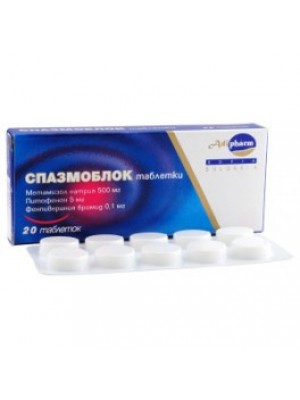
Spazmagalon is a round, flat, scored tablet on one side, white or off-white.
Package
10 or 20 tablets in a blister.
1 blister of 10 tablets in a cardboard box.
2 blister cards of 10 tablets in a cardboard box.
1 blister of 20 tablets in a cardboard box.
Write a review
Your Name:Your Review: Note: HTML is not translated!
Rating: Bad Good
Enter the code in the box below:
Related Products