Your shopping cart is empty!
Welcome visitor you can login or create an account.
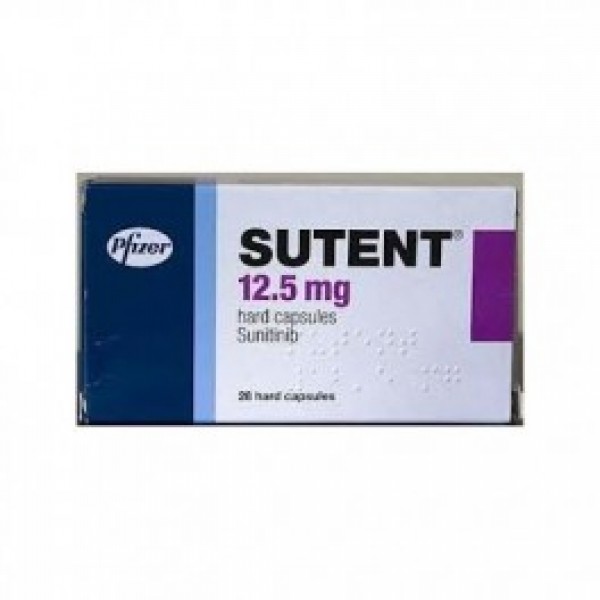
Sutent 12.5 mg. 30 capsules
Product Code: Sutent 12.5 mg. 30 capsules
Availability: In Stock
Product viewed: 1407


Sutent 12.5 mg. 30 capsules
What is Sutent and what is it used?
Sutent contains the active substance sunitinib, which is a protein kinase inhibitor. It is used to treat cancer by preventing the activity of a specific group of proteins known to be involved in the growth and spread of cancer cells.
Sutent will only be prescribed by a physician experienced in the use of anticancer medicines.
Sutent is used in adults to treat the following types of cancer:
- Gastrointestinal stromal tumor (GIST), a type of cancer of the stomach and bowel, where imatinib (another anticancer medicine) is not effective or can not take imatinib.
- Metastatic renal cell carcinoma (mRCC), a type of kidney cancer that has spread to other parts of the body.
- Neuroendocrine tumors of the pancreas (pNET) (tumors of hormone-producing cells of the pancreas), which are advanced and can not be surgically removed.
If you have any questions about how Sutent works or why it has been prescribed this medicine, ask your doctor.
2. What you need to know before you take Sutent?
Do not take Sutent
- If you are allergic to sunitinib or any of the other ingredients of Sutent (listed in section 6).
Warnings and Precautions
Talk to your doctor before taking Sutent:
- If you have high blood pressure. Sutent can raise blood pressure. Your doctor can check your blood pressure during treatment with Sutent, and can be treated with drugs to lower blood pressure, if necessary.
- If you have or have had blood disease, problems with bleeding or bruising. Treatment with Sutent may lead to an increased risk of bleeding or lead to changes in the number of certain blood cells, which may lead to anemia or affect the ability of your blood to clot. If you are taking warfarin or acenocoumarol - medicines that thin the blood to prevent clots, the risk of bleeding may be higher. Tell your doctor if you have any bleeding while taking Sutent.
- If you have heart problems. Sutent can cause heart problems. Tell your doctor if you feel very tired, have shortness of breath or swollen feet and ankles.
- If you have abnormal heart rhythm. Sutent can cause disturbances in your heart rate. Your doctor may do electrocardiograms to evaluate these problems during your treatment with Sutent. Tell your doctor if you feel dizzy, sick or you have palpitations while taking Sutent.
- If you have had problems with blood clots in the veins and / or arteries (types of blood vessels) recently, including stroke, heart attack, embolism or thrombosis. Call your doctor immediately if during treatment with Sutent have symptoms such as pain or pressure in the chest, pain in the arms, back, neck or jaw, shortness of breath, numbness or weakness on one side of the body, difficulty speaking, headache or dizziness .
- If you have thyroid problems. Sutent can cause thyroid problems. Tell your doctor if during the treatment with Sutent tire more easily, more cold you compared to other people or your voice becomes hoarse. The function of your thyroid gland should be checked before treatment and regularly during treatment. If your thyroid gland does not produce enough thyroid hormone, you may be applied thyroid hormone replacement therapy.
- If you have or have had pancreatic or biliary disorders. Tell your doctor if you experience any of the following symptoms: pain in the stomach (upper abdomen), nausea, vomiting, and fever. This may be due to inflammation of the pancreas or gallbladder.
- If you have or have had liver problems. Tell your doctor if you develop any of the following symptoms of liver problems during treatment with Sutent: itching, yellowing of the skin and eyes, dark urine and pain or discomfort in the right upper abdomen. Your doctor should do blood tests to check your liver function before and during treatment with Sutent, and if necessary according to your condition.
- If you have or have had kidney problems. Your doctor will monitor your kidney function.
- If you operate or rather your surgery. Sutent may affect the way your wounds heal. Usually your treatment with Sutent will be stopped if you have an operation. Your doctor will decide when to resume treatment with Sutent.
- You may be advised to have a dental examination before you start treatment with Sutent.
- If you have or have had pain in the mouth, teeth and / or jaw, swelling or inflammation in the mouth, numbness or a feeling of heaviness in the jaw or loosening of a tooth, immediately tell your doctor and dentist.
- If you have to undergo a bleeding dental treatment or dental surgery, tell your dentist that you are being treated with Sutent, especially if you also apply or are you bisphosphonates intravenously. Bisphosphonates are drugs used to prevent bone complications, which may be applied to another medical condition.
- If you have or have had skin and subcutaneous tissue. While this medicine may occur "pyoderma gangrenosum" (painful skin ulceration). This event is usually reversible after discontinuation of treatment. With the use of sunitinib, severe skin reactions (Stevens-Johnson, toxic epidermal necrolysis, erythema multiforme), which appear initially as red, similar to target points or circular spots, often centrally located blisters on the body. The rash may progress to widespread blisters or peeling of the skin and can be life-threatening. If you develop a rash or these skin symptoms, seek immediate medical advice.
- If you have or have had seizures. Immediately tell your doctor if you have high blood pressure, headache or loss of vision.
Children and adolescents
Sutent is not recommended under the age of 18 years. Sutent has not been studied in children and adolescents.
Other medicines and Sutent
Tell your doctor or pharmacist if you are taking, have recently taken or might take any other medicines, including medicines obtained without a prescription even those not prescribed.
Some medicines may affect the levels of Sutent in your body. You should tell your doctor if you are taking medicines containing the following active ingredients:
• ketoconazole, itraconazole - used to treat fungal infections
• erythromycin, clarithromycin, rifampicin -Use for infections
• -Use ritonavir for HIV
• Dexamethasone - a corticosteroid used in the treatment of various diseases
• phenytoin, carbamazepine, phenobarbital - used to treat epilepsy and other neurological disorders
• herbal preparations containing St. John's wort (Hypericum perforatum) - used to treat depression and anxiety
Sutent with food and drink
You should avoid the intake of grapefruit juice during treatment with Sutent.
Pregnancy and lactation
If you are pregnant or if you think you may be, tell your doctor.
Sutent should not be used during pregnancy unless clearly necessary. Your doctor will discuss with you the potential risk of taking Sutent during pregnancy.
If you could get pregnant, you must use reliable contraception during treatment with Sutent.
If you are breastfeeding, tell your doctor. Do not breast-feed during treatment with Sutent. Driving and using machines
If you experience dizziness or you feel unusually tired, take special care when driving or operating machinery.
3. How to take Sutent?
Always take this medicine exactly as prescribed by your doctor. If you are not sure, ask your doctor.
Your doctor will prescribe the correct dose for you, depending on the type of tumor. If you are being treated for GIST or MRCC, the usual dose is 50 mg once daily for 28 days (4 weeks), followed by 14 days (2 weeks) pause (no drug) in 6-week cycles. If you are being treated for pNET, the usual dose is 37,5 mg once daily without a rest period.
Your doctor will decide the right dose you should take, and whether and when to stop treatment with Sutent.
Sutent can be taken with or without food.
If you take more dose of Sutent
If you accidentally take too many capsules, tell your doctor immediately. You may need medical attention.
If you forget to take Sutent
Do not take a double dose to make up the missed dose.
4. Possible side effects
Like all medicines, this medicine can cause side effects, although not everybody gets them.
Should immediately contact your doctor if you experience any of these serious side effects (see also What you need to know before you take Sutent):
Heart problems. Tell your doctor if you feel very tired, have shortness of breath or swollen feet and ankles. These may be symptoms of heart problems, including heart failure and heart muscle problems (cardiomyopathy).
Problems with the lungs and breathing. Tell your doctor if you have a cough, chest pain, sudden shortness of breath or cough up blood. These may be symptoms of a condition known as pulmonary embolism which occurs when a blood clot reaches your lungs.
Renal disorders. Tell your doctor if you urinate with altered frequency or urinate, it may be symptoms of kidney failure.
Bleeding. Tell your doctor immediately if you experience any of these symptoms or problems with serious bleeding events during treatment with Sutent: painful bloating, vomiting of blood, black tarry stools, bloody urine, headache or change in your mental state, coughing blood or bloody sputum from the lungs or airways.
Disintegration of the tumor, leading to a breakthrough in the gut. Tell your doctor if you have severe abdominal pain, fever, nausea, vomiting, blood in the stool or changes in bowel habits.
Other side effects may include:
Very common side effects (may affect more than 1 in 10 users)
• Low platelet count, red blood cells and / or white blood cells (eg. Neutrophils).
• High blood pressure
• Infections.
• Pain / mouth irritation, redness / inflammation / dry mouth, changes in taste, burning or painful sensation in the tongue, upset stomach, nausea, vomiting, diarrhea, inflammation of the lining of the digestive system, more gas in the stomach or intestines, constipation , abdominal pain, loss / decrease of appetite, loss of strength, weight loss.
• Yellow skin / discoloration of the skin, discoloration of hair, hair loss, rash on the palms and soles of the feet, blisters, rash, dry skin;
• Excessive fatigue.
• Headache.
• Nosebleeds
• Pain in arms and legs.
• Fast swelling of the tissues due to the fluid under the skin
Common side effects (may affect 1 to 10 users in 100)
• Reduced activity of the thyroid (hypothyroidism).
• Fluid retention including around the lungs.
• Fever, fever, flu-like syndrome.
• Pain in the chest.
• Shortness of breath.
• Depression.
• Haemorrhoids, pain in the rectum, bleeding gums, difficulty swallowing or inability to swallow, heartburn.
• Difficulty in speaking.
• Cough, nasal dryness, congested nose.
• Excessive tear.
• Back pain, joint pain, muscle pain.
• Swelling of the legs and around the eyes.
• change the sensitivity of the skin, dry skin, itching, flaking and skin irritation, blisters, acne, excessive coloration of the skin.
• Changed sensations in the extremities
• Abnormally decreased / increased sensitivity, particularly to touch.
• High levels of uric acid in the blood.
• Hot flushes.
• Problems falling asleep.
• Abnormally colored urine.
• Change in color of your nails.
Uncommon side effects (may affect 1 to 10 of 1000 users)
• Stroke.
• Changes in the electrical activity of the heart or an irregular heartbeat.
• Fluid around the heart (pericardial effusion).
• Liver failure.
• Unusual muscle breakdown which can lead to kidney problems (rhabdomyolysis).
• Pain in the stomach (abdomen) caused by inflammation of the pancreas.
• tumor lysis syndrome (p) - p, including a group of metabolic complications that can appear during the treatment of cancer. These complications are caused by the breakdown products of dying cancer cells and may include the following: nausea, shortness of breath, irregular heartbeat, muscle spasms, seizures, clouding of urine and tiredness associated with abnormalities in laboratory test results (high levels of potassium, uric acid and phosphorous and low levels of calcium in the blood), which may lead to changes in kidney function and acute renal failure.
• The breakdown of the tumor, leading to a breakthrough in the intestine (perforation).
• Inflammation of the liver (hepatitis).
• inflammation (swelling and redness) of bile with or without the associated gallstones.
• Unusual changes in the brain that can cause a variety of symptoms, including headache, confusion, convulsions and loss of vision (syndrome of reversible posterior leukoencephalopathy).
• Pain in the mouth, teeth and / or jaw, swelling or inflammation in the mouth, numbness or a feeling of heaviness in the jaw or loosening of a tooth. These may be symptoms of bone damage in the jaw (osteonecrosis). Tell your doctor or dentist if you have any of them.
• Unnatural duct connecting a body cavity or other skin.
• Blood clots in the blood vessels.
• Overproduction of thyroid hormones which increases the amount of energy the body uses at rest. Inflammation of the thyroid gland.
• Problem wound healing after surgery.
• Abnormal results from blood tests including pancreatic and liver enzymes.
• Loss of protein in the urine, sometimes leading to swelling.
• Unusual and very severe reaction to an allergen.
Rare side effects (may affect 1 to 10 of 10,000 users)
• Life-threatening infection of the soft tissue, including the anogenital area. Contact your doctor immediately if symptoms of infection around a skin injury, including fever, pain, redness, swelling or discharge or blood.
• Painful ulceration of the skin (pyoderma gangrenosum).
• Severe skin reactions and / or mucous membranes (Stevens-Johnson, toxic epidermal necrolysis, erythema multiforme)
If you get any side effects, contact your doctor. This includes any possible effects not listed in this leaflet ..
5. How to store Sutent?
- Keep out of the reach and sight of children.
- Do not use this medicine after the expiry date stated on the carton and label after "EXP". The expiry date refers to the last day of that month.
- This medicine does not require any special storage conditions.
- Do not use this medicine if you notice that the pack is damaged or shows signs of tampering.
Do not dispose of medications in wastewater or household waste. Ask your pharmacist how to dispose of medicines no longer required. These measures will help to protect the environment.
6. Contents of the pack and other information
What Sutent?
Sutent 12,5 mg hard capsules
The active substance is sunitinib. Each capsule contains sunitinib malate, equivalent to 12,5 mg sunitinib. Other ingredients are:
- Capsule content: mannitol (E421), croscarmellose sodium, povidone (K-25) and magnesium stearate.
- Capsule: gelatin, red iron oxide (E172) and titanium dioxide (E171).
- Ink: shellac, propylene glycol, sodium hydroxide, povidone and titanium dioxide (E171).
Sutent 25 mg hard capsules
The active substance is sunitinib. Each capsule contains sunitinib malate equivalent to 25 mg.
Other ingredients are:
- Capsule content: mannitol, croscarmellose sodium, povidone (K-25) and magnesium stearate.
- Capsule: gelatin, titanium dioxide (E171), iron oxide yellow (E172), red iron oxide (E172), black iron oxide (E172).
- Ink: shellac, propylene glycol, sodium hydroxide, povidone and titanium dioxide (E171).
Sutent 37.5 mg hard capsules
The active substance is sunitinib. Each capsule contains sunitinib malate, equivalent to 37,5 mg.
Other ingredients are:
- Capsule content: mannitol, croscarmellose sodium, povidone (K-25) and magnesium stearate.
- Capsule: gelatin, titanium dioxide (E171), iron oxide yellow (E172).
- Ink: shellac, propylene glycol, sodium hydroxide, black iron oxide (E172).
Sutent 50 mg hard capsules
The active substance is sunitinib. Each capsule contains sunitinib malate equivalent to 50 mg.
Other ingredients are:
- Capsule content: mannitol, croscarmellose sodium, povidone (K-25) and magnesium stearate.
- Capsule: gelatin, titanium dioxide (E171), iron oxide yellow (E172), red iron oxide (E172), black iron oxide (E172).
- Ink: shellac, propylene glycol, sodium hydroxide, povidone and titanium dioxide (E171).
Sutent looks like and contents of the pack?
Sutent 12,5 mg is supplied as hard gelatin capsules with orange cap and orange body, printed with white ink "Pfizer" on the cap and on the body "STN 12.5 mg", containing yellow to orange granules.
Write a review
Your Name:Your Review: Note: HTML is not translated!
Rating: Bad Good
Enter the code in the box below:
Related Products
SUTENT. 12.5 mg. 30 capsules What is Sutent and what it is ..
1,599.00€