Your shopping cart is empty!
Welcome visitor you can login or create an account.
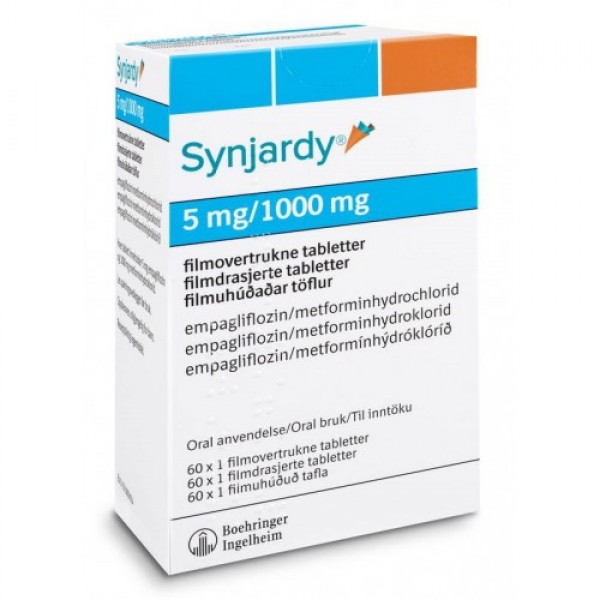
Synjardy 5 mg. / 1000 mg. 60 tablets
Product viewed: 3819


What Synjardy is and what it is used for
Synjardy is a medicine for diabetes that contains two active substances called emfgliflozin and metformin.
Empagelfosin works by blocking a kidney protein called sodium-glucose cotransporter 2 (SGLT2). SGLT2 prevents loss of glucose in the urine by reverse absorption of glucose into the bloodstream during blood filtration through the kidneys. By blocking this protein, the medicine causes the blood sugar to be released into the urine. This helps to lower blood glucose levels that are elevated in patients with type 2 diabetes;
Metformin works differently to lower blood sugar levels in the blood, mainly by blocking the production of glucose in the liver.
Synjardy is added to diet and exercise to treat type 2 diabetes in adult patients (18 years of age and older) in whom diabetes can not be controlled by the addition of metformin alone or metformin and other diabetes medicines.
Synjardy can also be combined with other medicines. These may be oral medicines or insulin injections.
In addition, Synjardy may be used as an alternative to taking epiglyphosine and metformin as separate tablets. To avoid overdosage, do not continue to take the individual tablets of emfgliflozine and metformin if you are taking this medicine.
It is important to continue with your diet and exercise, as your doctor, pharmacist or nurse has told you.
What is Type 2 diabetes mellitus?
Type 2 diabetes mellitus is a disease that is related to your genes and lifestyle. If you suffer from type 2 diabetes, your pancreas does not produce enough insulin to control the blood glucose level and your body can not use its own insulin effectively. This leads to high levels of glucose in your blood that can lead to health problems such as heart disease, kidney disease, blindness and poor blood circulation in the limbs.
2. What you need to know before taking Synjardy
Do not take Synjardy:
if you are allergic to emparglyphosine, metformin or any of the other ingredients of this medicine (listed in section 6);
if you have a severely reduced kidney function;
if you have uncontrolled diabetes, for example with severe hyperglycaemia (high blood sugar), nausea, vomiting, diarrhea, rapid weight loss, lactic acidosis (see "Lactic acidosis risk" below) or ketoacidosis. Ketoacidosis is a condition where substances called "ketone bodies" accumulate in the blood and can lead to a diabetic pre-coma. Symptoms include stomach pains, rapid and deep breathing, drowsiness or an unusual fruity aroma of your breath;
if you have a diabetic pre-coma;
if you have a severe infection, such as an infection affecting your lung, bronchus or kidney. Severe infections can cause kidney problems that may lead to the risk of developing lactic acidosis (see "Warnings and Precautions");
if you have lost many fluids from your body (dehydration), as a result of prolonged diarrhea or if you have vomited several times in a row. Dehydration can lead to kidney problems, which can lead you to the risk of developing lactic acidosis (see "Warnings and Precautions");
if you are being treated for acute heart failure or have recently had a heart attack, you have severe blood circulation problems (such as "shock") or have difficulty in breathing. This can lead to oxygen deficiency in the tissues, creating a risk for lactic acidosis (see "Warnings and Precautions");
if you have liver problems;
if you consume large amounts of alcohol, or every day or just occasionally (see "Synjardy with alcohol").
Warnings and precautions
Talk to your doctor, pharmacist or nurse before taking this medicine and during treatment:
if you have "type 1 diabetes" - this type of diabetes usually begins at a young age and your body does not synthesize insulin;
weight loss, nausea or vomiting, abdominal pain, excessive thirst, rapid and deep breathing, confusion, unusual drowsiness or fatigue, smell of sweet smell, sweet or metallic taste in the mouth or a different smell of urine or sweat, contact a doctor immediately or contact the nearest hospital. These symptoms may be a sign of "diabetic ketoacidosis" - a problem you may have;
if you have diabetes due to elevated levels of "ketone bodies" in your urine or blood that is found in laboratory tests. The risk of developing diabetic ketoacidosis may increase with prolonged starvation, excessive alcohol consumption, dehydration, a sharp decrease in insulin dose, or increased insulin requirements due to major surgery or severe illness;
if you are 75 years old or older
Stop taking Synjardy for a short period of time if you have a condition that may be related to dehydration (significant loss of body fluids) such as severe vomiting, diarrhea, fever, heat exposure, or if you drink less fluids than normal. Talk to your doctor for further instructions.
Stop taking Synjardy and contact your doctor or nearest hospital immediately if you have any of the symptoms of lactic acidosis as this condition can lead to coma.
Symptoms of lactic acidosis include:
vomiting;
stomach ache (abdominal pain);
muscle spasms;
general feeling of being unwell, accompanied by severe fatigue;
difficulty in breathing;
decreased body temperature and pulse.
Lactic acidosis is a condition requiring urgent medical attention and should be treated in a hospital.
If you have to undergo a serious operation, you must stop taking Synjardy during and for some time after the procedure. Your doctor will decide when to stop and when to resume treatment with Synjardy.
During treatment with Synjardy, your doctor will check your kidney function at least once a year or more if you are elderly and / or have impaired kidney function.
Glucose in the urine
Due to the mechanism of action of this medicine, your urine sugar tests will be positive while you are taking it.
Children and adolescents
This medicine is not recommended for use in children and adolescents under 18 because it has not been studied in these patients.
Other Drugs and Synjardy
If you need to be injected with a contrast agent containing iodine in your bloodstream, for example in the context of an X-ray or scanner, you should stop taking Synjardy before or during the injection. Your doctor will decide when to stop and when to resume treatment with Synjardy.
Tell your doctor if you are taking, have recently taken or might take any other medicines. You may need to have blood glucose and kidney function more often, or your doctor may adjust the dose of Synjardy. It is extremely important to mention the following:
medicines that increase urine output (diuretics), as Synjardy may increase the risk of excessive fluid loss. Your doctor may tell you to stop taking Synjardy. Possible signs of excessive fluid loss from the body are listed in section 4 "Possible side effects";
other medicines that lower blood sugar in your blood, such as insulin or a sulphonylurea. Your doctor may want to lower the dose of these medicines in order to avoid excessive drops in your blood sugar (hypoglycaemia);
cimetidine, a cure for stomach problems;
bronchodilators (beta-2 agonists) that are used to treat asthma;
corticosteroids (administered orally, such as injection or inhalation) that are used to treat inflammation in diseases such as asthma or arthritis;
medicines used to treat pain and inflammation (NSAIDs and COX-2 inhibitors such as ibuprofen and celecoxib);
some medicines to treat high blood pressure (ACE-inhibitors and angiotensin II receptor antagonists);
medicines containing alcohol (see Synjardy with alcohol);
containing medicines (medicines used during X-rays, see "Warnings and Precautions").
Synjards with alcohol
Avoid excessive use of alcohol while taking Synjardy as this may increase the risk of lactic acidosis (see section "Warnings and Precautions").
Pregnancy and breastfeeding
If you are pregnant or are breast-feeding, think you may be pregnant or plan to become pregnant, ask your doctor or pharmacist for advice before taking this medicine.
Do not use Synjardy if you are pregnant. It is not known whether this medicine can harm the fetus.
Metformin passes into small amounts in breast milk. It is not known whether emriglyphosine passes into the mother's breast. Do not use Synjardy if you are breast-feeding.
Driving and using machines
Synjardy has little influence on the ability to drive and use machines.
Taking this medicine in combination with medicines called sulphonylureas or insulin can cause very low blood sugar (hypoglycaemia), which can cause symptoms such as trembling, sweating, and changes in vision, and this may affect your ability to drive and operate machinery. Do not drive or use any tools if you feel dizzy while taking Synjardy.
3. How to take Synjardy
Always take this medicine exactly as your doctor has told you. If you are not sure, ask your doctor or pharmacist.
How much to take
The dose of Synjardy varies depending on your condition and the doses of diabetes medicines you are currently taking. Your doctor will adjust your dose as needed and will tell you exactly which type of medicine tablets
Taking this medicine
Swallow the tablet whole with water.
Take the tablets with food to reduce the risk of stomach discomfort.
Take the tablets twice a day through the mouth.
Your doctor may prescribe Synjardy with another anti-diabetes medicine. Remember that you should take all medicines as directed by your doctor to get the best results for your health. Your doctor may need to adjust your doses to control your blood sugar.
Diet and exercise can help your body better use blood sugar. It is important that you follow the diet and the motor regimen recommended by your doctor while taking Synjardy.
If you take more Synjardy than you should
If you take more than the required number of tablets Synjardy, you may get lactic acidosis. Symptoms of lactic acidosis are nonspecific, such as severe malaise, vomiting, stomach pain with muscle cramps, general malaise with severe fatigue and inability to breathe. Additional symptoms include decreased body temperature and slow heartbeat. If this happens to you, you may need immediate hospital treatment because lactic acidosis can lead to coma. Stop taking this medicine immediately and consult a doctor immediately or go to the nearest hospital (see section 2). Take the medicine pack with you.
If you forget to take Synjardy
If you miss a dose, take it as soon as you remember. If you have not thought of the next dose, skip skip the missed dose and then continue with your standard regimen. Do not take a double dose of this medicine.
If you stop taking Synjardy
Do not stop taking Synjardy before consulting your doctor. Your blood sugar may increase when you stop taking Synjardy.
If you have any further questions on the use of this medicine, ask your doctor, pharmacist or nurse.
4. Possible side effects
Like all medicines, this medicine can cause side effects, although not everyone gets them.
Contact a doctor immediately or contact your nearest hospital if you experience any of the following side effects:
Lactic acidosis, occurring very rarely (may affect up to 1 in 10,000 people):
Synjardy may lead to very rare (may affect up to 1 user in 10,000) but a very serious side effect called lactic acidosis (see Warnings and Precautions). If this happens, you must stop taking Synjardy and contact a doctor or nearest hospital immediately as lactic acidosis can cause a coma.
Diabetic ketoacidosis (rare, may affect up to 1 in 1,000 people):
These are signs of diabetic ketoacidosis (see section 2 "Warnings and Precautions"):
elevated levels of "ketonelates" in your urine or blood;
rapid weight loss;
nausea or vomiting;
tummy ache;
excessive thirst;
rapid and deep breathing;
confusion;
unusual drowsiness or fatigue;
breath with a sweet smell, a sweet or metallic taste in the mouth, or an unusual smell of urine or sweat.
This can happen regardless of the level of blood sugar. Your doctor may decide to temporarily or permanently stop your treatment with Synjardy.
Contact your doctor as soon as possible if you notice any of the following side effects:
Low blood sugar (hypoglycaemia), very common (may affect more than 1 in 10 people):
If you take Synjardy with another medicine that can cause low blood sugar, such as sulphonylureas or insulin, the risk of developing a low blood sugar is higher. Signs of low blood sugar may include:
trembling, sweating, feeling of great anxiety or confusion, rapid heartbeat;
very strong hunger, headache.
Your doctor will tell you how to adjust the low blood sugar level and what to do if you get any of the signs listed above. If you have symptoms of low blood sugar, eat lumps of sugar, a high-sugar breakfast, or drink fruit juice. If possible, measure your blood sugar and rest.
Urinary tract infection is common (may affect up to 1 in 10 people):
Signs of urinary tract infection are:
burning sensation when urinating;
urinary incontinence;
pain in the pelvis or in the middle of the back (when there is an infection of the kidneys).
Positions for urination or more frequent urination may be due to the way Synjardy works, but may also be signs of urinary tract infection. If you notice an increase in these symptoms, you should also contact your doctor.
Dehydration occurs uncommonly (may affect up to 1 in 100 people):
Signs of dehydration are not specific, but may include:
unusual thirst;
vertigo or dizziness when standing up;
seizure or
How to Store Synjardy
Keep out of the reach and sight of children.
Do not use this medicine after the expiry date which is stated on the blister and carton after EXP. The expiry date refers to the last day of that month.
This medicine does not require any special storage conditions.
Do not use this medicine if you notice that the packaging is damaged or has traces of opening.
Do not dispose of medicines in the sewage system or in the household waste container. Ask your pharmacist how to dispose of medicines you no longer use. These measures will help to protect the environment.
6. Package Contents and Additional Information
What Synjardy contains
The active substances are: emagliflozin and metformin.
Each film-coated tablet (tablet) of Synjardy 5 mg / 850 mg contains 5 mg of emphaglifosin and 850 mg of metformin hydrochloride.
Each film-coated tablet (tablet) of Synjardy 5 mg / 1,000 mg contains 5 mg of emriglyphosine and 1,000 mg of metformin hydrochloride.
Each film-coated tablet (tablet) of Synjardy 12.5 mg / 850 mg contains 12.5 mg embalgulosine and 850 mg metformin hydrochloride.
Each film-coated tablet (tablet) of Synjardy 12.5 mg / 1000 mg contains 12.5 mg of emriglyphosine and 1000 mg of metformin hydrochloride.
The other ingredients are:
Tablet core: corn starch, copovidone, colloidal anhydrous silica, magnesium stearate.
Film coated: hypromellose, macrogol 400, titanium dioxide (E171), talc. The Synjardy 5 mg / 850 mg and Synjardy 5 mg / 1,000 mg tablets also contain yellow iron oxide (E172). The Synjardy 12.5 mg / 850 mg and Synjardy 12.5 mg / 1000 mg tablets also contain Black Iron Oxide (E172) and Red Iron Oxide (E172).
What Synjardy looks like and contents of the pack
Synjardy 5 mg / 850 mg film-coated tablets are yellowish-white, oval, biconvex. On one side are the "S5" and the Boehringer Ingelheim logo, and on the other - "850". The tablet is 19.2 mm long and has a width of 9.4 mm.
Synjardy 5 mg / 1,000 mg film-coated tablets are brownish-yellow, oval, biconvex. On one side are the "S5" and the Boehringer Ingelheim logo, and on the other - "1000". The tablet is 21.1 mm long and has a width of 9.7 mm.
Synjardy 12.5 mg / 850 mg film-coated tablets are pink-white, oval, biconvex. On one side are the "S12" and the Boehringer Ingelheim logo, and on the other - "850". The tablet is 19.2 mm long and has a width of 9.4 mm.
Synjardy 12.5 mg / 1000 mg film-coated tablets are dark brownish-purple, oval, biconvex. On one side are the "S12" and the Boehringer Ingelheim logo, and on the other - "1000". The tablet is 21.1 mm long and has a width of 9.7 mm.
The tablets are supplied in perforated unit dose blisters of PVC / PVDC / Aluminum. There are packs of 10 x 1, 14 x 1, 30 x 1, 56 x 1, 60 x 1, 90 x 1 and 100 x 1 film-coated tablets and multipacks containing 120 (2 packs of 60 x 1), 180 (2 packs of 90 x 1) and 200 (2 packs of 100 x 1) film-coated tablets.
Not all packs may be marketed in your country.
Write a review
Your Name:Your Review: Note: HTML is not translated!
Rating: Bad Good
Enter the code in the box below:
Related Products
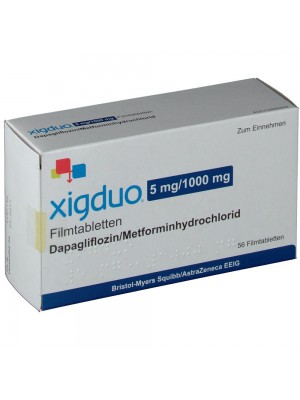
What is Xigduo and what it is used
This product contains tw..
89.00€