
Your shopping cart is empty!
Welcome visitor you can login or create an account.
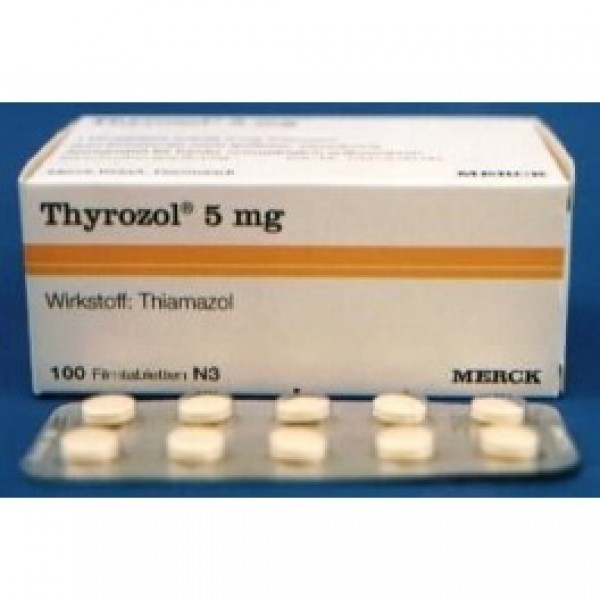
Thyrozol 5 mg. 50 tablets
Product Code: Thyrozol 5 mg. 50 tablets
Availability: In Stock
Product viewed: 2724


Thyrozol 5 mg. 50 tablets
What is Thyrozol and what it is used
This medicine contains thiamazole. It controls the overproduction of thyroid hormones in the thyroid gland, for whatever reason.
Thyrozol is used to treat the overproduction of thyroid hormones:
If you need to take medicines to treat overproduce thyroid, especially if you have a small goitre (swelling in the front of the neck) or no dewlap
If you will be undergoing surgery of the thyroid gland;
If you will be treated (a) with radioactive iodine, especially in severe cases of overproduction of thyroid hormones;
After treatment with radioactive iodine, while the effect does not pass entirely.
Tyrosol is also used in preventing overproduction of thyroid hormones before being exposed (a) to the action of iodine, for example, research with iodine containing contrast agent.
If you have mild overproduction of thyroid hormones without other symptoms;
If your thyroid certain areas producing hormones (autonomous adenoma);
If you have (a) overproduction of thyroid hormones early in life.
2. What you need to know before taking Thyrozol
Do not take Thyrozol
If you are allergic (a) (hypersensitive (a) to thiamazole to other similar substances (thionamides derivatives) or any of the other ingredients of Tyrosol (see section 6);
If laboratory tests show that you have a low number of certain blood cells (granulocytopenia);
If the secretion of bile is blocked before treatment with Thyrozol
If you received a bone marrow damage after previous treatment thiamazole or carbimazole.
Warnings and Precautions
Talk to your doctor or pharmacist before taking Thyrozol
Consult your doctor if you have a mild allergic reaction to thiamazole as allergic rashes or itching. The doctor will decide whether you can take Tyrosol.
Consult your doctor if you have a large goitre (swelling in the front of the neck), which impairs your breathing as the throat may increase during treatment with Tyrosol. Your doctor may decide to prescribe Tyrosol only a short time and you will have regular reviews during treatment.
Immediately contact your doctor if you have symptoms such as inflammation of the lining of the mouth, sore throat or fever. They may be due to a large reduction in the number of certain blood cells - agranulocytosis. It may occur particularly in the first weeks of treatment and may lead to serious consequences.
If you have a particularly severe overproduction of thyroid hormone may need to take very high doses Tyrosol (more than 120 mg per day). In this case, your doctor will perform blood tests specified period of time as possible your bone marrow to be affected. If this happens, your doctor may decide to discontinue therapy and, if necessary, will give you another medicine.
If your throat is increased during treatment with Tyrosol or if your thyroid gland is not active enough, you may need your doctor to review your dose Tyrosol. Such conditions, however, can also occur as a result of the natural course of your illness. Similarly, a certain type of eye disease (endocrine orbitopatiya) can develop or worsen, not related to treatment with Thyrozol
It is possible that the weight will increase during treatment with Tyrosol. This is the normal response of the body. Tyrosol affect your thyroid hormones that control energy consumption.
Other medicines and Thyrozol
Your reserves of iodine affect Thyrozol Your doctor will decide the dose Tyrosol to take, depending on your individual reserves iodine and thyroid gland you.
Consult your doctor if you are taking anticoagulants (drugs that are used to prevent blood clotting) since the normalization of thyroid function of Tyrosol may affect their action. The same could be true for other drugs. Therefore, please tell your doctor or pharmacist if you are taking or have recently taken any other medicines, including medicines obtained without a prescription.
Pregnancy and lactation
In general, pregnancy has a positive effect on the production of thyroid hormones. In any case, consult your doctor as you may need to continue taking Tyrosol, especially in the first months of pregnancy. Your doctor may decide to reduce the dose Tyrosol in order to avoid any harm to your baby. This is especially important if you have taken Tyrosol with thyroid hormones because such a combination should not be used during pregnancy.
The same applies if you want to breastfeed. 10 mg doses generally can not harm your baby. Your doctor will check how the thyroid works of your newborn baby.
Driving and using machines
Thyrozol does not affect the ability to drive and use machines.
Thyrozol contains lactose
Tell your doctor if you are intolerant to certain sugars as Tyrosol contains lactose.
3. How to take Thyrozol
Always take this medicine exactly as your doctor has told you. If you're not sure, ask your doctor.
Usual dose
Depending on how serious your condition, your doctor will determine your individual dose. Usually recommend the following doses:
Mature
The initial dose is 10-40 mg per day Tyrosol (or higher for certain patients), whereas the thyroid function is normal. The maintenance dose is 5-20 mg Tyrosol or a day in combination with a thyroid hormone or 2,5-10 mg daily without Tyrosol thyroid hormones. *
Use in children and adolescents (between 3 and 17 years)
The initial dose is 0,5 mg Thyrozol per kg body weight per day. Then your doctor will decide if less maintenance dose is sufficient and if necessary extra thyroid hormones. *
Use in children (2 and less years)
Thyrozol not recommended for use in children of 2 or less years.
If you are exposed (a) of the risk of overproduction of thyroid hormones after diagnostic examination with iodine containing contrast agent, your doctor may prescribe Tyrosol 10-20 mg per day with perchlorate for approximately 10 days (until the iodine-containing contrast agent leave the body). *
* In low doses, tablets of 5 mg.
Patients with liver problems
Tell your doctor if you have liver problems or liver disease. In this case your dose Tyrosol will have to be reduced.
Patients with kidney disease
Tell your doctor if you have kidney problems or diseases. In this case, your dose Tyrosol should be reduced.
Duration of treatment
The duration of treatment may vary depending on the condition for which the use Tyrosol. Your doctor will discuss with you how long you should take Tyrosol.
Typically the duration of treatment is as follows:
Treatment of overproduction of thyroid hormones (without surgery): from 6 months to 2 years;
Treatment before surgery of the thyroid gland: 3-4 weeks before surgery;
Treatment prior to radioiodine therapy: to normalize the function of your thyroid gland;
Treatment after radioiodine therapy: 4-6 months until it manifests the effect of radioactive iodine.
Application
Swallow the tablets with a little liquid, such as half a cup of water in the morning after breakfast. The tablet can be divided into equal doses.
If you take more than one tablet a day, you can also take them several times at regular intervals during the day.
If you take more dose Thyrozol
If you take a higher dose than prescribed, there is no problem. If you have taken a higher dose than prescribed more frequently, consult your doctor as soon as possible. You may need your doctor to adjust your dosage Tyrosol or may in addition give thyroid hormones to avoid an increase in throat.
If you forget to take Thyrozol
Do not take a double dose to make up for the missed tablet, but take your normal dose the next day.
If you have any further questions on the use of Tyrosol, ask your doctor or pharmacist.
4. Possible side effects
Like all medicines, this medicine can cause side effects, although not everybody gets them.
While taking Thyrozol , you may experience one or more of these side effects in some cases even after several months of treatment:
Very common (may affect more than 1 in 10 people):
Skin reactions with varying degrees (rash, itching, itchy swellings). Typically, they are mild and disappear during treatment with Tyrosol.
Common (may affect up to 1 in 10 people):
Joint pain (arthralgia).
Uncommon (may affect up to 1 in 100 people):
If you have symptoms of inflammation of the mouth, sore throat or fever, contact your doctor immediately. These may be signs of a greater reduction in the number of certain blood cells (agranulocytosis).
Rare (may affect up to 1 in 1000 people):
Infringement or loss of taste (dysgeusia, ageusia);
Temperature.
Very rare (may affect up to 1 in 10,000 people):
Reducing the number of platelets (thrombocytopenia), reduced numbers of all blood cells (pancytopenia), disease of the lymph nodes (generalized lymphadenopathy);
Infringement of hormones regulating blood sugar and expressed reduced levels of blood sugar (insulin autoimmune syndrome);
Inflammation or irritation of the nerves (neuritis, polyneuropathy);
Swelling of the salivary glands;
Liver dysfunction or liver inflammation (cholestatic jaundice, toxic hepatitis). Generally the symptoms disappear after cessation of treatment;
Severe allergic skin reactions, probably occurring throughout the body including blistering of the skin (Stevens-Johnson), hair loss, inflammatory autoimmune disease of the skin and connective tissue (lupus erythematosus).
Children and adolescents
Adverse reactions in children and adolescents are similar to those seen in adults.
If any of the side effects gets serious, consult your doctor.
If you notice any side effects not listed in this leaflet, please tell your doctor or pharmacist.
5. How to store Thyrozol
Keep out of reach of children.
Do not use Tyrosol after the expiry date which is stated on the package after the inscription EHR. The date of expiry date refers to the last day of the month.
Do not store above 25 ° C.
Do not dispose of medications in wastewater or household waste. Ask your pharmacist how to dispose of medicines you no longer use. These measures will help to protect the environment.
6. Contents of the pack and further information
What Thyrozol
The active substance is thiamazole. Each tablet contains 5 mg, 10 mg or 20 mg of thiamazole.
Other ingredients are:
Tablet core: Silica, colloidal anhydrous, magnesium stearate, hypromellose, talc, powdered cellulose, maize starch, lactose monohydrate, sodium starch glycolate;
Film-coating: dimethicone 100, macrogol 400, hypromellose, titanium dioxide (E 171), iron oxide (E 172).
Thyrozol looks like and contents of the pack
Thyrozol 5 mg film-coated tablets are yellow, biconvex, round, scored on both sides.
Thyrozol 5 mg film-coated tablets are available in packs of 20, 30, 50 or 100 tablets.
Write a review
Your Name:Your Review: Note: HTML is not translated!
Rating: Bad Good
Enter the code in the box below:
Related Products

Iodine from kelp 225 mcg. 250 capsulesMaintain a healthy thy..
37.00€
