Your shopping cart is empty!
Welcome visitor you can login or create an account.
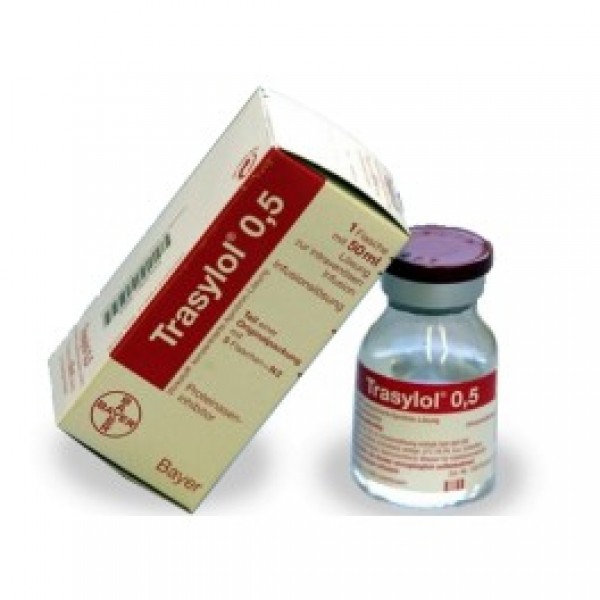
TRASYLOL 500.E. 50 ml.
Product Code: TRASYLOL 500.E. 50 ml.
Availability: In Stock
Product viewed: 1368


TRASYLOL 500.E. 50 ml.

WHAT TRASYLOL 500 000 AND WHAT IT IS USED FOR ?
Trasylol 500 000 is a proteinase inhibitor , comprising highly purified natural polypeptides derived from bovine lung .
Trasylol 500 000 is used to prevent a reduction in blood loss and blood transfusions in patients undergoing surgery for coronary artery bypass apparatus heart - lung machines which have an increased risk of blood loss or transfusions .
2 . BEFORE YOU USE TRASYLOL 500 000
Trasylol 500 000 should be used :
In patients who are allergic to the active substance ;
In the event but a positive test for aprotinin - specific IgG antibodies;
In the event of suspected prior use of aprotinin in the last 12 months if it is not possible to test for aprotinin - specific IgG antibodies
There is insufficient experience to assess the efficacy and safety of aprotinin in children.
Special measures for the application of Trasylol 500 000 .
Trasylol 500 000 should be used during pregnancy only if justified , after careful evaluation of the benefit / risk (see section " Pregnancy and lactation " ) .
Possible hypersensitivity reactions following administration of Trasylol 500 000 and in some cases may be severe or life threatening. If used repeatedly (especially within 6 months) , these reactions may be common ( see also section 4 'POSSIBLE SIDE EFFECTS') .
Because of the risk of allergic reactions require a careful assessment of the risk / benefit of the treatment , before each administration of Trasylol 500 000 , especially in patients who are known to have received the active substance aprotinin (including fibrin glue containing aprotinin ) before , or where the previous administration of aprotinin can not be excluded with certainty, or who have an allergic diathesis, or a history of known drug hypersensitivity .
There must always be equipment available for emergency treatment of allergic / anaphylactic reactions during treatment with aprotinin .
All patients treated with Trasylol must first obtain a test dose to determine their potential for allergic reactions ( see section 4.2 " Posology and method of administration " ) . Patients should be intubated prior to administration of the test dose aprotinin and must be able to quickly cannulation . Test dose should be administered in the operating room.
You should always be prepared for emergency treatment of hypersensitivity reactions .
In spite of these measures to the infusion of Trasylol 500 000 may be developed hypersensitivity . In these cases , the use of Trasylol should be terminated immediately and if necessary to start normally applied allergy treatment (see section 4 'POSSIBLE SIDE EFFECTS') .
The results of these observational studies during the clinical application showed that aprotinin may cause renal impairment , especially in patients with compromised renal function. An analysis of all placebo - controlled trials in patients after surgery for coronary artery bypass graft has shown that treatment with aprotinin has elevations in serum creatinine levels of > 500 000 mg / dl compared to the initial value (see also 5.1) . It is therefore required careful evaluation of the risk / benefit before aprotinin administered to patients whose renal function is already disabled and in patients with risk factors (eg , concomitant therapy with aminoglycoside s) .
Appendix surgery in deep decrease ( hypothermia ) body temperature and circulatory arrest : Increasing incidence of renal failure and mortality compared with age- comparable and tracked over time cases has been reported in patients treated with Trasylol in connection with the reconstruction of the aortic arch in deep hypothermia with circulatory arrest. Therefore, aprotinin should be used with extreme caution and maintain adequate anticoagulation with heparin coating .
Need for adequate suppression of coagulation in cardiac-bypass surgery :
500 000 Trasylol increased the risk of blockage trasplantata in patients undergoing cardiac bypass surgery , especially when patients do not receive adequate anticoagulation coverage.
Adequate heparinisation , a Trasylol 500 000 should be used only if it can ensure the necessary monitoring. The results of the employed methods for this purpose have to be interpreted with caution, especially in case of in vitro monitoring of the method with an activated clotting time (ACT) of whole blood. The determination of the ACT is not standardized , and different coagulation test systems for the evaluation may be differently influenced by Trasylol 500 000 ( and other various factors such as the effects of dilution and temperature ) . In Celite -activated systems , Trasylol 500 000 caused a significant variable in the individual extension of the ACT, but this occurs to a much lesser extent in the use of kaolin - activated system .
Therefore, it is recommended that patients be treated with Trasylol 500 000 to obtain a standard loading dose of heparin before being connected to the machine heart-lung . The initial dose of heparin , including the amount of heparin added to the initial volume of the apparatus heart-lung , to be not less than 350 W / kg. An additional quantity of heparin administered or as a fixed dose scheme ( based on the weight of the patient and the duration of the connection with the apparatus heart-lung ) , or the dose may be based on ACT, using a kaolin - activated system .
It is recommended to maintain ACT > 480 sec during the connection with the apparatus heart-lung , if Trasylol 500 000 was co-administered with the kaolin - activated system , and of > 750 sec at celite - ektivirana system .
Alternatively, the levels of heparin , and the required quantity of heparin can be determined also by using the protamine titration method , which is not affected by aprotinin . Loading dose of heparin is determined before administration of aprotinin , as you first need to test the effect of dose heparin with protamine titration method. The additional amount of heparin to be administered on the basis of the levels of heparin , measured with protamine titration method . During extracorporeal circulation, heparin levels must not fall below 2,7 lU / ml (2,0 mg / kg) or below the level specified in advance when testing the effect of dose.
In patients treated with Trasylol, used to neutralize heparin , at the end of the ECC dose protamine must be based either on a fixed ratio to the dose of heparin or protamine is controlled by a titration method .
important:
Trasylol is not a product, store heparin. Keeping transplant :
Vein grafts explanted should not be stored in the blood -containing solutions, taken by a catheter through which it was infused Trasylol 500 000 , as this may increase the risk of clogging of the transplant .
If Trasylol 500 000 is used with other medicaments :
The effects of thrombolytic agents such as streptokinase, urokinase, alteplase and inhibited by Trasylol in a dose dependent manner .
Trasylol may affect the measurement of the activated clotting time (ACT ) in blood . Especially with Celite -activated systems , Trasylol causes considerable interindividual variation in the extension of the ACT. This should be borne in mind if the determination of ACT is
used to monitor anticoagulation during extracorporeal circulation in heparinisation (see also "Take special care when applying Trasylol 500 000 " ) .
Pregnancy and lactation :
No evidence of adequate and controlled studies in pregnant women. In animal studies there was no evidence of harmful fetal effects. When assessing the risk / benefit should be borne in mind that Trasylol 500 000 can cause severe adverse reactions such as anaphylaxis or cardiac arrest requiring medical intervention and can lead to harm to the fetus .
It is not known whether Trasylol 500 000 is secreted in human milk. Since the active substance does not penetrate into the bloodstream following oral administration , however , any amount of active substance in breast milk would not have an effect on the infant.
Driving and using machines:
Not applicable .
3 . HOW TO USE TRASYLOL 500 000 ?
dose:
Due to the risk of allergic / anaphylactic reactions , all patients do test with 1 ml ( 10 000 CS ) Trasylol 500 000 before each treatment with Trasylol 500 000 , with a subsequent observation period of 10 minutes ( for more information , see . " Special measures in the implementation of Trasylol 500 000 " ) .
Suggested dosage
In operation for a heart bypass machine heart-lung :
A loading dose of 2 million KIU as infusion for 20-30 minutes at the beginning of the operation, followed by a continuous infusion of 250000-500000 KIU / hr until the end of the operation. Another 2 million KIU should be placed in the pump apparatus heart-lung ( ASB ) . Due to the risk of physical incompatibility between heparin and Trasylol 500 000 , these substances should be added in a way ensuring adequate dilution of the initial solution in the pump.
Overall, the total dose for a single treatment should not exceed 7 million KIU .
Method of administration :
The vials should be opened immediately before use and any residue discarded.
Trasylol 500 000 should be administered intravenously through a central venous line that does not have to be used for the administration of other drugs .
Trasylol 500 000 should always be assumed to be physically incompatible with other medicinal products. Avoid prilagozhenieto mixed infusions. Trasylol 500 000 is compatible , however , with the following solutions : 20% glucose, lactated Ringer's , hydroxethyl starch .
Trasylol 500 000 should always be applied to patients in the supine position and a slow ( up to 5-10 ml / min) intravenous injection or infusion.
Duration of treatment :
As a rule , aprotinin is not to be used for longer than 6 hours at onepatsiya to cardiac bypass apparatus using a heart -lung .
Patients with renal impairment:
Clinical experience so far indicates the need for dose adjustment in patients with impaired renal function.
Experience in patients with severe renal insufficiency is limited. Therefore aprotinin should only be applied very carefully . Cf. also "Take special care when applying Trasylol 500 000 ."
If you use more than the amount of Trasylol 500 000 : There is no known symptoms of overdose or poisoning. There is no antidote .
4 . POSSIBLE SIDE EFFECTS
Like all medicines , Trasylol 500 000 can cause side effects, although not everybody gets them .
* See . " Special measures for implementation of Trasylol 500 000 "
Additional information about hypersensitivity reactions :
Trasylol 500 000 - specific antibodies were detected in approximately 50 % of patients after the administration of Trasylol 500 000 for the first time. Hypersensitivity reactions , however , are rare in patients who have not had previous exposure to Trasylol. Upon repeated administration frequency can reach up to 5% (5.0 % to 6 months and 0.9 % for more than 6 months after the initial application) . The incidence of serious hypersensitivity reactions is even higher in patients who have undergone treatment with Trasylol more than twice , for a period of 6 months.
Even when the second application of aprotinin drifted without symptoms , subsequent treatment with Trasylol 500 000 can cause severe allergic reactions and anaphylactic shock in rare cases fatal .
The symptoms which can occur in hypersensitivity affects :
• Respiratory system : asthma and shortness of breath ( dyspnea)
• Cardiovascular : blood pressure reduction
• Skin : rash, nettle rash and itching
• gastrointestinal system : nausea
If you develop a hypersensitivity reaction , the use of Trasylol should be stopped immediately, and immediately start emergency treatment such as adrenaline / ephedrine , volume - replacement therapy and corticosteroids, if at the discretion of the state to establish that it is necessary. There is no specific antidote . Regarding precautions , see . " Special measures for implementation of Trasylol 500 000 "
Additional information about cardiovascular side effects:
In the overall analysis of placebo-controlled clinical trials with patients undergoing cardiac bypass surgery , there is the following frequency of myocardial infarction : 5.8 % in patients treated with Trasylol compared with 4.8% in patients treated with placebo , the difference between groups was 0.98 %. In some studies have tended to higher incidence of myocardial infarction following administration of Trasylol in comparison with placebo , while in others the observed rate compared with placebo is lower . In many centers conducted a study in patients undergoing primary cardiac-bypass surgery , there is an increased risk of clogging transplant patients treated with Trasylol compared to patients treated with placebo. This result is significantly influenced negatively in two centers . At one center heparinized was inadequate, while the other center is not used a standard technique for preserving transplant . The use of catheters for blood infusion of Trasylol for preservation of the transplant does not recommended (in terms of preservation and heparinisation trensplantata , cf . Also " Special measures for application of Trasylol 500 000 " ) . There were no differences between the groups in this study with respect to the incidence of myocardial infarction or death.
If you notice other effects not listed in this leaflet , please tell your doctor or pharmacist.
5 . STORAGE TRASYLOL 500 000
Do not use after the expiry date stated on the carton and container. The expiry date refers to the last day of that month.
Storage Conditions :
Do not store above 25 ° C.
Do not apply vials containing cloudy or discolored .
Keep out of the reach of children.
6 . FURTHER INFORMATION
What does Trasylol 500 000 :
The active ingredient is a concentrated solution of aprotinin .
One vial of 50 ml Trasylol 500 000 contain concentrated aprotinin solution , equivalent to 500 000 KIU ( kallikrein inhibitory units) ( approximately 277,78 Ph. Eur. Units). Each milliliter contains 10,000 KIU .
The other ingredients are sodium chloride and water for injection. Looks like Trasylol 500,000 and contents of container :
Trasylol 500 000 is a clear, colorless, sterile and isotonic infusion pH 4.5-6.5 .
Write a review
Your Name:Your Review: Note: HTML is not translated!
Rating: Bad Good
Enter the code in the box below:
Related Products