Your shopping cart is empty!
Welcome visitor you can login or create an account.
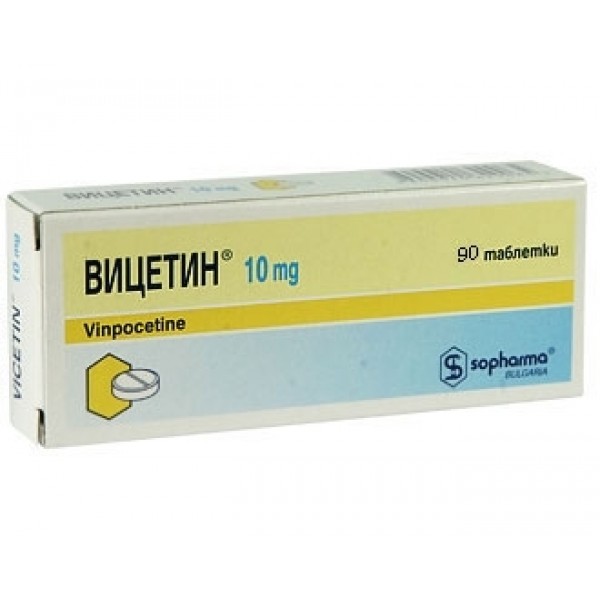
Vicetin 10 mg. 90 tablets
Product Code: Vicetin 10 mg. 90 tablets
Availability: In Stock
Product viewed: 1827


WHAT VICETIN IS AND WHAT IT IS USED FOR
VICETINE has a brain-protective effect. Improves metabolic processes, significantly increasing the resistance of brain cells to oxygen deficiency. It improves brain circulation and oxygen transport to the tissues by reducing the disease's increased blood viscosity and peripheral vascular resistance. It does not have a significant influence on blood pressure. Removes vertigo, stimulates brain activity, improves hearing, vision, and memory.
It is used to treat various forms of cerebral infarction (post-stroke), vascular dementia (memory disorders), cerebral atherosclerosis, brain disorders after trauma and high blood pressure. It is used to reduce the mental and neurological symptoms of cerebral circulation disorders, vascular disorders of the vascular occlusion, retina and choroidia; dizziness, hearing loss of different origin, tinnitus; to influence the vascular-prognostic symptoms of climacteric syndrome.
2. BEFORE YOU USE VICETINE
Do not use Vecetin
if you are allergic (hypersensitive) to the active substance, to the alkaloids of Vinca minor (vinblastine, vincristine) or any of the excipients;
if you are pregnant or breast-feeding;
use in children is contraindicated.
Take special care with Vitamin
ECG control is required if you have heart disease with abnormalities in the electrocardiogram and also with ECG treatment.
Taking other medicines
Please tell your doctor or pharmacist if you are taking or have recently taken any other medicines, including medicines obtained without a prescription.
You should tell your doctor if you are taking a medicine containing alpha-methyldopa (a medicine to lower high blood pressure), central nervous system medicines, anticoagulants (medicines to prevent the formation of blood clots) or antiarrhythmics (medicines used for disorders of heart rhythm).
To date, there are no known clinically significant interactions of Vecetin with other drugs.
Pregnancy and breastfeeding
Ask your doctor or pharmacist for advice before taking any medicine. Treatment with Vacetin during pregnancy and lactation is contraindicated.
Driving and using machines
Vecetine has no influence on the ability to drive or use machines.
Vicenza has no adverse effect on active attention and reactions.
Important information about some of the ingredients of Vecetin
Viecatin tablets 5 and 10 mg contain lactose. If you have been told by your doctor that you have an intolerance to some sugars, consult with your doctor before taking this product.
VICETINE tablets 5 and 10 mg contain as a excipient wheat starch. Vecetin is suitable for people with celiac disease (gluten enteropathy). Patients with wheat allergy (other than celiac disease) should not take this product.
3. HOW TO USE VICETINE
Always use Vecetin exactly as your doctor has told you. If you are not sure, ask your doctor or pharmacist.
The usual daily dose is 5-10 mg 3 times a day. The tablets are taken after a meal with enough water. The maximum daily dose is 30 mg. The maintenance dose is 10-15 mg daily. The treatment is continuous (months, years) and is determined by the treating physician.
Patients with renal and hepatic diseases
No dose adjustment is necessary in patients with kidney and liver disease.
If you take more than the necessary dose of Vecetin
If you have taken a dose greater than prescribed, talk to your doctor.
There are no cases of overdose with Vecetin.
If you forget to take VICETINE
If you miss a dose, take it as soon as possible. If it is almost time for the next dose, take it as usual by skipping the dose you have forgotten. Do not take a double dose to make up for the missed dose. Continue to take the medicine as prescribed by your doctor.
If you stop taking VICETINE
Do not stop taking Vecetin without consulting your doctor.
If you have any further questions on the use of this product, ask your doctor or pharmacist.
4. POSSIBLE SIDE EFFECTS
Like all medicines, vitamin may cause side effects, although not everybody gets them.
Side effects with Vecetin are very rare, transient, and do not require discontinuation.
Gastrointestinal disorders
Uncommon: stomach discomfort, dry mouth, nausea; rare: abdominal pain, constipation, diarrhea, dyspepsia, vomiting; very rare: dysphagia, stomatitis.
Cardiac disorders
Rare: myocardial ischaemia / heart attack (heart attack), angina (chest pain), accelerating or slowing of heart rhythm, palpitations;
very rare: arrhythmia, atrial flutter.
Vascular disorders
Uncommon: lowering of blood pressure;
rare: increase of
Nervous system disorders
Uncommon: headache;
rare: dizziness, taste disturbance, numbness, partial unilateral paresis, drowsiness, memory changes;
very rare: trembling, convulsions.
Eye disorders
Rare: swelling of the palate;
very rare: reddening of the conjunctiva.
Ear and labyrinth disorders
Uncommon: vertigo;
rare: increased or decreased hearing acuity, vertigo, tinnitus.
Skin and subcutaneous tissue disorders
Rare: redness, increased sweating, pruritus, urticaria (hives);
very rare: rash.
General disorders and administration site conditions
Rare: frustration, fatigue, feeling of heat;
very rare: chest discomfort, decreased body temperature.
Research
Uncommon: lowering of blood pressure; rare: increase in blood pressure, changes in electrocardiogram (ST segment depression), changes in liver enzymes (increase in blood triglycerides) decrease / increase in eosinophils; very rare: decrease / increase in white blood cell count, decrease in red blood cell count, decrease in prothrombin time, weight gain.
If any of the side effects gets serious, or if you notice any side effects not listed in this leaflet, please tell your doctor or pharmacist.
5. HOW TO STORE VICETIN
Store in the original package in order to protect from light and moisture. Store below 25 ° C.
Keep out of the reach and sight of children.
Do not use VICETIN after the expiry date which is stated on the blister and the carton. The expiry date refers to the last day of that month.
Medicines should not be disposed of via wastewater or household waste. Ask your pharmacist how to dispose of your unnecessary medicines. These measures will help to protect the environment.
6. ADDITIONAL INFORMATION
What VICETIN tablets contain
The active substance is vinpocetin 5 or 10 mg in one tablet.
The other ingredients are: lactose monohydrate, wheat starch; colloidal anhydrous silica; magnesium stearate, talc, gelatin.
What Vecetin looks like and contents of the pack
5 mg tablets: white to light yellow, round, flat, faces and scored on one side, 9 mm in diameter, odorless.
10 tablets in a blister of solid, clear, colorless PVC / aluminum foil, 5 blisters in a cardboard box, together with a leaflet.
10 mg tablets: white to light yellow, round, flat, faces and scored on one side, 10 mm in diameter, odorless. The tablet can be divided into 2 equal halves.
10 tablets in a blister of solid, clear, colorless PVC / aluminum foil, 3 or 9 blisters in a cardboard box, together with a leaflet.
Write a review
Your Name:Your Review: Note: HTML is not translated!
Rating: Bad Good
Enter the code in the box below:
Related Products