Your shopping cart is empty!
Welcome visitor you can login or create an account.
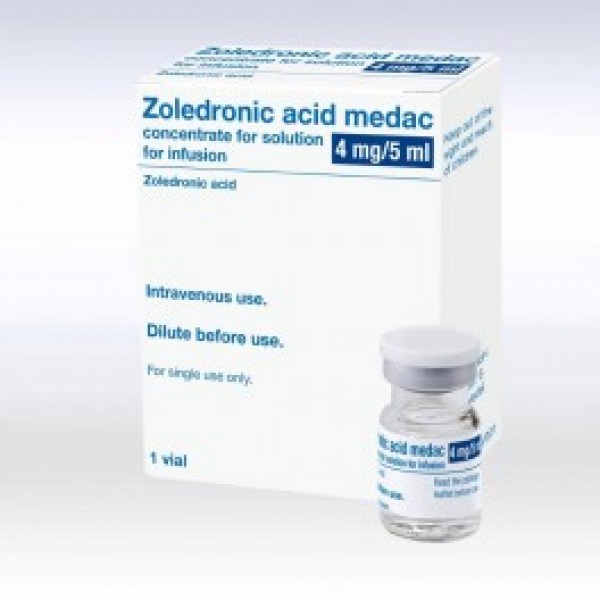
ZOLEDRONIC acid 4 mg. / 5 ml.
Product Code: ZOLEDRONIC acid 4 mg. / 5 ml.
Availability: In Stock
Product viewed: 1389


ZOLEDRONIC acid 4 mg. / 5 ml.
What Zoledronic acid Sandoz and what it is used
Zoledronic acid Sandoz contains the active substance zoledronic acid, which belongs to a group of substances called bisphosphonates. Zoledronic acid acts as an attach on bone and slows the rate of bone change. Used for:
Prevention of bone complications, e. fractures in adult patients with bone metastases (cancer metastasis to the bone);
Decrease the amount of calcium in the blood in adult patients when the calcium level is too high because of the presence of a tumor. Tumours can accelerate normal bone change and lead to increased excretion of calcium from the bones. This condition is called tumor-induced hypercalcaemia (TIH).
2. What you need to know before you are given Zoledronic acid Sandoz
Carefully follow your doctor's advice.
Your doctor will do blood tests before starting treatment with zoledronic acid Sandoz and will monitor how you respond to treatment at regular intervals.
You should not be administered zoledronic acid Sandoz
if you are allergic to zoledronic acid, another bisphosphonate (the substances that Zoledronic acid belongs Sandoz) or any of the other ingredients of this medicine (listed in section 6);
if you are breastfeeding.
Warnings and Precautions
Talk to your doctor before you are given Zoledronic acid Sandoz:
if you have or have had kidney problems;
if you have or have had pain, swelling or numbness of the jaw, a feeling of heaviness in the jaw or shake your teeth;
if you are dental treatment or having dental surgery, tell your dentist that you are being treated with zoledronic acid Sandoz.
Patients aged over 65 years
Zoledronic acid Sandoz can be given to patients aged over 65 years. There are no data on the need for additional precautions.
Children and adolescents
Zoledronic acid Sandoz is not recommended in children and adolescents under 18 years.
Other medicines and Zoledronic acid Sandoz
Tell your doctor if you are taking, have recently taken or take any other medicines. It is extremely important that you inform your doctor if you use:
Aminoglycosides (medicines used to treat severe infections), as their combination with bisphosphonates can reduce many levels of calcium in the blood;
Thalidomide (a medicine used to treat a type of blood cancer that affects the bones) or other medicines that can damage your kidneys;
Other medicinal products containing zoledronic acid are used to treat osteoporosis and other non-cancerous diseases of the bones, or other bisphosphonates, as the action of these drugs in combination with Zoledronic acid Sandoz are not known;
Angiogenic drugs (used to treat cancer), as their combination with zoledronic acid may increase the risk of bone damage in the jaw (osteonecrosis).
Pregnancy and lactation
You should not apply Zoledronic acid Sandoz if you are pregnant. Tell your doctor if you are pregnant, think you may be pregnant or planning a pregnancy.
You should not apply Zoledronic acid Sandoz if you are breastfeeding.
If you are pregnant or breast-feeding, talk to your doctor before taking any medicine.
Driving and using machines
In very rare cases, the use of zoledronic acid, a dizziness and drowsiness. Caution when driving, operating machinery, or other activities that require attention.
Zoledronic acid Sandoz contains sodium
This product contains sodium, less than 1 mmol (23 mg) per dose, ie practically does not contain sodium.
3. How to use Zoledronic acid Sandoz
Zoledronic acid Sandoz should be administered only by medical professionals who have experience in the application of bisphosphonates intravenously, ie vein.
Your doctor will recommend that you drink enough water before each application to avoid dehydration.
Carefully follow the advice of your doctor, nurse or pharmacist.
How much is given Zoledronic acid Sandoz
Typically the unit dose that is administered is 4 mg zoledronic acid.
If you have kidney problems, your doctor will give you a lower dose depending on the severity of the problem.
How often applied Zoledronic acid Sandoz
If ongoing therapy for prevention of bone complications due to bone metastases, will be infused with zoledronic acid Sandoz every 3 or 4 weeks.
If you are taking therapy to reduce levels of calcium in the blood, usually made only one infusion of zoledronic acid Sandoz.
How to apply Zoledronic acid Sandoz
Sandoz zoledronic acid administered as drip (infusion) into a vein, which will last at least 15 minutes and must be administered as a single intravenous solution in a separate infusion line.
Patients with very low levels of calcium will be prescribed supplemental calcium and vitamin D, which must be taken every day.
If you are given more than the amount of Zoledronic acid Sandoz
If you are given more than the recommended dose should be carefully monitored by your doctor. This is because you may develop serum electrolyte abnormalities (eg. Abnormal levels of calcium, phosphorus and magnesium) and / or a change in your kidney function, including severe renal impairment. If calcium levels are too low, you should be made an additional infusion of calcium.
4. Possible side effects
Like all medicines, this medicine can cause side effects, although not everybody gets them. The most common such effects are usually mild and will probably disappear after a short time.
If any of the following serious side effects, contact your doctor:
Common (may affect 1 to 10 users in 100):
Severe renal impairment (normally determined by the physician in conducting certain blood tests);
Low levels of calcium in the blood.
Uncommon (may affect less than 1 in 100 users):
Pain in the mouth, teeth and / or jaw, swelling or sores in the mouth, numbness or a feeling of heaviness in the jaw, or loosening of a tooth. These may be signs of bone damage in the jaw (osteonecrosis). Tell your doctor immediately and dentist if you experience such symptoms;
Irregular heart rhythm (atrial fibrillation) occurred in patients using zoledronic acid for treatment of postmenopausal osteoporosis. It is not yet clear whether the irregular heartbeat caused by zoledronic acid, but you should tell your doctor if you have such a feeling after administration of zoledronic acid;
Severe allergic reaction: shortness of breath, swelling mainly in the throat.
If any of the following side effects, contact your doctor as soon as possible:
Very common (may affect more than 1 user in 10):
Low levels of phosphate in the blood.
Common (may affect 1 to 10 users in 100):
Headache and flu-like symptoms such as fever, fatigue, general weakness, drowsiness, chills and bone, joint and / or muscle pain. In most cases it is not necessary to treat these symptoms, they may disappear after a short period of time (hours or days);
Gastrointestinal disturbances such as nausea, vomiting and loss of appetite;
conjunctivitis;
Low levels of red blood cells (anemia).
Uncommon (may affect less than 1 in 100 users):
Hypersensitivity reactions;
Low blood pressure, fainting due to low blood pressure;
weakness;
Chest pain;
Skin reactions (redness or swelling) at the injection site, rash, itching;
High blood pressure, shortness of breath, dizziness, sleep disturbances, tingling or numbness in hands or feet, trembling;
Increased sweating;
Low white blood cells and platelets;
Low levels of magnesium and potassium in the blood. Your doctor will make the necessary investigations and take appropriate action;
drowsiness;
Blurred vision, eye irritation or eye sockets;
Suddenly feeling cold accompanied by seizures, exhaustion or collapse;
anxiety;
Swelling of the hands, ankles, or feet;
Difficulty breathing with wheezing or coughing;
Itchy rash (urticaria);
Dysgeusia;
Constipation, diarrhea, indigestion, abdominal pain, inflammation of the stomach;
Dry mouth;
Blood in urine;
Increased or decreased sensitivity to touch or feeling;
Muscle cramps;
Weight gain.
Rare (may affect less than 1 in 1,000 people):
Slow heartbeat;
confusion;
High levels of potassium or sodium in the blood;
Weakness, bruising and frequent infections due to lack of blood cells;
May occur rarely unusual fractures of the thigh bone particularly in patients on long-term treatment for osteoporosis. Contact your doctor if you experience pain, weakness or discomfort in the hip, pelvis or groin as this may be an early indication of a possible fracture of the femur.
Very rare (may affect less than 1 in 10,000 users):
Severe pain in bones, joints and / or muscles, in some cases leading to incapacity;
Painful redness and / or swelling of the eye.
If you get any side effects, tell your doctor, nurse or pharmacist. This includes any not listed in this leaflet.
5. How to store Zoledronic acid Sandoz
Keep out of the reach and sight of children.
Your doctor, nurse or pharmacist knows how to store properly Zoledronic acid Sandoz.
Do not use this medicine after the expiry date stated on the carton and vial. The expiry date refers to the last day of that month.
This medicinal product does not require any special storage conditions.
The product should be used immediately after first opening. Discard unused portion. Do not use this medicine if you notice any signs of deterioration, such as particulate matter and discoloration.
Do not dispose of medications in wastewater or household waste. Ask your pharmacist how to dispose of medicines no longer required. These measures will help to protect the environment.
6. Contents of the pack and further information
What Zoledronic acid Sandoz
The active substance is zoledronic acid. One vial of 5 ml concentrate for solution for infusion contains 4 mg zoledronic acid, corresponding to 4,264 mg of zoledronic acid monohydrate. 1 ml concentrate for solution for infusion contains 0,8 mg zoledronic acid.
The other ingredients are mannitol (E421), sodium citrate (EZZ1), water for injections.
Looks Zoledronic acid Sandoz and contents of the pack
Zoledronic acid Sandoz concentrate is supplied as a clear, colorless solution in a vial. One vial contains 4 mg zoledronic acid.
Each package contains a vial of concentrate.
Zoledronic acid Sandoz is supplied in packs containing 1, 4 or 10 vials.
Not all pack sizes may be marketed.
The following information is intended for healthcare professionals only:
How to prepare and administer Zoledronic acid Sandoz
To prepare an infusion solution containing 4 mg zoledronic acid, further dilute Zoledronic acid Sandoz concentrate (5.0 ml) with 100 ml solution for infusion contains calcium. If necessary, the preparation of a lower dose, the volume of the first pull, which is shown below, and further dilute it with 100 ml of infusion solution. To avoid potential incompatibilities, the infusion solution to be used for dilution must be 0.9% w / w sodium chloride solution or 5% w / w glucose solution.
Do not mix Zoledronic acid Sandoz with calcium or other infusion solution containing a divalent cation, such as lactated Ringer's solution.
Note for the preparation of lower doses Zoledronic acid Sandoz, the appropriate volume of the concentrate as follows:
4,4 ml of a dose of 3,5 mg;
4,1 ml of a dose of 3,3 mg;
3,8 ml of a dose of 3,0 mg.
Disposable. Any unused portion should be discarded. Do not use this medicine if you notice any signs of deterioration, such as particulate matter and discoloration. During the preparation of the solution should be used aseptic techniques.
Zoledronic acid 4 mg Sandoz concentrate for solution for infusion, further diluted in 100 ml, should be administered as a single intravenous infusion over a period of at least 15 minutes, in separate infusion system. Before the administration of zoledronic acid Sandoz patients should be adequately hydrated.
Studies in several types of infusion sets of polyvinyl chloride, polyethylene and polypropylene showed no incompatibility with Zoledronic acid Sandoz.
In the absence of compatibility studies of zoledronic acid Sandoz other products administered intravenous zoledronic acid Sandoz should not be mixed with other medications / substances and should be applied in a separate infusion line.
How to store Zoledronic acid Sandoz
Zoledronic acid Sandoz Keep out of reach of children.
Do not use Zoledronic acid Sandoz after the expiry date stated on the carton.
Unopened vial does not require any special storage conditions.
Diluted infusion Zoledronic acid Sandoz should be used immediately to avoid microbiological contamination.
Write a review
Your Name:Your Review: Note: HTML is not translated!
Rating: Bad Good
Enter the code in the box below:
Related Products
Sildenafil Sandoz table. 100 mg What is Sildenafil Sandoz an..
39.00€
Nebivolol table. 5 mg. 30 tablets Nebivolol Sandoz WHAT IS A..
15.00€