Your shopping cart is empty!
Welcome visitor you can login or create an account.
Amitriptyline Valeant 25 mg. 60 tablets
Product Code: Amitriptyline Valeant 25 mg. 60 tablets
Availability: In Stock

Product viewed: 934


Amitriptyline Valeant 25 mg. 60 tablets
WHAT amitriptyline VALEANT AND WHAT IT IS USED
VALEANT Amitriptyline is an antidepressant. The exact mechanism of action is unknown, but it is assumed that he influenced the formation of certain substances in the brain (primarily norepinephrine and serotonin) and strengthens the implementation of certain nerve impulses. Moreover antidepressant effect, it has a soothing effect.
2. BEFORE YOU TAKE amitriptyline VALEANT
Do not take amitriptyline VALEANT
• if you are allergic (hypersensitive) to amitriptyline or any of the other ingredients of amitriptyline VALEANT;
• if you are allergic (hypersensitive) to benzodiazepines;
• If you have had acute myocardial infarction, disorders of the atrioventricular conduction, heart rhythm disorders, angina pectoris;
• If you have a manic agitation, severe hepatic insufficiency and porphyria (increased formation and release of substances called porphyrins with various neurological and skin manifestations);
• concomitantly with MAO inhibitors (a group of medicines that inhibit the enzyme monoamine oxidase) and the first two weeks after stopping treatment with these medicinal products;
• pregnancy, during lactation, and in children and adolescents under 16 years.
Take special care with amitriptyline VALEANT
• If you have bipolar affective disorder (use of amitriptyline can lead to exacerbation of manic phase);
• If you have schizophrenia (can occur exacerbation of symptoms of the disease as a result of the use of amitriptyline);
• If you have an enlarged prostate gland (difficulties in urination may increase);
• If you have narrow-angle glaucoma (intraocular pressure can be increased);
• If you have delayed gastric - intestinal patency;
• If you have epilepsy (during treatment may occur exacerbation of disease symptoms, the use of this product in this group of patients may require escalating doses of antiepileptic drugs);
• If you have liver failure (increased risk of accumulation of amitriptyline and symptoms of overdose);
• If you have hyperthyroidism (underactive thyroid gland), and patients treated with thyroid hormones (such patients effects of amitriptyline are strengthened and accordingly may need to adjust the dose).
In patients who undergo surgery, amitriptyline VALEANT should be stopped several days before surgery. If you need surgery to be made immediately, the anesthetist should be informed that the patient is treated with amitriptyline. Not recommended use of electroshock therapy in patients treated with amitriptyline because of the risk of an increase in complaints related to treatment.
Taking other medicines
Amitriptyline VALEANT should not be administered concurrently with medicinal products from the group of MAO inhibitors as well as during the first two weeks after the interruption thereof (there is a risk of the occurrence of high blood pressure, hyperthermia and convulsions) and with sympathomimetic agents such as epinephrine, norepinephrine, isoprenaline, ephedrine, phenylephrine, and phenylpropanolamine.
To a group of medicines that can interact with amitriptyline VALEANT belong to the following medicinal products:
• cholinolytics and thyroid hormones (thyroid hormones);
• suppressors of the central nervous system, barbiturates, benzodiazepines, phenothiazine derivatives, narcotic analgesics, non-narcotic analgesics, antihistamines, and alcohol;
• sympatholytic agents such as clonidine and guanitidin;
• disulfiram;
• medicines that slow the metabolism of amitriptyline, such as quinidine, cimetidine, certain antidepressants, phenothiazine derivatives, inhibitors of serotonin reuptake, type 1C antiarrhythmics (among them flecanide and propafenone);
• analgesics.
Please tell your doctor or pharmacist if you are taking or have recently taken any other medicines, including medicines obtained without a prescription.
Taking Amitriptyline VALEANT with food and drink
The medicine may be taken regardless of meals.
Pregnancy and lactation
Ask your doctor or pharmacist before taking any medicine.
Used during pregnancy only when, at the discretion of the physician, the potential benefit outweighs the potential risk to the fetus.
The medicinal product should not be used during breastfeeding.
Driving and using machines
Not shocking as the medicinal product may cause impaired concentration and drowsiness. Do not use any tools or machines as the medicinal product may cause impaired concentration and drowsiness.
Important information about some of the ingredients of amitriptyline VALEANT
This medicinal product contains lactose and sucrose.
If you suffer from an intolerance to some sugars, consult your doctor before taking amitriptyline VALEANT.
3. HOW TO TAKE amitriptyline VALEANT
Always take Amitriptyline VALEANT just as you have been told by your doctor. If you're not sure, ask your doctor or pharmacist.
• Adults and children over 16 years:
Treatment is usually started with a dose of 50 mg to 100 mg daily as a single dose assigned bedtime or in divided doses.
Thereafter, the dosage is gradually increased to achieve efficiency. The highest dose used in the outpatient treatment is 200 mg daily. After achieving clinical improvement, the amount of the product should be gradually reduced to the lowest effective dose (typically 50 mg to 100 mg daily).
The medicinal product shall be administered in divided doses (2-4 times daily) or as a single dose in the evening due to the calming and hypnotic effect (50 mg to 100 mg at bedtime).
• Patients over 65 years
Treatment should be initiated at a dose of 25 mg to 75 mg daily. Since the likelihood of adverse events was higher doses of the drug should be increased carefully supervised. In this group of patients the therapeutic effect can be achieved with doses lower half of those used in young patients.
• Children and adolescents under 16 years
The medicinal product must not be used.
To reduce the possibility of resumption of the disease, the recommended duration of treatment is 3 to 6 months.
If you take more dose amitriptyline VALEANT
When the medicinal product is overdoses, toxic symptoms develop quickly, usually within a few hours.
During overdose can appear life-threatening symptoms such as heart and respiratory dysfunction, and loss of consciousness, transient visual hallucinations, impaired concentration, disorientation, heart failure, decreased body temperature, pupil dilatation, abnormal ocular motility, drop in blood pressure, acute idiopathic polyneuritis (paralysis of respiratory neurons), intestinal dysfunction, coma and convulsions. A man who had overdosed product should seek medical attention to be held, if necessary, appropriate treatment (including entry into a hospital, vomiting, administration of activated charcoal treatment of the symptoms of overdose).
If you forget to take amitriptyline VALEANT
Do not take a double dose to make up for a forgotten tablet. If a dose is missed, it should be adopted as soon as possible. However, if the time for your next dose, the missed dose should be skipped.
If you stop taking amitriptyline VALEANT
Abrupt discontinuation of treatment, especially after a long period of acceptance of the product may cause the occurrence of various side effects. To avoid this, it is recommended the product be discontinued gradually.
If you have any further questions on the use of this product, ask your doctor or pharmacist.
4. POSSIBLE SIDE EFFECTS
Like all drugs, amitriptyline VALEANT can cause side effects, although not everybody gets them.
Adverse reactions associated with anticholinergic properties:
Reduced salivary secretion and related dry mouth and susceptibility to caries, increased sweating, accommodation disorders, fundus, increased intraocular pressure, difficulty urinating (especially in men), constipation, paralytic ileus (obstruction of the bowel due to inhibition of intestinal peristalsis). Due to age-related deterioration of the parasympathetic system, the likelihood of the above reactions is higher in patients of advanced age.
Adverse effects on blood circulation:
Increase or decrease in blood pressure, orthostatic hypotension, tachycardia, palpitations, myocardial infarction, heart rhythm disturbances, violations of predsardnokamernata conductivity ischemic stroke.
Adverse effects on the central and peripheral nervous system:
Confusion, impaired concentration, disorientation, hallucinations, hypomania, insomnia, psychomotor agitation, anxiety disorders, drowsiness, nightmares, feelings of numbness of the extremities, chills and presteziya in the limbs, peripheral neuropathy, ataxia, tremor, generalized seizures coma, EEG deterioration, involuntary movements and extrapyramidal syndrome expressed in involuntary movements, dyskinesias, tinnitus, dizziness, fatigue, weakness, headache, visual disturbances.
Affecting the blood system:
Bone marrow insufficiency with concomitant agranulocytosis, leukopenia, eosinophilia, thrombocytopenia-ing and bleeding diathesis.
Gastro - intestinal tract:
Nausea, vomiting, abdominal pain, inflammation of the mouth, black tongue, unpleasant taste (metallic taste), soft stools, swelling of the salivary glands, hepatitis, cholestatic jaundice.
Endocrine disorders:
Swelling of the testicles, gynecomastia, menstrual disorders, breast enlargement and galactorrhea (copious and spontaneous leakage of milk from the mammary glands) in women, increased or decreased libido, impotence, increased or decreased blood sugar levels, abnormal secretion of antidiuretic hormone (syndrome Schwartz-Bartter).
Symptoms of hypersensitivity to the product:
Kozhni rashes, hives, photodermatosis, swelling of the face and tongue.
Others:
Frequent urination, hair loss, excessive or insufficient appetite, running or weight loss.
Special attention should be paid in the initial period of use of amitriptyline VALEANT (2 to 4 weeks after starting treatment), because during this period the risk that patients make suicide attempts increased.
If any of the side effects gets serious, or you notice other effects not listed in this leaflet, please tell your doctor or pharmacist.
5. HOW TO STORE amitriptyline VALEANT
• Keep out of reach of children.
• Do not store above 25 ° C.
• Store in original container.
• Do not use amitriptyline VALEANT after the expiry date stated on the carton.
Write a review
Your Name:Your Review: Note: HTML is not translated!
Rating: Bad Good
Enter the code in the box below:
Related Products

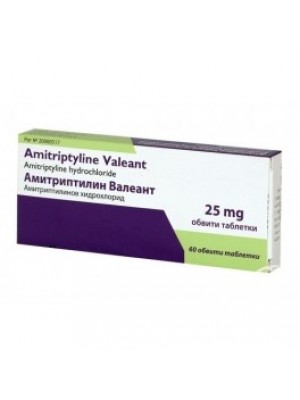
Amitriptyline. 25 mg. 60 tablets Amitriptyline VALEANT WHAT..
25.00€