Your shopping cart is empty!
Welcome visitor you can login or create an account.
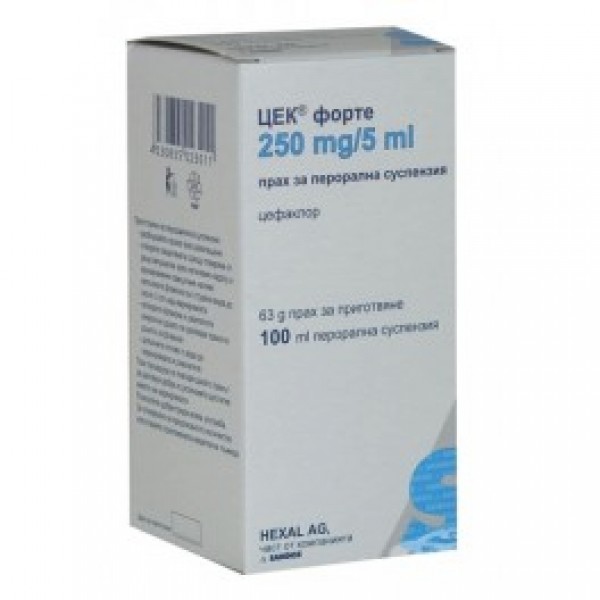
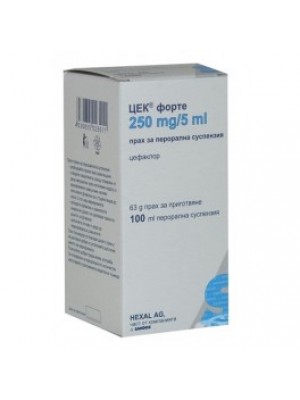
CEC FORTE 250 mg. / 5 ml. 100 ml.
Product Code: CEC FORTE 250 mg. / 5 ml. 100 ml.
Availability: In Stock
Product viewed: 777


CEC FORTE 250 mg. / 5 ml. 100 ml.
What is the active substance?
63 g of granules for the preparation of oral suspension containing: 5,244 g cefaclor monohydrate, corresponding to 2,5 g cefaclor
5 ml (1 scoop) of the prepared oral suspension contain: 262,24 mg cefaclor monohydrate, corresponding to 250 mg cefaclor
What else contains CEC forte granules for oral suspension?
himeteloza, sodium lauryl sulfate, sodium starch glkzholat (type A), sucrose, silicone emulsion, xanthan gum, flavors (strawberry, raspberry)
Tip for diabetics
5 mf (1 scoop) of the prepared oral suspension containing 2,86 g of sucrose, corresponding to 0.24 carbohydrate units.
Formulation and packaging:
Original packs containing 1 vial with 63 g granules for preparation of 100 ml oral suspension
What CECe forte granules for oral suspension?
CEC is an antibiotic belonging to the group of cephalosporins, which are used to treat bacterial infections.
What is CEC forte granules for oral suspension?
Used to treat acute and chronic acute infections of varying severity caused by cefaclor-sensitive bacteria and diseases are suitable for oral therapy.
For the treatment are shown in the following infections:
- The upper and lower respiratory tract
- Ear, nose and throat - as otitis media (otitis media), sinusitis, tonsillitis (tonsillitis) and pharyngitis (sore throat)
- Kidney and the lower urinary tract
- Skin and soft tissue
- Gonorrhea
When you should not take CEC forte granules for oral suspension?
You should not take CEC forte, if you are allergic to cefaclor, other antibiotics of this group (cephalosporins) or any of the ingredients.
Tell your doctor if you have experienced hypersensitivity reactions to penicillin antibiotics as possible be allergic to cephalosporins (cross-allergy).
If you are informed that you have an intolerance to some sugars, contact your doctor before starting treatment with this product.
In which case you can use CEC forte granules for oral suspension only after consulting a doctor?
In certain diseases or conditionsCEC forte may be used only after consultation with your doctor.
Tell your doctor if you suffer from asthma or allergy manifested as you are under increased risk of allergic reactions to the product.
What precautions you should consider when taking SES® forte granules for oral suspension?
Tell your doctor if you suffer from severe gastrointestinal disorders accompanied by vomiting and diarrhea, since in these cases is not guaranteed sufficient absorption and efficacy CEC forte.
CEC forte could affect the efficacy of certain products inhibiting blood coagulation (coumarin-type anticoagulants). In such patients should be carefully monitored indicators clotting. If necessary, your doctor will reduce the dose of CEC forte.
If you need to examine your urine and / or blood, please tell your doctor that you take CECforte, because certain tests can give inaccurate results (eg. Non-enzymatic methods for the determination of glucose and protein in the urine, Coombs test ).
This medicinal product contains sucrose 2,86 g / 5 ml. When taken according to the dosage recommendations each dose provide up to 2,86 g sucrose.
The product is unsuitable for people with hereditary fructose intolerance, glucose / galactose malabsorption or sucrose / isomaltulose deficit.
What other products influence the effect of CEC forte granules for oral suspension or can be influenced by the product?
Tell your doctor if you are taking or have recently received any medicines, even those without a prescription.
Antibiotics
CEC forte should not be combined - where possible - by drugs suppressing the growth of bacteria (eg., Chloramphenicol, erythromycin, sulfonamides, tetracyclines or), as the effect of CEC forte can be reduced.
Probenecid (product for the treatment of gout)
The additional use of probenecid leads to suppressing the secretion of cefaclor by the kidneys, resulting in yielding higher concentrations of cefaclor and more prolonged presence in the blood.
Anticoagulants
In patients receiving concomitant CEC forte and medicines that suppress the coagulation of blood (coumarin-type anticoagulants) to monitor individual patients with prolonged prothrombin time with or without bleeding.
Please note that these data refer and of recent medicines.
What foods and herbs should avoid?
No evidence of foods and spices that must be avoided.
What must comply children and elderly patients when administering CEC forte granules for oral suspension?
CEC forte should not be administered to premature infants because there is not enough clinical data.
What special precautions should be taken during pregnancy and lactation?
Observations in pregnant women have not shown evidence of harm to the fetus. Studies in animals have found embryo / fetotoxic effects.
However, in pregnancy, particularly during the first three months CEC forte should be taken only if the physician deems it necessary this treatment and after careful evaluation of the benefit / risk ratio.
During lactation CEC forte should be used only in particularly urgent need of treatment because the active ingredient can pass into breast milk. Infant may develop hypersensitivity to the active ingredient and to monitor diarrhea or colonization of the intestinal mucosa with fungi (eg. Blastomitseti).
What to be aware when driving or operating machinery?
So far it is not known CEC forte affecting concentration and speed of reaction, but side effects such as hypotension or vertigo may increase the risk of distortion of those activities.
Dosage, method and duration of application:
The following dosage is recommended, unless your doctor has prescribed CEC forte in another dosing regimen. Please follow these instructions for use. Otherwise CECforte will not work properly.
How much and how often you can take CEC forte granules for oral suspension?
Children under 6 years should take 30 mg of cefaclor / kg body weight / day in three divided doses.
In the case of severe infections, otitis media, or infections caused by less sensitive pathogens, recommended 40 to 50 mg of cefaclor / kg body weight / day for up to 1 g of cefaclor per day. In the case of otitis media, the total daily dosage may be administered in two divided doses every 12 hours.
In mild infections such as uncomplicated infections of the lower urinary tract is sufficient dosage of 20 mg of cefaclor / kg body weight / day divided in 2-3 divided doses every 8 or 12 hours.
Children 6 to 10 years should receive 1 measuring spoon 3 times daily (corresponding to 250 mg cefaclor three times daily).
In severe infections, otitis (otitis media) or infections caused by less sensitive bacteria need a dose of 1 scoop 4 times per day (corresponding to 250 mg of cefaclor 4 times daily).
Otitis media can also be treated with 2 scoops 2 times daily (corresponding to 500 mg of cefaclor 2 times a day). In mild infections such as uncomplicated infections of the lower urinary tract is sufficient dosage of 1 scoop morning and evening (corresponding to 250 mg of cefaclor 2 times a day).
Adults, adolescents and children over 10 years should receive a standard dose of 2 scoops three times daily (500 mg of cefaclor 3 times daily). The dose may be doubled for severe infections (like pneumonia) or infections caused by less sensitive bacteria. In some cases, adults have received doses up to 4 g of cefaclor day her they were well tolerated. This dose should not be nadvishavanal.
In mild infections such as infections of the lower urinary tract, uncomplicated, it is recommended that the dosage of 1 measuring spoon 3 times daily (corresponding to 250 mg of cefaclor 3 times daily).
In the treatment of acute gonorrhea urethritis in men and women appointed 3 g of cefaclor, possibly combined with 1 g of probenecid.
Dosage in patients with impaired renal function
CEC forte can be applied even in patients with renal impairment without dose adjustment.
Haemodialysis reduces serum half-life of 25-30%.
In patients on regular hemodialysis predialysis should be administered an initial dose of 250 mg to 1 g. The maintenance dose administered between two dialysis was the same as in patients without dialysis.
When and how you can take CEC forte granules for oral suspension?
Preparation of oral suspension
- Mix by shaking the pellets
- Protected against open child resistant closure by pushing down while turning left
- Fill the bottle with cold water to about ½ cm above the mark (ring on the lens)
- Close the vial and mix vigorously until dissolved granule bottom of the vial
- Fill with water again up to the mark (ring on the lens) and shake. This procedure must be repeated until the oral suspension reaches the mark (ring on the lens).
Shake the bottle vigorously at each intake.
Please use added to the package measuring spoon (with a readability of 1,25 ml, 2,5 ml and 5 ml), to measure the prescribed amount.
You can take CEC forte during the meal, which does not violate absorption.
How long can you take CEC forte granules for oral suspension?
As a rule CEC forte should be taken 7 to 10 days, or at least 2-3 days after disappearance of disease symptoms.
In the treatment of infections with beta-hemolytic streptococci recommended treatment duration of at least 10 days, in order to prevent late complications (e. Rheumatic fever and glomerulonephritis). The duration of use is determined by your doctor.
What should I do if CEC forte granules for oral suspension has been adopted in very large amounts (intentional or inadvertent overdose)?
So far no cases of intoxication cefaclor; If 'accepted large quantities of the product should consult a doctor. Please keep the packaging of the drug, in order to establish the accepted amount of the active ingredient.
What should you do if you take less than the prescribed dose CEC forte granules for oral suspension, or you missed taking the drug?
If you have forgotten accept, please take the dose as soon as possible. If you forget to take medicine several times, you should consult your doctor to trace the course of the disease and to rapidly take the necessary treatment.
What you need to know if you have discontinued or have it terminated prematurely?
If you are discontinued prematurely, the risk of relapse.
What side effects can cause the application of CEC forte granules for oral suspension?
Like all medicines, the application of CEC forte can cause side effects.
Blood and blood cells
Very rarely were observed changes in the number of blood cells (eosinophilia, leukopenia, lymphocytosis, thrombocytopenia uncommon -neutropeniya and in some cases, aplastic and hemolytic anemia). These side effects are normalized spontaneously after treatment. Infrequently observed a significant reduction in the number of white blood cells (agranulocytosis).
Liver and biliary tract
Infrequently can be observed reversible increase of liver enzymes in the serum (transaminases, alkaline phosphatase).
Reported were isolated cases of transient liver cell damage (hepatitis) and swelling in violation of bile (jaundice).
Digestive system
Uncommonly, a lack of appetite, abdominal pain, diarrhea, vomiting, heaviness in the stomach, nausea and loose stools. These events are mild and usually disappear during or after therapy interruption and. As with other broad spectrum antibiotics, can occur bowel inflammation (colitis), including pseudomembranous colitis.
Kidney and urinary tract
May occur uncommonly acute inflammation of the kidneys (acute interstitial nephritis), but it subsides after completion of therapy. It was also observed a slight increase in blood urea and / or creatinine.
Nervous system
Reported have been uncommon cases of temporary hallucinations, hyperactivity, nervousness, insomnia or drowsiness, dizziness or sheepish behavior. As with other drugs in this group (cephalosporin antibiotics) can not be excluded increased tendency to convulsions.
Hypersensitivity Reactions
Often allergic skin reactions (eg. Redness of the skin with burning sensation (rash), itching, hives, blisters and swelling (urticarial exanthema), rash similar to measles (maculopapular, morbilliform exanthema).
Other symptoms of hypersensitivity reactions may be increasing the number of eosinophilic cells (eosinophilia), a positive test Coomb (detection of certain types of antibodies in the blood), (angioneurotic) edema, drug fever, and inflammation of the vagina.
Reported cases were uncommon, serum sickness -multiformena erythema (redness of the different manifestations of the skin) or the above mentioned skin reactions accompanied by joint symptoms and fever. In these cases, in contrast to serum sickness, lymphadenopathy and proteinuria have been observed very rarely. There are no circulating antibodies.
Generally these allergic reactions were observed during or after the re-treatment with cefaclor (more common in children than in adults) and disappear within a few days after cessation of treatment.
Severe hypersensitivity reactions can be expressed by a drop in blood pressure to life-threatening shock, swelling of the face (facial edema), increased heart rate, laryngeal edema with spasm of the airways, difficulty breathing, swelling of the tongue. In individual patients, these reactions occur after the first administration of the preparation. In appearance they need immediate medical attention.
Uncommon cases of severe skin manifestations of life-threatening systemic reactions (such syndrome Stevens-Johnson, exfoliative dermatitis syndrome Lyell) have been reported in connection with the intake of CEC
Other side effects
After taking CEC occasionally been reported temporary rise in blood pressure.
Prolonged or repeated administration of CECforte can lead to secondary infection (superinfection) and colonization by resistant bacteria cefaclor or to the development of a fungal infection (blastomitseti).
If you notice any side effects not listed in this leaflet, please tell your doctor or pharmacist.
What measures should be taken in relation to side effects?
If during or after treatment with the product is observed severe or persistent diarrhea, please consult your doctor as this may be a manifestation of a serious intestinal disease (pseudomembranous colitis), which should be treated immediately. Please do not take self with medicines that inhibit gastrointestinal motility.
If you experience sudden severe hypersensitivity reactions, please consult your doctor as you may need immediate treatment.
Storage Instructions:
Ready-to-use suspension has a shelf life of 14 days under refrigeration (below 8 ° C). Unused after this period amount should be discarded.
The expiry date of the medicine is printed on the packaging.
Do not use after the expiry date stated on the packaging.
How should I store CEC forte granules for oral suspension?
The product should be stored at temperatures below 25 ° C.
The reconstituted suspension should be stored in a refrigerator (at a temperature not higher than 8 ° C).
Keep out of reach of children!
Write a review
Your Name:Your Review: Note: HTML is not translated!
Rating: Bad Good
Enter the code in the box below:
Related Products
WEC eff. table. 500 mg. 10 table What is WEC 500 effervesce..
28.00€
CEC granules 125 mg. / Ml 5. 100 ml. What is the active ingr..
8.00€
CEC FORTE suspension 250 mg. / 5 ml. 100 ml.What is the acti..
14.00€