
Your shopping cart is empty!
Welcome visitor you can login or create an account.
MEDOCLOR 125 mg. / 5 ml. 100 ml.
Product Code: MEDOCLOR 125 mg. / 5 ml. 100 ml.
Availability: In Stock

Product viewed: 1078


MEDOCLOR 125 mg. / 5 ml. 100 ml.
WHAT MEDOCLOR AND WHAT IT IS USED
Cefaclor belongs to the group of medicines known as cephalosporin antibiotics. Antibiotics help your body fight infections. Cefaclor act by destroying certain bacteria causing infection.
Medoklor can be used to treat a wide variety of bacterial infections. These may include those of the chest (bronchitis, pneumonia, exacerbated chronic bronchitis), of the ears (otitis), the nose (rhinitis), of the throat (pharyngitis and tonsillitis), dental abscesses, skin, bone and joints, urinary bladder (cystitis), kidney infections and those of the prostate (prostatitis). Ask your doctor if you are unsure of what being treated.
Your doctor can tell you what kind of infection being treated and to tell you more.
2. BEFORE YOU TAKE MEDOCLOR
Do not take MEDOCLOR:
if you are allergic (hypersensitive) to cephalosporin antibiotics or any of the other ingredients of MEDOCLOR.
Take special care with MEDOCLOR:
If you have had an allergic reaction in the past to cefaclor, cephalosporins, penicillins, or other drugs (including rash, itching, swelling or sudden deepening difficulty breathing);
If you have severe kidney problems;
If you have colitis (a type of severe diarrhea);
If you are diabetic, cefaclor can affect some tests for sugar in the urine;
If you are pregnant, trying to become pregnant or are breast-feeding.
Taking other medicines
Please tell your doctor or pharmacist if you are taking or have recently taken any other medicines, including medicines obtained without a prescription, herbal products and supplements, including:
Probenecid;
Medications to reduce blood clotting such as warfarin; they are called oral anticoagulants.
Taking MEDOCLOR with food and drink
MEDOCLOR can be taken one hour before or two hours after a meal.
Pregnancy and lactation
If you are pregnant or trying to get pregnant, ask your doctor or pharmacist before taking any medicine, including MEDOCLOR.
If you are taking these drugs and breast-feeding, you should consult with your doctor. Cefaclor is found in small quantities in breast milk and may affect the infant.
Driving and using machines
No effects of MEDOCLOR on ability to drive and use machines.
3. HOW TO TAKE MEDOCLOR
Always use MEDOCLOR exactly as you have been told by your doctor. If you're not sure, ask your doctor or pharmacist. If possible, before starting treatment, always read the printed leaflet.
Take this medicine on regular intervals and finish your course assignments. It is important to do the full course even if you feel that your infection deal to prevent resumption of infection.
MEDOCLOR suspension is suitable for children. Small children can be established that the suspension is more easily swallowed, and the dose can be determined accurately. MEDOCLOR is also available in capsule form.
The number of doses you take and how often you take depends on what you are treated and the severity of the infection. In children, it also depends on how the child weighs. The doctor may tell you what you are being treated you or your child, and why this dose was selected.
Described dosing is common, sometimes the doctor may order other doses and you should follow the doctor's instructions.
The usual total daily dose for children over one month is 20 mg / kg / bw., In divided doses every 8 or 12 hours depending on the infection being treated. For more severe infections or those caused by less sensitive organisms, the daily dose can be higher up to 40 mg / kg daily in equally divided doses. The maximum daily dose should not exceed 1 g.
In patients with kidney problems and / or dialysis dosage may be lower than those described above.
If you have the impression that the effect of MEDOKLOR is too strong or too weak, talk to your doctor or pharmacist.
If you take more dose Medoclor
Never take more than your prescribed dose. If you suspect you have taken or someone else has taken too many capsules, immediately contact your doctor immediately or go to the emergency department of the nearest hospital. Always bring the container with you, if possible, even if it is empty.
If you forget to take Medoclor
If you forget to take a dose, take it as soon as you remember.
In one day, do not take more medicine than you have been advised by your doctor. Do not take two dosages at the same time or with an interval of one hour between them. Try to accept an interval of at least four hours.
If you stop taking Medoklor
Take this medicine on regular intervals and complete course assignments.
It is important that you complete the course, even if you feel that your infection resolves to resume helps prevent infection.
4. POSSIBLE SIDE EFFECTS
Like all medicines Medoklor can sometimes cause side effects. These are so-called side effects.
If you get any of the following STOP taking the medicine immediately and tell your doctor:
rash or itching, swelling of the face and / or obstruction of breathing (wheezing, shortness of breath);
joint pain with or without fever, redness (ie. syndrome, serum sickness);
severe diarrhea with bleeding.
It is important to tell your doctor if during or after treatment receive:
headache, anxiety, confusion, dizziness, hallucinations, insomnia, nervousness and somnolence (rare);
diarrhea (most common adverse reaction), nausea, vomiting;
vaginal discharge or vaginal itching.
If you are having blood tests, urine and liver function, tell your doctor that you take Medoklor. Medoklor can sometimes change the results of the tests.
Do not be alarmed by this list of possible responses; when you can not have any one.
If any of the side effects gets serious, or you notice other effects not listed in this leaflet, please tell your doctor or pharmacist.
5. HOW TO STORE MEDOCLOR
Keep out of reach of children.
Before dissolving granules for oral suspension should be stored at temperatures below 25 ° C, in the original packaging.
Shelf life after reconstitution: 7 days and stored below 25 ° C and 14 days at 2 ° - 8 ° C (refrigerated).
Do not use the medicinal product after the expiry date stated on the carton and label.
Medicines should not be disposed of in wastewater or household waste. Ask your pharmacist how to dispose of medicines no longer required. These measures will help to protect the environment.
6. ADDITIONAL INFORMATION
What MEDOCLOR
The active substance is: cefaclor (cefaclor) as cefaclor monohydrate.
MEDOCLOR 125 mg / 5 ml granules for oral suspension contains 5 per ml after reconstitution of 125 mg of the active ingredient cefaclor, in the form of cefaclor monohydrate.
MEDOCLOR FORTE 250 mg / 5 ml granules for oral suspension contains 5 per ml after reconstitution of 250 mg of the active substance cefaclor, in the form of cefaclor monohydrate.
The other ingredients are xanthan gum, methylcellulose, erythrosine E127, sucrose, dimethicone, sodium lauryl sulfate, pregelatinized starch, and strawberry flavoring.
Looks MEDOCLOR and cocoa contents of the pack
MEDOCLOR 125 mg / 5 ml granules for oral suspension contains red without any visible foreign matter, with a characteristic aroma of strawberry, loose granules for oral suspension.
MEDOCLOR Forte 250 mg / 5 ml granules for oral suspension contains red granules for oral suspension without visible foreign matter, with a characteristic aroma of strawberry.
Granules for oral suspension are packaged in brown glass bottles type III, with an aluminum cap with antioxidant PVC coated inside with seal. In a cardboard box containing a bottle of the package leaflet and a plastic spoon 5 ml to prepare 100 ml suspension.
Write a review
Your Name:Your Review: Note: HTML is not translated!
Rating: Bad Good
Enter the code in the box below:
Related Products
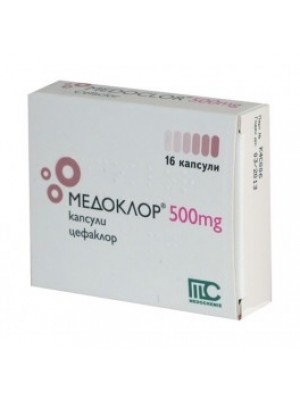
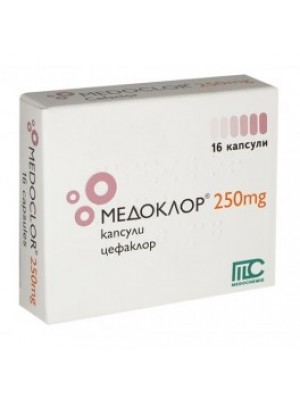
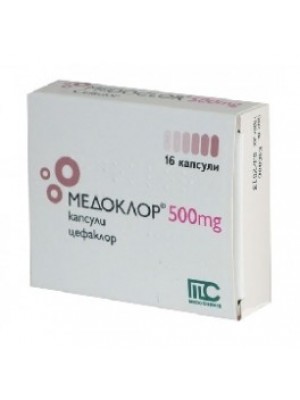

MEDOCLOR 250 mg. / 5 ml. 100 ml.WHAT MEDOCLOR AND WHAT IT IS..
25.00€