
Your shopping cart is empty!
Welcome visitor you can login or create an account.
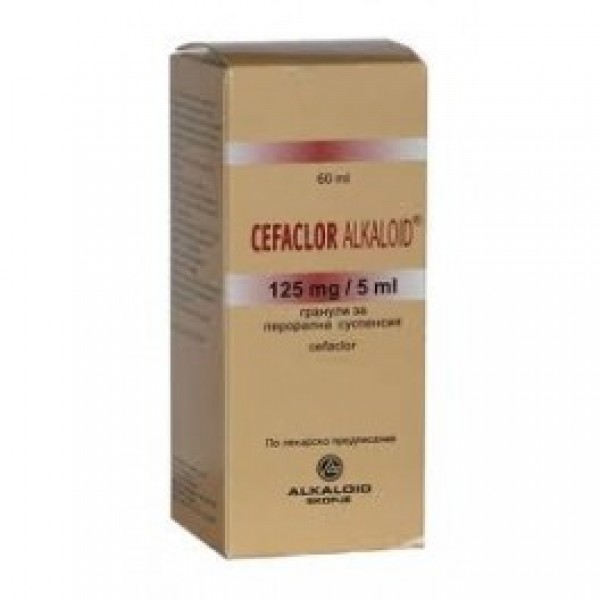
Cefaclor 125 mg. / 5 ml. 60 ml.
Product Code: Cefaclor 125 mg. / 5 ml. 60 ml.
Availability: In Stock
Product viewed: 1010


Cefaclor 125 mg. / 5 ml. 60 ml.
WHAT Cefaclor alkaloids AND WHAT IT IS USED
Cefaclor Alkaloid is an antibiotic belonging to a group of drugs called cephalosporins, which act by destroying certain bacteria causing infections.
Cefaclor Alkaloid are used to treat these infections, which are caused by the cefaclor - sensitive bacteria:
otitis media;
tonsillitis and throat;
bronchitis and pneumonia;
cystitis and urinary tract infections;
infections of skin and soft tissue.
2. BEFORE YOU TAKE Cefaclor alkaloids
Do not take Cefaclor Alkaloid:
if you are allergic (hypersensitive) to cefaclor, penicillin or cephalosporin antibiotics.
Take special care with cefaclor Alkaloid if:
You have ever had an allergic reaction to antibiotics such as penicillin or cephalosporins or other type drugs (allergic reaction may include rash, itching, swelling, unusual joint pain or difficulty breathing);
have or have had severe gastrointestinal disorders accompanied by vomiting and diarrhea (especially colitis);
have kidney problems or are on dialysis.
Prolonged or repeated administration of cefaclor Alkaloid can lead to secondary infection (superinfection) and the development of resistant microorganisms and fungi, forming a white deposits in the oral mucosa or causing a change in vaginal contents.
Alkaloid cefaclor may interfere with some tests for sugar in urine. The safety and effectiveness of cefaclor in infants under one month of age has not been studied.
Taking other medicines
Please tell your doctor or pharmacist if you are taking or have recently taken any other medicines, including medicines obtained without a prescription.
It is essential if you are taking any of the following medications:
oral anticoagulants (blood thinners) as cefaclor strengthens their anticoagulation activity;
probenecid (a medicine for the treatment of gout), as it increases in plasma levels of cefaclor.
Taking Alkaloid cefaclor with food and drink
It is best cefaclor Alkaloid be taken 1 hour before or at least 2 hours after a meal.
Pregnancy and lactation
Ask your doctor or pharmacist before taking any medicine.
During pregnancy, cefaclor can be applied only when a clear need.
The effect on the infant has not been studied. During breastfeeding cefaclor be used with caution.
Driving and using machines
Cefaclor no effect on ability to drive and use machines.
Important information about some of the ingredients of cefaclor Alkaloid
If your doctor has told you that you have an intolerance to some sugars, contact your doctor before taking this product.
Alkaloid cefaclor 125 mg / 5 ml granules for oral suspension containing 2,303 g sucrose in 5 ml prepared suspension.
Alkaloid cefaclor 250 mg / 5 ml granules for oral suspension containing 2,997 g sucrose in 5 ml prepared suspension.
This should be considered in patients with diabetes mellitus (diabetes mellitus).
This can damage the teeth.
3. HOW TO TAKE Cefaclor alkaloids
Always take cefaclor Alkaloid exactly as you have been told by your doctor. If you're not sure, ask your doctor or pharmacist.
Adults
The recommended dose of cefaclor in adults is 250 mg every 8 hours. In extremely severe infections, the recommended dose 500 mg every 8 hours. The maximum dosage is 4 g per day.
Elderly
As in adults.
children
The recommended dose of cefaclor in children is 20 mg / kg daily, in divided doses every 8 hours. In bronchitis and pneumonia dose is 20 mg / kg per day in divided doses taken three times daily. For the treatment of otitis media and pharyngitis total daily dosage may be divided and administered every 12 hours. There are no safety and efficacy of cefaclor in infants under 1 month.
125 mg / 5 ml of 250 mg / 5 ml
<1 year (9 kg) 2.5 ml every 8 hours
1-5 years (9-18 kg) 5.0 ml every 8 hours
Over 5 years 5.0 ml every 8 hours
For more severe infections, otitis media, and infections caused by less sensitive organisms recommended 40 mg / kg per day in divided doses up to a maximum of 1 g per day.
For the treatment of beta hemolytic streptococcal infection, a therapeutic dose of cefaclor should be administered at least 10 days.
Prepare the slurry as indicated below:
Cefaclor oral suspension 125 mg / ml: before use, add 40 ml of distilled water in a glass bottle and shake well.
Cefaclor oral suspension 250 mg / ml: before use, add 34 ml of distilled water in a glass bottle and shake well.
Preparation suspension is reddish-pink viscous liquid with a pleasant strawberry flavor.
Before using the bottle, shake well!
The dosing of the prepared suspension is done with a special spoon.
If you take more than the amount of cefaclor Alkaloid
If you take more than you should, immediately contact your doctor or pharmacist.
Toxic symptoms of overdose of cefaclor include nausea, vomiting, epigastric pain and diarrhea. Severity of epigastric pain and diarrhea are dose-dependent.
If you forget to take cefaclor Alkaloid
Do not take a double dose to make up for missed.
When passing a reception, the next dose should be taken as soon as possible.
If it is nearly time for your next dose, the missed dose should be skipped and to continue treatment in the prescribed schedule.
If you have any further questions on the use of this product, ask your doctor or pharmacist.
4. POSSIBLE SIDE EFFECTS
Like all medicines, cefaclor Alkaloid can cause side effects, although not everybody gets them.
Common side effects (likely to occur in 1 to 10 in every 100 patients):
allergic skin reactions (eg. red skin with burning sensation - rash, pruritus, urticaria, exanthema);
rash similar to measles (measles exanthema);
diarrhea.
Uncommon side effects (likely to occur in 1 to 10 of every 1,000 patients):
changes in the number of blood cells (reversible neutropenia, agranulocytosis, hemolytic anemia, and aplastic anemia);
serum sickness - erythema multiforme (other manifestations of redness of the skin) or above skin reactions accompanied by symptoms such as joint arthritis / arthralgia, with or without fever;
increase of liver enzymes in the serum (transaminases, alkaline phosphatase).
Rare side effects (likely to occur in 1 to 10 in every 10,000 patients):
nausea and vomiting. As with other broad-spectrum antibiotics may occur colitis, including pseudomembranous colitis;
insomnia, confusion, hallucinations and sleepiness, reversible hyperactivity, agitation, irritability, hypertension, dizziness;
Rare cases of liver cell damage (hepatitis) and disorder in swelling of the bile (jaundice);
kidney inflammation (interstitial nephritis), which passes after the end of therapy;
mild transient increases in serum creatinine or urea;
candidiasis (a fungal infection, wherein the white scales form in the oral mucosa or which may cause a change in the vaginal content, which causes itching);
severe hypersensitivity reactions, which can be expressed with a drop in blood pressure to life-threatening shock, swelling of the face, throat and mouth, wheezing or difficulty breathing (these events occurred more frequently in patients allergic to penicillin)
Rare cases of severe skin manifestations of common life-threatening reactions (Stevens-Johnson, toxic epidermal necrolysis).
Very rare side effects (likely to occur in fewer than 1 in every 10,000 patients):
changes in the number of white blood cells (thrombocytopenia, eosinophilia, lymphocytosis, and leukopenia). These reactions reluctance normalize spontaneously after treatment;
lymphadenopathy (damage to the lymph nodes) and proteinuria (presence of protein in the urine).
If any of the side effects gets serious, or you notice other effects not listed in this leaflet, please tell your doctor or pharmacist.
5. HOW TO STORE cefaclor
Keep out of reach of children.
Do not use cefaclor Alkaloid after the expiry date stated on the package (for expiry date abbreviation used). The expiry date refers to the last day of that month.
Keep at temperatures below 25 ° C.
The finished suspension is stable 14 days and stored at 2 to 8 ° C (in a refrigerator).
Medicines should not be disposed of in wastewater or household waste. Ask your pharmacist how to dispose of medicines no longer required. These measures will help to protect the environment.
6. FURTHER INFORMATION
What cefaclor Alkaloid
The active substance is cefaclor. In 5 ml (one scoop) of the suspension contains 125 mg or 250 mg of cefaclor (as monohydrate 130.60 mg cefaclor or 262.60 mg).
The other ingredients are microcrystalline cellulose and carmellose sodium, sucrose, sodium benzoate, citric acid monohydrate, xanthan gum, colorant E129, strawberry flavor, sodium lauryl sulfate and simethicone emulsion 30%.
Cefaclor Alkaloid looks like and contents of the pack
Cefaclor Alkaloid granules for oral suspension is a beige granular powder with a pleasant strawberry flavor.
Glass bottle (brown neutral glass with an aluminum cap with a plastic seal 30 g of granules for oral suspension (60 ml oral suspension - 125 mg / 5 ml) or 40 g of granules for oral suspension (60 ml oral suspension - 250 mg / 5ml) plastic spoon and package leaflet in a carton.
Write a review
Your Name:Your Review: Note: HTML is not translated!
Rating: Bad Good
Enter the code in the box below:
Related Products
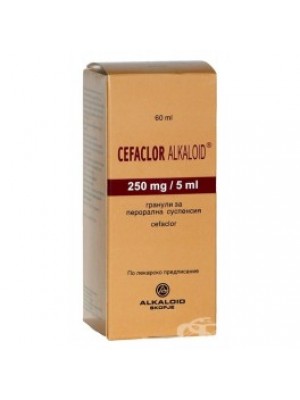
Cefaclor syrup 250 mg. / Ml 5. 60 ml.WHAT cefaclor alkaloids..
12.00€
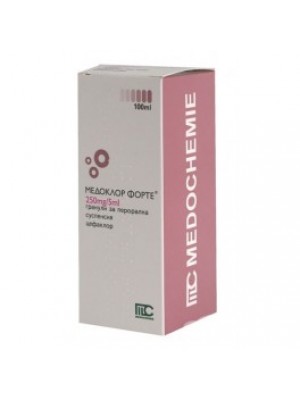
MEDOCLOR 250 mg. / 5 ml. 100 ml.WHAT MEDOCLOR AND WHAT IT IS..
25.00€
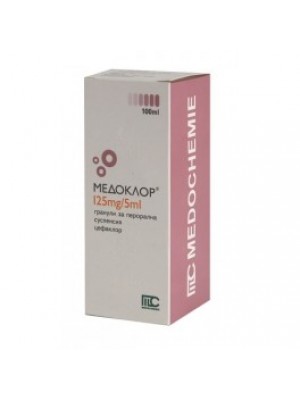
MEDOCLOR 125 mg. / 5 ml. 100 ml.WHAT MEDOCLOR AND WHAT IT IS..
19.00€