Your shopping cart is empty!
Welcome visitor you can login or create an account.
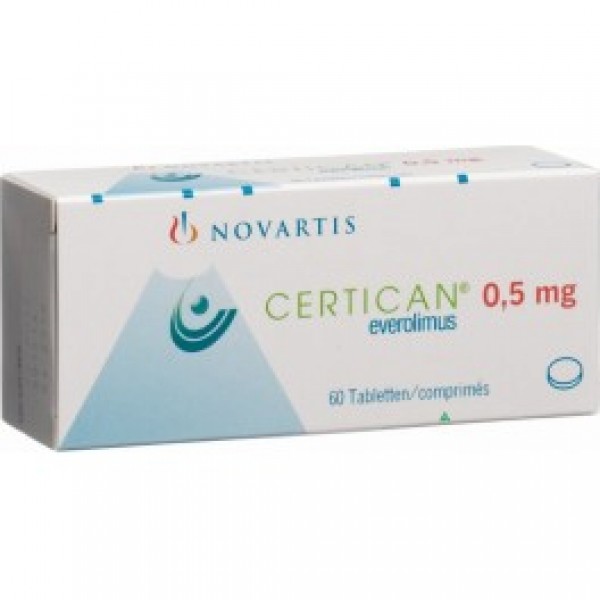
CERTICAN. 0.5 mg. 60 tablets
Product Code: CERTICAN. 0.5 mg. 60 tablets
Availability: In Stock
Product viewed: 1200


CERTICAN. 0.5 mg. 60 tablets

INDICATION
Certican is indicated for the prophylaxis of organ rejection in adult patients at low to moderate immunological risk receiving allogeneic kidney or heart . Certican should be administered in combination with ciclosporin microemulsion and corticosteroids.
Dosage and administration :
Certican therapy should begin and be carried out only by physicians experienced in immunosuppressive therapy after organ transplantation , able to trace levels of everolimus in whole blood.
adults:
The initial dose of 0.75 mg twice daily is recommended for the general population of patients with transplanted kidney or heart , as applicable in the shortest possible time after transplantation. Always Certican daily dose should be administered orally in two divided doses , with or without food and at the same ciclosporin microemulsion .
Certican is for oral use .
Certican tablets should be swallowed whole with a glass of water and must be crushed before use. For patients who can not swallow tablets whole , are created dispersible tablets Certican.
Host Certican patients may need a dosage adjustment according to blood levels achieved , tolerability , individual response , change in concomitant medications and clinical status . Dosage adjustment may be made at intervals of 4-5 days.
Black patients :
The incidence of biopsy-proven acute rejection of organs in Black patients was significantly higher than patients of other races . There is a limited amount of data , which indicate that Black patients may require larger doses Certican, in order to achieve efficacy comparable to that of patients with other races . Currently, the efficacy and safety are too small to be able to make specific recommendations on the use of everolimus in Black patients .
Use in children and adolescents:
Not enough experience to make recommendations for the use of Certican in children. There is only limited information on pediatric renal transplant patients.
Elderly :
Clinical experience in patients under 65 years is limited.
Patients with impaired renal function:
It is not necessary to adjust the dosage.
Patients with impaired hepatic function:
Concentrations of everolimus blood levels should be monitored carefully. In patients with mild to moderate hepatic impairment , dosage should be reduced to half the normal
CONTRAINDICATIONS :
Certican is contraindicated in patients with known hypersensitivity to everolimus, sirolimus or any of the excipients .
Pregnancy and lactation
There are no adequate data from the use of everolimus, in pregnant women. Studies in animals have shown reproductive toxicity effects including embryo / fetal toxicity . The potential risk for humans is unknown. Certican should not be taken by pregnant women unless the potential benefit outweighs the potential risk to the fetus . Women of childbearing potential must not exceed the potential risk to the fetus. Women of childbearing potential should be advised to use effective contraception while taking Certican and 8 weeks after cessation of treatment.
It is not known whether everolimus, is excreted in human milk . In animal studies, everolimus and / or its metabolites are rapidly and easily pass into the milk of lactating rats. Therefore host Certican women should not breastfeed.
SIDE EFFECTS :
Infections and infestations:
Common - viral, bacterial and fungal infections , sepsis
Uncommon - wound infections
Blood and lymphatic system disorders:
Common - thrombocytopenia , anemia, coagulopathy , thrombotic trombotsitopichna purpura / hemolytic uremic syndrome
Uncommon - hemolysis
Endocrine disorders:
Uncommon - male hypogonadism / low testosterone , elevated LH
Metabolism and nutrition disorders :
Very common - hypercholesterolemia , hyperlipidemia
Common - hypertriglyceridemia
Vascular disorders:
Common - hypertension, lymphocele , venous thromboembolism
Respiratory, thoracic and mediastinal disorders:
Common - pneumonia
Uncommon - pneumonitis
Gastrointestinal Disorders:
Common - abdominal pain, diarrhea , nausea, vomiting
Hepatobiliary disorders:
Uncommon - Hepatitis, liver disorders , jaundice, liver function tests
Skin and subcutaneous tissue disorders:
Uncommon - rash
Violation of the musculoskeletal system :
Uncommon - myalgia
Renal and urinary disorders:
Common - UTI
Uncommon - tubular necrosis of the kidney
General disorders and administration site conditions :
Common - swelling , pain
Write a review
Your Name:Your Review: Note: HTML is not translated!
Rating: Bad Good
Enter the code in the box below:
Related Products
AMLATOR. 10 mg. / 5 mg. 30 tablets QUALITATIVE AND QUANTITA..
12.00€