Your shopping cart is empty!
Welcome visitor you can login or create an account.
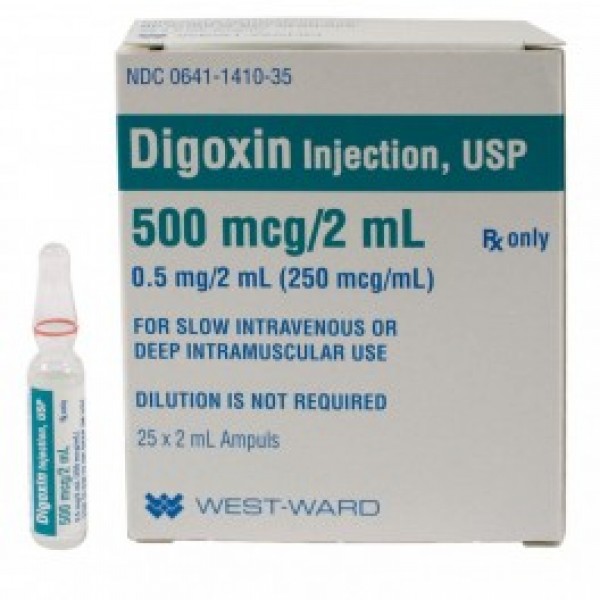
Digoxin 500 mcg .2 ml. 10 ampoules
Product Code: Digoxin 500 mcg .2 ml. 10 ampoules
Availability: In Stock
Product viewed: 1146


Digoxin 500 mcg .2 ml. 10 ampoules
Indications
Injection:
Chronic heart failure, third and fourth NYHA functional class with an ejection fraction less than 45% and decreases in contractile performance in an insufficient effect of ACE inhibitors and diuretics.
Tachyarrhythmia in atrial fibrillation or flutter to control ventricular rate.
* Dosage
Injection:
Parenterally, by intravenous infusion in emergency and rapid digitalization or impossible oral intake. IM can be painful and risk of muscle necrosis - be injected deep into the muscle and massage. Undiluted or diluted with at least four of sterilized water for injection and administered immediately. Recommended slow intravenous infusion for at least 5 minutes. Rapid introduction - systemic or coronary vzokonstriktsiya. Do not mix with others in the same syringe or a bank. Dosage - according to the condition, body weight, renal function, age, disease or other drugs.
Adults - together with a diuretic and an angiotensin-converting enzyme inhibitors.
Fast digitization (24 hours). Total dose (for a patient weighing 70 kg - 8 to 12 μg / kg) - 0,8 to 1,2 mg; initial intravenous infusion - 0,25-0,5 mg and then 0,125-0,25 mg every 6-8 hours to effect, then - tablets for maintenance therapy for termination of supraventricular tachycardias, atrial fibrillation or flutter.
Intravenous and oral form:
Comparisons between systemic bioavailability and equivalent doses of digoxin products
Product Absolute bioavailability equivalent doses (μg) in various formulations
Digoxin tablets 60-80 62.5% 125 250 500
Digoxin ampoules / i.v. 100% 50,100,200,400
Example: digoxin tablets 125 μg equivalent of digoxin injection 100 μg.
Slow digitization - maintenance dose - 0,25 mg daily for 7-10 days.
Supporting digitization - 1/8 - 1/10 (0,125 mg - 0,25 mg daily) than the total dose of saturation, without pause.
Patients over 70 years - excretion e extended, so even with normal serum creatinine values, the dosage can be adapted accordingly for such cases.
Chronic renal failure - doses comply with creatinine clearance. Starting dose 0,100-0,125 mg. In CRF loading dose is not administered.
Doses of digoxin according to the creatinine clearance:
Clcr ml / min Digoxin
Under 10 ¼ to 1/10 of the dose
10-25 0,10 mg every other day
26-50 0,10 mg daily
51-80 0,15-0,20 mg daily
Control of ventricular rate in patients with atrial fibrillation / flutter - 10-15 mcg / kg. Preferred minimum effective dose of digoxin
In children - depending on body weight and body surface area. In neonates, renal clearance of digoxin is diminished, especially for preterm. When kidney disease dose - carefully titrated based - on the clinical effect. Recommended for children with normal sinus rhythm and normal renal function:
Digitizing daily doses / 24 h, iv - Prematurity 15 mcg to 25 mcg / kg, Newborn - 20 to 30 mcg / kg, children from 1 month to 2 years - 20 mcg to 35 mcg / kg, Children 2 to 5 years - 25 to 35 mcg / kg, Children from 5 to 10 years - 15 mcg to 30 mcg / kg, Children over the age of 10 - 8 mcg to 12 mcg / kg. Loading dose - portionwise initially introduced near 1/2 of the estimated total dose. The remainder is injected at 6-8 hour intervals.
Maintenance dose - starts 24 hours after digitization. Prematurity - 20 to 30% of the digitized dose iv, divided into portions. In newborns and children up to 10 years - 25 to 35% of the total digitized dose iv, divided into portions.
* Contraindications
Injection:
o Hypersensitivity to digoxin or other cardiac glycosides
o Suspicion of digitalis intoxication;
o Heart failure in hypertrophic cardiomyopathy with subaortic stenosis, acute myocardial infarction within the first 1-2 days;
o high-sinus bradycardia below 45-50 beats / min - most commonly in syndrome sick sinus;
o AV-block I, II and III-degree;
o high-hypokalemia;
o Increased ventricular excitability due to the risk of ventricular mazhdener, frequent polytope grouped and premature ventricular beats and episodes of ventricular tachycardia, ventricular fibrillation or flutter;
o WPW-syndrome;
o hypercalcemia;
o Treatment with calcium products.
* Special warnings
Injection:
Change in dose and duration of treatment in patients with low body weight.
In atrial fibrillation, when planned elektrokardioverziya, 1-2 days before the operation - dose reduction (in order to avoid the occurrence of ventricular arrhythmias). On suspicion of digitalis intoxication elektrokardioverziyata be postponed.
There will be an extension of the PR-interval and depression of ST-segment and false positive ST-changes in exercise test driven electrophysiological properties of digoxin, not intoxication.
Reduced tolerance and the risk of intoxication in hypokalemia, hypomagnesemia, hypercalcemia, pulmonary insufficiency and hypoxia of different genesis, hypothyroidism, acidosis, alkalosis, severe myocardial injury, acute myocardial infarction, cardiomyopathy, renal failure and severe liver failure, constrictive pericarditis, cardiac amyloidosis and acute cor pulmonale.
Increased tolerance (a need for higher doses of saturation) in supraventricular tachycardias and ectopic tachyarrhythmias, thyrotoxicosis, childhood, and in rare cases of digitalis antibodies.
Warning: Digoxin injection contains ethanol.
* Interactions
Injection:
The clinical effect of digoxin may change significantly in concomitant use with other drugs that alter blood levels. They may be increased due to influence renal excretion, tissue binding, plasma protein binding, distribution in the body, increased sensitivity to digoxin. When concomitant administration of digoxin with other medicines these interactions should be taken into account in doubt that serum concentrations of digoxin.
With rapid intravenous calcium - severe heart rhythm disorders.
Diuretics, lithium salts, corticosteroids, carbenoxolone (cause hypokalemia or vatretakanen potassium deficiency) - increased sensitivity to digoxin.
Parathyroid hormone and vitamin D increases the level of calcium in the blood, and thus can increase the sensitivity of the myocardium to digoxin.
Increasing levels of digoxin when administered with: alprazolam, amiodarone, verapamil, gentamicin, indomethacin, itraconazole, prazosin, propafenone, quinidine, spironolactone, macrolide antibiotics neomycin, tetracycline, trimethoprim. Clarithromycin inhibits the renal clearance of digoxin - risk of digoxin toxicity. Amphotericin B increases toxicity of digoxin.
Salbutamol, sulfasalazine, neomycin, rifampicin, some cytostatics, phenytoin, metoclopramide - reduced digoxin levels and reduce its effect.
Digoxin and sympathomimetics or succinylcholine - risk of cardiac arrhythmias.
Digoxin Beta-blockers - suppression of atrio-ventricular conduction.
Verapamil and felodipine increase plasma levels of digoxin and nifedipine and diltiazem can raise them or not change them. ACE inhibitors may also increase or not change the plasma digoxin concentrations.
* Pregnancy and lactation
Injection:
Pregnancy
Applies only when clearly indicated and under medical supervision.
Breastfeeding
Be used with caution in nursing mothers, although concentrations in breast milk are below the level of maintenance doses of digoxin for infants.
* Adverse drug reactions
Injection:
Usually a dose-dependent and occurred in the introduction into the organism of higher doses than those necessary to achieve the desired therapeutic effect. Therefore, the side effects are less common when digoxin is used within the recommended dosages or in the therapeutic serum concentrations, and when there is careful monitoring of competitive interactions with other drugs, and general condition of the patient.
For adults
More frequently observed reactions of the gastrointestinal tract - nausea, vomiting, diarrhea.
Nausea and vomiting are the first symptoms of digitalis toxicity and may precede the onset of arrhythmias.
By cardiovascular - ventricular extrasystoles, bigeminy, trigeminy, polytope ventricular extrasystoles, ventricular fibrillation, atrial tachycardia with AV-block, nodal rhythm, sinus bradycardia, ventricular tachycardia combined with block extension of the PR-interval depression ST-segment high-grade conduction disturbances to a complete block.
Of the central nervous system - headache, fatigue, anxiety, apathy, confusion, depression, hallucinations; visual disturbances - scotoma, blurred vision, yellow vision.
Allergic skin reactions - itching, hives, rashes occur very rarely.
Other reactions - extremely rare cases of thrombocytopenia and gynecomastia during chronic administration.
Children
Early symptoms of adverse reactions are mainly related to the cardiovascular system - atrial tachycardia, junctional tachycardia, sinus bradycardia and occurrence of arrhythmia.
* Formulation and packaging
Solution for infusion / injection:
Ampoules.
10 ampoules in a blister, 1 or 10 blisters in a box.
Write a review
Your Name:Your Review: Note: HTML is not translated!
Rating: Bad Good
Enter the code in the box below:
Related Products
SOFAFILIN. 240 mg. / ml. 10 ml.5 ampules An ampoule of 10 m..
19.00€
Quinidine SULPHATE 200 mg. 20 tabletsQuinidine WHAT IS AND W..
8.00€