Your shopping cart is empty!
Welcome visitor you can login or create an account.
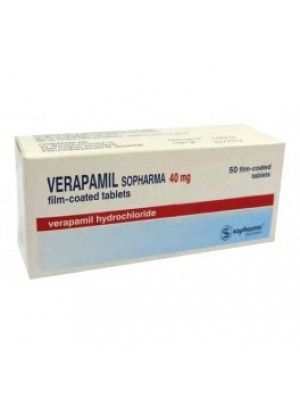
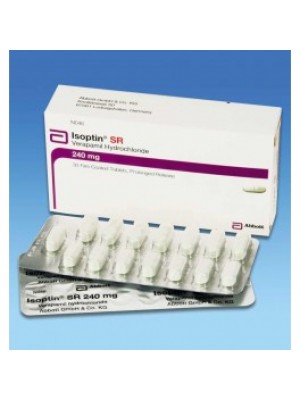
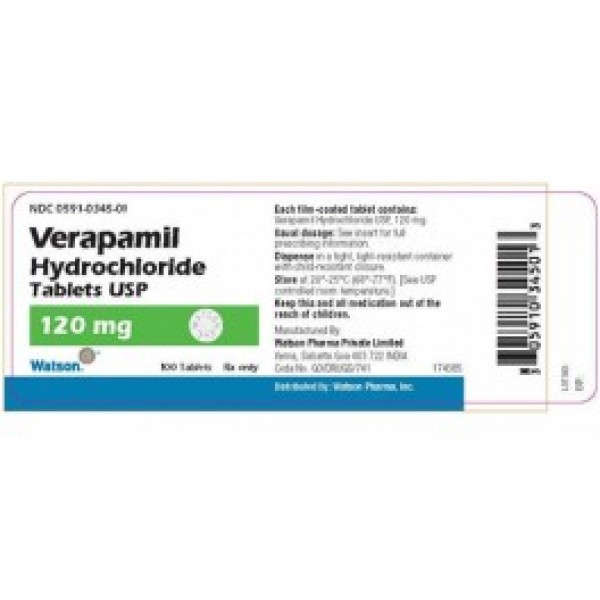
Verapamil 120 mg. 50 tablets
Product Code: Verapamil 120 mg. 50 tablets
Availability: In Stock
Product viewed: 1655


Verapamil 120 mg. 50 tablets
WHAT verapamil AND WHAT IT IS USED
Verapamil drug belongs to a group of so called calcium channel blockers. It leads to a reduced calcium influx in cells of the heart and blood vessels, thereby causing vasodilation, increased blood flow to the heart and improve its supply with oxygen, slowing heart rate and decrease blood pressure.
This medicine is used to:
• Treatment of hypertension.
• Symptomatic coronary artery disease:
- Chronic stable angina (angina of effort);
- Unstable angina (crescendo angina, angina at rest);
- Vasospastic angina (Prinzmetal angina, variant angina);
- Infarction angina in patients without heart failure, when not indicated for treatment with beta-blockers.
• Treatment and prevention of certain heart rhythm disorders:
- Paroxysmal supraventricular tachycardia;
- To control the ventricular rate in chronic atrial fibrillation and atrial flutter with acceleration between the atria and the cameras (except syndrome Wolff - Parkinson - White - WPW).
2. WHAT YOU NEED TO KNOW BEFORE verapamil Actavis
Verapamil Actavis does not apply to:
• Allergy to the drug or to any of the excipients.
• hypotension (systolic blood pressure <90 mmHg) or cardiogenic shock.
• Acute myocardial infarction with complications (bradycardia, hypotension, left ventricular weakness).
• syndrome sick sinus (disorder in heart rate).
• Severe cardiac conduction disorders (atrial or atrioventricular block grade II and III).
• Congestive heart failure.
• Atrial fibrillation or flutter, where additional translation link in the myocardium (WPW - syndrome) due to an increased risk of ventricular tachycardia unlock.
• Simultaneous intravenous administration of beta-blockers.
• First and second trimester of pregnancy.
In the application of this product, please note the following:
During treatment with verapamil requires very careful control in the presence of:
• atrioventricular block first degree.
• bradycardia (low heart rate <50 beats per minute).
• Severe hepatic impairment.
• Conditions associated with disorders of neuromuscular conduction (myasthenia gravis syndrome Labëria-Ethan, advanced muscular dystrophy). Verapamil has a suppressive effect on the pumping function of the heart, which is generally offset by the vasodilating action. It is therefore necessary verapamil be used with caution in patients with decreased pump function of the heart, as in these cases it can lead to clinical manifestations of heart failure, including congestive heart failure and pulmonary edema. Treatment with verapamil in patients with evidence of heart failure should be conducted against the background of pre-treatment with digitalis, diuretics and ACE inhibitors. It should be borne in mind that individual patients blood pressure lowering effect of verapamil may be more pronounced, and therefore the determination of the initial dose must be individually and carefully increasing the dosage. During treatment with verapamil should be given the existing high risk of accelerating reverse conductivity additional conduction pathways in the myocardium and a rapid ventricular response, including ventricular fibrillation in individual patients with paroxysmal or chronic atrial fibrillation. During treatment with verapamil risk of occurrence of asymptomatic bradycardia with atrioventricular block I degree. In these cases, the dose of verapamil should be reduced, and in the case of atrioventricular block II or III level treatment should be discontinued. In patients with hypertrophic cardiomyopathy need this product be used with caution because of the risk of serious side effects (pulmonary edema, severe hypotension). Verapamil may inhibit neuromuscular transmission in patients with muscular dystrophy. During treatment with verapamil require periodic monitoring of liver function tests.
Application of Verapamil Actavis with food and drink:
There is evidence that grapefruit juice increases plasma levels of verapamil. Because it is not desired to be used during treatment with verapamil.
Pregnancy
Before intake of any medicine, consult your doctor or pharmacist. No evidence of a thorough and well-controlled studies regarding the influence of verapamil on the fetus in pregnant women. Therefore, the first and second trimester of pregnancy is not recommended the use of verapamil and its application in the last trimester should be done only when necessary expressed after careful consideration of the risk / benefit of the attending physician.
Breastfeeding
Before taking any medicine, consult your doctor or pharmacist. Verapamil passes into breast milk. Because of the risk of adverse reactions in nursing infants, must take a decision or to discontinue nursing or the medicinal product.
Driving and using machines
At the beginning of treatment and dose increase, especially in conjunction with alcohol, may be temporarily impaired ability to drive and use machines, mainly due to lower blood pressure.
Important information about some of the ingredients of Verapamil Actavis
This medicinal product contains lactose as an excipient, which makes it unsuitable for patients with lactose intolerance.
Taking other medicines
Please tell your doctor or pharmacist if you are taking or have recently taken any other medicines, even if they have not been prescribed by your doctor. Verapamil can interact with a significant number of medicinal products. Since the metabolism of verapamil is performed by the liver enzyme systems, it may be reacted with a large number of drugs that are metabolized by the same enzymes.
Pharmacodynamic interactions (interactions at the level of action of medicinal products)
Antiarrhythmic - with concomitant administration of verapamil with other antiarrhythmic products there is an increased risk of atrioventricular block, decreased heart rate, low blood pressure and / or heart failure.
Beta-blockers - verapamil should not be combined with beta-blockers because of the enhancement of their suppressive effect on the pumping function of the heart.
Antihypertensive (blood pressure lowering) - during concomitant administration of verapamil and other antihypertensives (vasodilators, ACE inhibitors, diuretics, beta-blockers), the antihypertensive effect may be enhanced, including the development of collapse. Preferably a combination of verapamil with ACE inhibitors and diuretics.
Quinidine - it is possible to enhance the reduction of blood pressure. In patients with hypertrophic obstructive cardiomyopathy may occur pulmonary edema.
Inhalation anesthetics - administration of verapamil simultaneously general anesthetics there is a risk of inhibiting the heart function. Muscle relaxants - verapamil may potentiate the action of these drugs on neuromuscular transmission.
Acetylsalicylic acid - increased bleeding.
Pharmacokinetic drug interactions (interactions at the level of administration, distribution and broadcasting of Medicinal Products)
Carbamazepine - Verapamil may increase the plasma concentrations of carbamazepine and accordingly its neurotoxicity.
Lithium - verapamil decreased the plasma concentrations of lithium salts resulting in enhanced renal excretion.
Theophylline - verapamil can suppress the release of theophylline from the body and to increase the plasma concentrations.
Digitalis - administration of verapamil to control ventricular rate in patients with digitized permanent atrial fibrillation is appropriate if the dose of digoxin is appropriate. With prolonged use, verapamil may increase serum digoxin 50-75%, which in turn can lead to digitalis toxicity. This risk is increased in patients with liver cirrhosis. Therefore, the concomitant use of verapamil and digoxin to monitoring plasma concentrations of digoxin and where appropriate dosage adjustment him.
Anticancer - verapamil may increase serum levels of doxorubicin and enhance its toxicity. At the same time the absorption of verapamil may be reduced by cyclophosphamide, vincristine, procarbazine, prednisone, and adriamycin.
Phenobarbital - increases the release of verapamil.
Rifampicin - accelerates metabolism and reduces the availability in the body of verapamil when administered concomitantly.
Ethanol - verapamil significantly suppressed degradation and elimination of the ethanol, which leads to increasing the concentration of the latter in the blood and inducing toxic effects.
Statins (drugs lowering fat content in the blood) - verapamil may increase plasma levels.
3. HOW TO TAKE verapamil
Always Verapamil Actavis exactly as your doctor has instructed. It is only with a prescription! The tablets should be swallowed whole without chewing or sucking, with sufficient water, preferably during meals or immediately thereafter. The dosage is individual and depends on the testimony, the severity of the disease and individual patient tolerance.
Clinical practice has shown that the average daily dose in almost all indications is between 240 and 360 mg, such as in prolonged use, it should not exceed 480 mg, except for a short time.
Adults and adolescents weighing more than 50 kg:
Hypertension
The recommended daily dose is 240-480 mg (Table 2-4.) Divided in 2 doses.
Ischemic heart disease
The recommended daily dose is 240-480 mg (Table 2-4.) Divided in 2 doses.
Paroxysmal supraventricular tachycardia, atrial fibrillation / atrial flutter
The recommended daily dose is 240-480 mg (Table 2-4.) Divided in 2 doses.
Patients with hepatic insufficiency:
In patients with impaired hepatic function the effect of verapamil is more pronounced and prolonged, delayed due to his metabolism, depending on the degree of hepatic impairment. In these patients, administration of the product should be done with particular care and treatment begin with a lower dose - 80-120 mg verapamil daily, divided into 2-3 doses.
Verapamil should be administered to patients with infarction angina after the seventh day of the onset of acute myocardial infarction. The duration of treatment is determined by the attending physician, depending on the nature of the disease and the effectiveness of the therapy is applied. Treatment with verapamil should not be stopped abruptly after prolonged use. It is recommended this be done gradually.
If you have the impression that the effect of the application of Verapamil Actavis is too strong or too weak, talk to your doctor or pharmacist.
If you used a larger dose than prescribed Verapamil Actavis:
When taking a higher dose than prescribed, immediately contact a doctor!
Symptoms of overdose:
Symptoms of overdose of verapamil depend on the amount ingested, as in severe cases of poisoning may experience the following symptoms: blurred consciousness to coma, extreme lowering of blood pressure, slow and irregular heartbeats, rapid and irregular heartbeat, abnormal conduct heart pulses, high blood sugar, decrease in the potassium content of the blood, changes in the acid composition of blood, cardiogenic shock with pulmonary edema, hepatic failure, seizures.
Treatment of overdose:
If overdosage occurs, therapy with verapamil should be discontinued and the patient should be closely monitored in the context of intensive care. The main goals of treatment are elimination of the medicinal product and to maintain cardiovascular and respiratory function. Below are gastric lavage, activated charcoal, laxatives. In addition, if required, apply symptomatic means. If symptoms of overdose, immediately contact a doctor!
If you forget to use Verapamil Actavis
If you miss a dose, take it at the next regular intake without increasing the dose.
4. POSSIBLE SIDE EFFECTS
Like all medicines, Verapamil Actavis can cause side
reactions.
In most patients, treatment with verapamil was well tolerated. Adverse reactions that have been reported with its use are described below, are distributed in frequency:
Very common -> 10%
common -> 1% - <10%,
Uncommon -> 0.1% - <1%
rare -> 0.01% - <0.1%,
very rare <0.01%, including isolated reports.
Metabolism:
Uncommon - changes in blood sugar (glucose tolerance).
Psychiatric disorders:
Common - fatigue, nervousness.
Of the central nervous system:
Common - headache, vertigo, dizziness, paresthesia, neuropathy, tremor.
Very rare - extrapyramidal symptoms (Parkinson's syndrome, choreoathetosis, dystonic syndromes). These adverse reactions resolved after discontinuation of therapy.
By the cardiovascular system:
Common - development of congestive heart failure or worsening, severe lowering of blood pressure, lowering blood pressure in occupying the body upright, slow heart rate, atrioventricular block first degree, ankle swelling, redness skin and face and a warm feeling.
Uncommon - increased heart rate, atrioventricular block second and third degree.
Very rare - conduction disorders (sinus arrest and asystole).
Respiratory system:
Uncommon - bronchospasm.
Vestibular system:
Uncommon - tinnitus.
Gastrointestinal:
Very common - nausea, flatulence, constipation.
Uncommon - vomiting.
Very rare - ileus, expansion lining of the gums (gingivitis, bleeding gums).
Hepatobiliary disorders:
Uncommon - reversible increases in liver enzymes, as a manifestation of allergic hepatitis.
Skin:
Common - allergic reactions, erythema, pruritus, rash.
Rare - petechial bleeding.
Very rare - photosensitivity, severe allergic reactions (angioedema, Stevens - Johnson).
Musculoskeletal:
Rare - muscle and joint pain, muscle weakness.
Very rare - disorders of neuromuscular conduction (exacerbation of myasthenia gravis syndrome Labëria-Eton or advanced Duchenne muscular dystrophy).
Reproductive system:
Uncommon - erectile dysfunction.
Rare - reversible gynecomastia (enlarged breasts in men) in long-term treatment of elderly patients.
Very rare - elevated levels of the hormone prolactin secretion and mammary glands.
If you notice any side effects not listed in this leaflet, please tell your doctor or pharmacist.
5. Storage
Keep out of reach of children.
At temperatures below 25 ° C!
Write a review
Your Name:Your Review: Note: HTML is not translated!
Rating: Bad Good
Enter the code in the box below:
Related Products
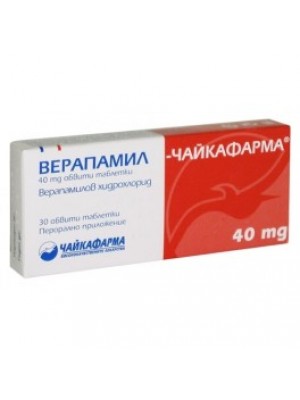
Verapamil table. 40mg. 30 tablets Verapamil WHAT IS AND WHAT..
29.00€