Your shopping cart is empty!
Welcome visitor you can login or create an account.
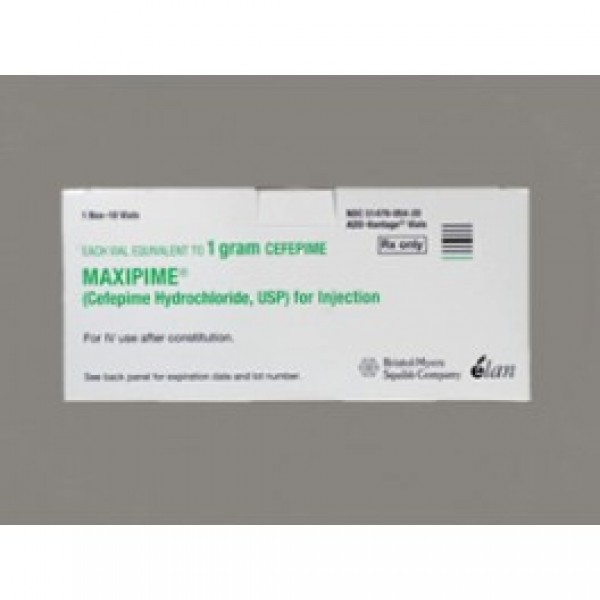
MAXIPIME 1 g.
Product Code: MAXIPIME 1 g.
Availability: In Stock
Product viewed: 1180


MAXIPIME 1 g.

Each vial contains 2000 mg lOOOmg or cefepime and excipient L-arginine.
formulation
Powder for solution for injection
Type of product
Cefepime is a cephalosporin antibiotic with a broad spectrum of activity for intramuscular and intravenous administration.
What applies Maksipim?
Maksipim is indicated for the treatment of the following infections when caused by microorganisms susceptible to cefepime resistant to other antibiotics:
• Infections of the lower respiratory tract infections, including pneumonia and bronchitis
• Urinary tract infections as complications include pyelonephritis and uncomplicated infections
• Infections of the skin and skin structure
• intra-abdominal infections, including peritonitis and biliary tract infections)
• Gynaecological infections
• septicemia (blood poisoning) and bacteremia (presence of bacteria in the circulating blood)
• Empirical therapy for febrile neutropenia (reduced neutrophil leukocytes in peripheral blood)
Pediatrics
Maksipim is indicated for the treatment of pediatric infections listed below caused by susceptible bacteria:
• Pneumonia
• Urinary tract infections, including pyelonephritis as complicated and uncomplicated infections;
• Infections of the skin and skin structures;
• Septicemia;
• Empirical treatment of febrile neutropneniya;
• Bacterial meningitis.
When should you not use Maksipim?
Maksipim is contraindicated in patients with prior hypersensitivity to any component of the drug, cephalosporins, penicillins, or other beta-lactam antibiotics.
precautions
In patients with impaired renal function, the dosage of Maksipim must be adjusted to compensate for the delayed release of the drug by the kidneys.
In the elderly need special care in determining the dose and monitoring of renal function. Must be carefully assessed whether the patient had a known hypersensitivity to cefepime, cephalosporins, penicillins, or other B-lactams. Caution should be used when patients have a history of drug allergy. Allergic reactions requiring discontinuation. Prior to prescribe cephalosporins need a thorough history of the patient. Severe reactions of hypersensitivity require adrenaline and maintenance therapy. Pseudomembranous colitis is seen in the use of broad spectrum antibiotics. It is important that this diagnosis be considered in patients with diarrhea during treatment with Maksipim. In mild cases, treatment is stopped, and at worst is .nalaga; special treatment. If during therapy appears superinfection require additional treatment.
drug Interactions
The patient should inform the doctor of all concomitant medications.
Use in pregnancy and lactation
Before starting treatment with Maksipim, the patient must inform the physician if pregnant or breastfeeding.
Maksipim safety in pregnant has not been established, since these patients are no adequate controlled trials .. This medicine may be used during pregnancy only if there are clear indications for use. Maksipim separated in very small quantities in the milk. Therefore, attention should be given to nursing mothers.
Effects on ability to drive or operate machinery
Not studied the effect of Maksipim when driving or operating machinery.
What should be taken Maksipim?
Dosage and frequency of administration
The dosage and duration of treatment prescribed by the doctor.
Maksipim may be administered intravenously or intramuscularly.
The usual dose in adults and children> 40 kg (12 years) with normal renal function is 1 g administered intravenously or intramuscularly every 12 hours.
The duration of treatment is 7-10 days, but may be longer in severe infections.
Dose, route of administration and duration vary depending on the sensitivity of the causes, severity of infection and renal function of the patient.
Pediatric patients with normal renal function (aged 1 month to 12 years)
Recommended dosages:
Pneumonia, urinary tract infections, skin and skin structures: Patients> 2 months weighing <40 kg: 50 mg / kg every 12 hours for 10 days. For severe infections, apply an 8-hour dosing interval.
Septshtemiya, bacterial meninigit and empiric treatment of febrile neutropenia Patients> 2 months, weighing <40 kg: 50 mg / kg every 8 hours for 7-10 days. Experience of treatment Maksipim in pediatric patients <2 months is limited. Data obtained using a dose of 50 mg / kg and Modeling of pharmacokinetic parameters obtained from subjects> 2 months indicate that a dose of 30mg / kg to 12 hours, or 8 hours may be administered to patients aged 1 to 2 months. Two doses of 50 mg / kg for patients> 2 months and 30 mg / kg for patients between 1 and 2 months are comparable to the dose of 2g in adults. Maksipim application of these patients should be closely monitored.
In pediatric patients weighing> 40 kg administered dose recommended for adults (see Table 1). Patients over 12 years with a body weight <40 kg dosage is the same as for younger patients with body weight <40 kg. The dosage for pediatric patients should not exceed the maximum dosage for adults proporachvana (2g every 8 hours). Experience with intramuscular administration of the drug in pediatric patients is limited. Elderly
No need dose adjustment unless there is concomitant renal impairment.
Patients with impaired hepatic function
No need dose adjustment unless there is concomitant renal impairment
Patients with impaired renal function
In patients with impaired renal function the dose of cefepime should be adjusted to compensate for the slower renal elimination. The recommended starting dose of cefepime in patients with mild to moderate in severity renal dysfunction should be as in patients with normal renal function.
Dialysis patients
Hemodialysis, about 68% of the total cefepime in the body is removed for a 3-hour period of dialysis. Dose equivalent to the starting dose should be administered at the completion of each dialysis session .. In continuous ambulatory peritoneal dialysis Maksipim can be administered every 48 hours in normal recommended doses: 500mg, 1 g, 2 g depending on the severity infection.
Method and route of administration
Maksipim be administered intravenously or intramuscularly in a deep muscle mass.
Intravenous administration is preferred in severe and life-threatening infections, especially if there is a risk of shock.
overdose
In case of overdose, consult a doctor.
In cases of overdose, especially in patients with problems in kidney function, dialysis is used to remove the body Maksipim (hemodialysis is preferred over peritoneal dialysis).
Undesirable effects
Maksipim well tolerated. The most common side effects were gastrointestinal symptoms and hypersensitivity reactions. The following AEs occurred at a rate of 0.1% -1% (unless otherwise indicated):
• Hypersensitivity: rash (1.8%), pruritus, urticaria
• Gastrointestinal: nausea, vomiting, oral moniliasis, diarrhea (1.2%), colitis (including. Pseudomembranous colitis)
• Central nervous system: headache
• Other: fever, vaginitis, erythema.
Events that occurred at a frequency between 0.05 - 0.1% were: abdominal pain, constipation, vasodilation, dyspnoea, dizziness, paraesthesia, genital itching, altered taste, fever and nonspecific moniliasis.
Events with clinical significance occurring at a frequency of <0.05% include anaphylaxis and seizures.
Local reactions: in place of the infusion (5.2%): phlebitis (2.9%) and inflammation (0.1%). On-site administration of muscle inflammation and muscle pain (2.6%).
The patient should inform the doctor if you develop side effects.
How should I store Maksipim?
Maksipim in individual glass vials 500mg, lg and 2g. Maksipim (powder for injection) is stored below 30 ° C protected from light.
The reconstituted solution is stable for 7 days in a refrigerator at 2-8 ° C. Do not use after the expiry date stated on the packaging.
Write a review
Your Name:Your Review: Note: HTML is not translated!
Rating: Bad Good
Enter the code in the box below:
Related Products