Your shopping cart is empty!
Welcome visitor you can login or create an account.
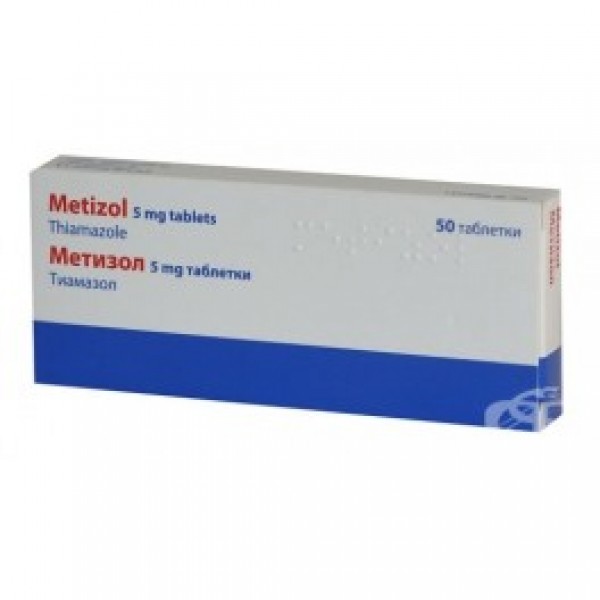
METIZOL 5 mg. 50 tablets
Product Code: METIZOL 5 mg. 50 tablets
Availability: In Stock
Product viewed: 1728


METIZOL 5 mg. 50 tablets
What is Metizol and what it is used
Metizol a medicinal product inhibits the synthesis of thyroid hormones. He, however, does not affect the amount of previously synthesized hormones or of their separation and therefore the effect of his action occurs only after a few days use.
Thanks to its properties Metizol used in overactive thyroid gland (of whatever type) in thyroid crisis in preparation for thyroidectomy and assisting the preparation of treatment with radioactive iodine.
2. What you need to know before taking Metizol
Do not take Metizol:
if you are allergic (hypersensitive) to thiamazole to other medicines belonging to the group of thionamides derivatives or to any of the other ingredients of Metizol;
if you have moderate to severe blood count (granulocytopenia);
in existing cholestasis (condition in which the bile flow is impeded, or stopped altogether), which is not the result of hyperthyroidism; if you have a previous injury to the bone marrow after treatment with thiamazole or carbimazole.
When pregnancy does not take Metizol and thyroid hormones at the same time.
Warnings and precautions:
if you have a large goiter with compression of the trachea (due to the risk of growth of the crop);
if you develop stomatitis, pharyngitis or temperature (symptoms that indicate agranulocytosis - failure of the bone marrow to produce white blood cells) during treatment, especially during the first weeks of treatment (in this case, you should immediately contact your doctor a blood test);
if you are taking high doses of the drug (above 100 mg per day), as this may damage your bone marrow, to cause hypothyroidism (see below) and / or the growth of the crop;
if you suffer from liver failure as possible the release of the drug from the body to be extended, and the power of action to increase;
if you develop Graves disease or the condition worsens during treatment, as this may be associated with progression of the disease of the thyroid gland;
if you develop symptoms such conditions as dry and itchy skin, increased sensitivity to cold, constipation, puffy face, sudden weight gain, muscle aches, joint pain, depression, because they can show the development of hypothyroidism (a condition wherein the thyroid does not produce enough hormones).
If you have mild hypersensitivity reactions (allergic rash, itching) in the past, should not take Metizol than on clear instructions from your doctor.
Children and adolescents
No study on the use of Metizol in children less than two years. Metizol can be used in children and adolescents aged 3 to 17 years (see. P.3). Ask your doctor for more information.
Other medicines and Metizol
Please tell your doctor or pharmacist if you are taking or have recently taken any other medicines, including medicines obtained without a prescription.
Iodine and medicinal products containing iodine (eg. Amiodarone) as well as X-ray contrasting agents, reduce the effect of the action of thiamazole while thiamazole reduces the absorption of radioactive iodine by the thyroid gland.
With the normalization of the concentration of thyroid hormones in the blood, as a result of treatment with Metizol, blood levels of some concomitantly used drugs (theophylline, choline theophyllinate, aminophylline, cardiac glycosides, anticoagulants) can be changed. Therefore, it is possible to require adjustment of their dosing.
Combination therapy with thiamazole and thyroid hormones is contraindicated in pregnancy.
Metizol with food and drink
You can take Metizol with or without food.
Pregnancy, lactation and fertility
Ask your doctor or pharmacist before taking any medicine.
Medicinal product should not be used during pregnancy unless absolutely necessary and other methods of treatment can not be applied.
Thiamazole is excreted in human milk. Therefore, lactating women need to use the lowest effective dose not higher than 10 mg per day.
Driving and using machines
Metizol not affect your ability to drive and use machines.
Metizol contains lactose monohydrate.
If previously established that you are sensitive to some sugars, consult your doctor before using this medicine.
3. How to take Metizol
Always take Metizol exactly as your doctor tells you. If you're not sure, ask your doctor or pharmacist.
The physician determines the dosing individually for each patient depending on the degree of hyperactivity of the thyroid and the size of the crop.
Mature
The initial dose is typically 10-40 mg (2-8 tablets).
In maintenance therapy, the recommended dose is 5-20 mg (1-4 tablets) in combination with levothyroxine or 2,5-10 mg (1 / 2-2 tablets) daily as monotherapy (treatment with one medicine). In hyperthyroidism caused by iodine may be used at higher doses.
Medical treatment of hyperthyroidism usually lasts 1.5 years. If, during this entire period, no improvement can be administered long term anti-thyroid therapy, using the lowest dose, alone or in combination with low doses of levothyroxine.
In treating thyroid crisis, the starting dose is 100 mg (20 tablets), followed by 30 mg (6 tablets) every 8 hours.
In preparation for thyroidectomy, the drug is usually administered 3-4 weeks before surgery.
Elderly:
There is no need to change the dose.
Use in children and adolescents (from 3 to 17 years)
In children (age 3 and older) and adolescents, the dose is determined by patient weight. The initial recommended dose is 0,5 mg / kg per day divided in 2 or 3 equal doses per day. Your doctor may gradually reduce the dosage to a maintenance dose. The total daily dose should not exceed 40 mg.
Not recommended for use in children 2 years and younger.
Patients with renal insufficiency:
There is no need to change the dose.
Patients with hepatic insufficiency:
Follow extremely accurate prescriptions the doctor without using larger doses than prescribed.
Metizol must be taken regularly.
If you take more dose Metizol
In case of overdose can occur: nausea, vomiting, myalgia (muscle pain), constipation (constipation), headaches, menstrual irregularities (in women), low body temperature, increase or appearance of goitre (swelling of the front of the neck), excessive sleepiness or laziness and fatigue, weight gain, dry skin (dry skin) and insomnia.
Drug overdose, contact your doctor, who will take appropriate treatment (eg, vomiting, gastric lavage, administration of activated charcoal).
If you forget to take Metizol
If you miss a dose when it should be taken as soon as possible, provided that it is nearly time for your next dose. If not, do not take a dose to compensate missed. Do not take a double dose to make up the missed dose.
If you stop taking Metizol
If you stop treatment early Metizol can deteriorate your condition.
If you have any further questions on the use of this product, ask your doctor or pharmacist.
4. Possible side effects
Like all medicines, Metizol can cause side effects, although not everybody gets them. Most side effects occur during the first 4-8 weeks of therapy, and the frequency of their occurrence and their intensity depends on the dosage of the drug.
The incidence of adverse reactions is defined as follows:
Very common (> = 1/10);
Common (> = 1/100, <1/10);
Uncommon (> = 1/1000, <1/100);
not known (can not be determined on the basis of available data).
Blood and lymphatic system:
very common - a reduced concentration of total white blood cells in the blood, manifested in the form of cough, sore throat and oral mucosa, temperature hriplivost (frequency of occurrence at the time of application of Metizol: 12% in adults, in children 25% in patients with previously untreated hyperthyroidism 10%);
uncommon - a reduced concentration of the granulocytes, which manifests itself in the same manner as the reduced concentration of white blood cells (incidence: 0.4%);
Not known - aplastic anemia (cough, sore throat and oral mucosa, temperature, hriplivost, weakness, shortness of breath under load, bleeding, petechial hemorrhages in the skin), reduced concentration of platelets in the blood (haemorrhages, often appearing bruised blood in stool or urine, dark stools, pinpoint hemorrhages in the skin), increased lymph nodes.
Metabolism and nutrition disorders:
Not known - a reduction of appetite.
Nervous system disorders:
Not known - peripheral neuropathy (numbness and tingling in hands, feet and face), dizziness.
Vascular disorders:
Not Known - inflammation of the vessels.
Gastrointestinal disorders:
Not known - intestinal sluggishness, vomiting, stomach pain, increase in salivary glands.
Hepatobiliyarni disorders:
Not known - cholestatic jaundice (yellowing of the skin and eye sclera) and hepatonekroza.
Skin and subcutaneous tissue disorders:
common - a skin rash or itching (in 3-5% of patients);
very rare - only isolated reports of severe forms of the syndrome Stevens-Johnson, including generalized dermatitis.
Musculo-skeletal and connective tissue disorders:
Not known - joint pain and inflammation of the joints (joint pain and swelling, redness of the skin on the joints), pain and polymyalgia rheumatica nevliyaeshti of glucocorticosteroids (general weakening of the body and temperature).
Renal and urinary:
Not known - inflammation of the kidneys and renal vessels (pain in the waist, increase or decrease the amount of urine, swelling in the feet and legs).
General disorders:
common - a high temperature;
very rare, including isolated reports: reported isolated cases of insulin autoimmune syndrome (with a sharp drop in blood sugar).
If any of the side effects gets serious, or you notice other effects not listed in this leaflet, please tell your doctor or pharmacist.
5. How to store Metizol
Store in the original container.
Keep out of reach of children.
This medicinal product does not require any special storage conditions.
Do not use Metizol after the expiry date stated on the carton. The expiry date refers to the last day of that month.
Medicines should not be disposed of in wastewater or household waste. Ask your pharmacist how to dispose of medicines no longer required. These measures will help to protect the environment.
6. Contents of the pack and further information
What Metizol
The active substance is thiamazole as 5 mg.
The other ingredients are lactose monohydrate, potato starch, povidone, talc, magnesium stearate.
Write a review
Your Name:Your Review: Note: HTML is not translated!
Rating: Bad Good
Enter the code in the box below:
Related Products

Iodine from kelp 225 mcg. 250 capsulesMaintain a healthy thy..
37.00€