
Your shopping cart is empty!
Welcome visitor you can login or create an account.
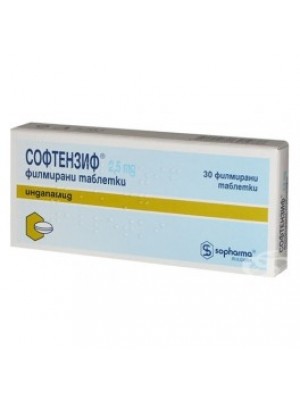
NEOPAMID 2.5 mg. 30 tablets
Product Code: NEOPAMID 2.5 mg. 30 tablets
Availability: In Stock

Product viewed: 1016


NEOPAMID 2.5 mg. 30 tablets
Pharmacotherapeutic group
Neopamid 2.5 mg (indapamide) is a non-thiazide sulfonamide indole ring belonging to the group of diuretics.
Indications
For the treatment of hypertension.
Information required prior to use
Contraindications
Neopamid 2.5 mg is not recommended in patients with:
• a recent cerebrovascular accident,
• severe renal insufficiency,
• hepatic encephalopathy or severe hepatic insufficiency
• severe hepatic infarction,
• hypokalaemia
• hypersensitivity to sulfonamides. Special precautions for use
• The level of potassium in the blood, and urate levels should be closely monitored in patients predisposed or susceptible to hypokalaemia (those treated with cardiac glycosides, patients over 65 years of age or suffer from aldosteronism), and in patients suffering from gout.
• In case of worsening of renal impairment is recommended that treatment with 2.5 mg Neopamid be discontinued.
• In patients with hyperparathyroidism treatment Neopamid 2.5 mg must be stopped at the occurrence of hypercalcemia.
• Studies in functional anephric patients within one month, to be on chronic hemodialysis, have shown no evidence of drug accumulation, although indapamide not dialyzed.
• Although 2.5mg indapamide day (one tablet) can safely be administered to hypertensive patients with impaired renal function, treatment should be discontinued if evidence of renal failure aggravated.
Interactions
Combined administration of 2.5 mg Neopamid not recommended with the following medications:
• Diuretics (risk of electrolyte imbalance)
• Antiarrhythmics as hinidinovi derivatives, cardiac glycosides, corticosteroids or laxatives in case of hypokalemia
• Lithium (increase in blood levels due to reduced urinary excretion of lithium)
Use in pregnant and lactating
Pregnancy: No teratogenic effects in animals, but since this type of studies are not always predictive of human response, Neopamid 2.5 mg should be used during pregnancy only if strictly necessary. The basic rule is to avoid the use of diuretics during pregnancy and should never be used even to treat physiological edema during pregnancy. Diuretics can cause ischemia fitoplatsentarna risk of fetal hypotrophy.
Breastfeeding: Breastfeeding is not recommended during treatment (indapamide is excreted in breast milk).
Since most drugs are excreted in human milk, if the use of 2.5 mg Neopamid® is extremely urgent, the patient should stop nursing.
Effects on ability to drive and use machines
Indapamide does not affect vigilance but can sometimes occur different reactions in relation to the reduction of blood pressure, especially at the beginning of treatment or include other antihypertensive LP. As a result can impair the ability to drive and use machines.
Information on proper use
Dosage and frequency of administration
Adults: The daily dose is one tablet containing 2.5mg indapamide hemihydrate, taken in the morning. The effect of 2.5 mg Neopamid is gradually reducing blood pressure can continue without reaching a maximum within a few months after starting treatment. More than 2.5mg dose Neopamid 2.5 mg daily is not recommended due to insignificant additional effect on account of the apparent diuretic effect. If the once-daily tablet 2.5 mg Neopamid® not achieve sufficient reductions in blood pressure, can be added for other antihypertensives; in combination with 2.5 mg Neopamid can be used beta-blockers, ACE inhibitors, methyldopa, clonidine and other adrenergic blocking agents. Adding in therapy Neopamid 2.5 mg of diuretics that can cause hypokalemia, it is not recommended.
There is no evidence of rebound hypertension after stopping Neopamid 2.5 mg.
Patients over 65 years of age: There were no significant changes in the pharmacokinetics of indapamide in elderly patients. Numerous clinical studies have shown that the drug can be used without problems, and that has a particularly advantageous effect on systolic blood pressure in these patients.
Children: There is no clinical experience of the preparation in children. Symptoms of overdose
These are those related to diuretnichniya effect: electrolyte disturbances, hypotension and muscle weakness.
Emergency measures in overdose
Treatment should be symptomatic, aimed at correcting electrolyte disturbances, sometimes having to perform gastric lavage and induce vomiting.
Adverse reactions
Most of the clinical side effects and effects on laboratory tests are dose-dependent and can be reduced by determining the minimal effective dose.
Thiazide diuretics and their analogues can cause the following effects:
In terms of laboratory parameters:
o Broadcast potassium with hypokalemia; this is particularly important in the risk groups (see Precautions).
In clinical trials with indapamide 2.5mg in the dose is found a decrease in serum potassium after 4 to 6 weeks treatment: at 2.5% of the patients but the serum potassium level was <3.4 mmol / 1 and in 10% of patients - <3.2 mmol / 1 . After 12 weeks of treatment, mean decrease in serum potassium concentration was 0.41 mmol / 1.
o Hyponatremia with accompanying hypovolemia leads to dehydration and postural hypotension. Concomitant loss of chloride ions secondary triggers a compensatory metabolic alkalosis. This effect is weak and occurs rarely.
o Increased serum concentration of uric acid and glucose during treatment. The use of such diuretics in patients suffering from gout and diabetes, should be carefully considered (see 5.1 Pharmacodynamic properties).
o Much more rare hematological disorders - thrombocytopenia, leukopenia, agranulocytosis, bone marrow aplasia, and hemolytic anemia.
o In very rare cases hypercalcaemia.
Regarding clinical indicators:
o Hepatic encephalopathy can develop when liver damage (see Contraindications and Warnings).
o Hypersensitivity reactions, mainly dermatological, in patients prone to allergic and asthmatic events.
o maculopapular rash, purpura, possible aggravation of existing systemic lupus erythematosus.
o Nausea, constipation, dizziness, Aston, paresthesia, headache, dry mouth - occur rarely and usually weaken with dose reduction.
o In very rare cases, pancreatitis.
Special storage conditions
Do not store above 30 ° C.
Write a review
Your Name:Your Review: Note: HTML is not translated!
Rating: Bad Good
Enter the code in the box below:
Related Products
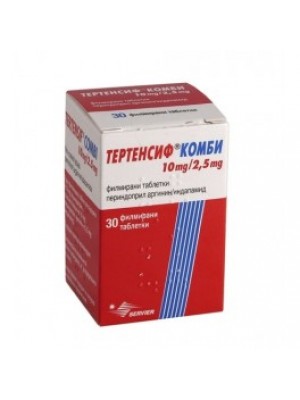
TERTENZIF COMBI table. 2.5 mg. / 10 mg WHAT TERTENSIF COMBI ..
37.00€
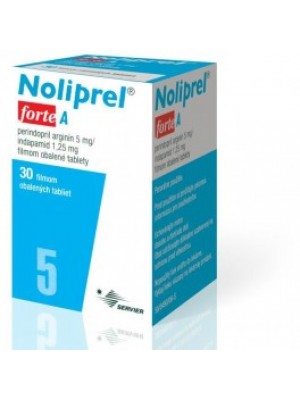
NOLIPREL FORTE 5 mg. 30 tabletsINGREDIENTS:Active substance:..
23.00€