
Your shopping cart is empty!
Welcome visitor you can login or create an account.
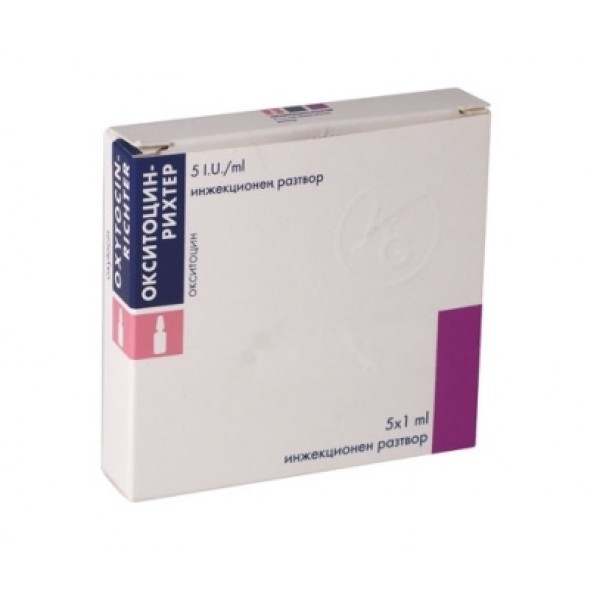
OXYTOCIN 5 IU 1 ml. 5 ampules
Product viewed: 2541


OXISOTCIN solution for injection 5 IU / ml
2. QUALITATIVE AND QUANTITATIVE COMPOSITION
Each ampoule of 1 ml contains 5 IU / 1 ml oxytocin.
For excipients, see 6.1.
3. PHARMACEUTICAL FORM
Solution for injection.
Clear, colorless, injection injections and ethanol.
4. CLINICAL PARTICULARS
4.1, Therapeutic Indications
Oxytocin is indicated for the induction or stimulation of uterine contractions.
Forerunner testimonial:
Oxytocin is indicated for birth induction on medical indication
Follow-up:
control of post-partum bleeding and uterine hypotension
4.2. Dosage and route of administration
The dosage should be tailored to the individual needs of each patient, depending on the maternal and fetal response.
The following information refers to different dosage regimens and indications in the majority of cases.
Induction or stimulation of labor
Intravenous infusion (drip method) is the most appropriate route of administration for induction or birth stimulation. Strict control of the drip infusion rate is essential. For greater certainty, it is necessary to use an infusion pump or other similar device and to perform frequent monitoring of the contraction force and heart rate during the induction or stimulation of labor. If uterine contractions become too strong, the infusion may stop immediately and oxytocin stimulation of the uterine muscles will soon decrease.
Oxytocin infusion should not be started within 6 hours after vaginal prostaglandin administration.
1. An infusion of solution containing no oxytocin solution of physiological electrolytes should be included.
2. The usual infusion solution is prepared as the contents of one ampoule of 1 ml (5 IU) are aseptically dissolved in 1000 ml of physiological saline. The combined solution, after gently shaking, contains 5 mU oxytocin / ml. The oxytocin solution bank is fed into the system via an infusion pump or other similar device, with a view to strictly controlling the rate of infusion.
3. The starting dose should not exceed 0.5-4 mU (milliseconds) per minute. The dose can be increased gradually every 20 to 40 minutes by 1 to 2 milliliters / min. until an adequate uterine activity is established. When the desired frequency of contractions (similar to that of a spontaneous normal delivery) is achieved without signs of fetal distress and childbirth is advanced to 4-6 cm detection, the rate of oxytocin infusion can be reduced with the same degree. The term "high-speed infusion" should be used with great caution, and it is very rare to use more than 8-9 milliseconds per minute. Prior to the term, larger quantities are often required, sometimes more than 20 milliseconds / min.
If an adequate uterine activity is not achieved in women close to the term after infusion of 5 IU of oxytocin, it is recommended to discontinue the induction of labor induction; labor induction trials may resume the next day, starting again at a dose of 0.5-4 mU / min.
4. Fetal heart rate monitoring, uterine tone beyond the contractions, and the frequency, duration and severity of contractions are necessary.
5. Oxytocin infusion should be discontinued immediately in the event of uterine hyperactivity or fetal distress. Oxygen should be given to the mother. The condition of the mother and the fetus should be evaluated by a competent physician.
Control of post-birth bleeding:
a) Intravenous infusion (drip method):
10-40 units of oxytocin are dissolved in a 1000 ml saline solution for control of post-birth bleeding, administered at a rate of 20-40 milliliters / minute sufficient to protect uterine atonia.
(b) Intramuscular use:
1 ml (5 units) oxytocin is administered after the placental release.
Use in Incomplete or Progressive Abortion
Infusions are infused with 500 ml saline or 5% dextrose in saline, to which 10 units of oxytocin are added at a rate of 20-40 drops / minute.
Diagnosis of utero-placental insuffiency (functional oxytocin test)
It starts with an intravenous infusion of 0.5 milliliters / minute, doubled every 20 minutes until the effective dose (typically 5-6 milliliters / min, maximum 20 milliliters / min) is reached. After recording three moderate contractions (lasting from 40 to 60 seconds) for a 10-minute interval, the infusion is discontinued and late or varying degrees of fetal heart rate decay are observed.
4.3. Contraindications
The use of oxytocin is contraindicated in any of the following cases: patients with drug hypersensitivity; significant discrepancy between the size of the fruit and the pelvis, unfavorable position or presentation of the fetus, where the birth is impossible without a prior version (crosswise); ie urgent obstetric conditions in which the risk to the mother or the fetus necessitates surgery
4.4. Special warnings and special precautions for use
Except in unusual circumstances, oxytocin should not be administered under the following conditions: prematurity, borderline pelvic-fetal imbalance, pre-operative cervical or uterine surgery, caesarean section, uterine rewetting, high multipariety, invasive cervical carcinoma. It should not be used for induction of labor before engagement of the foreseen part of the fetus - head or seat. Because of the variety of combinations of factors under the conditions described above, the definition of "unusual circumstances" is based on the judgment of the physician. The decision should be made only after careful consideration of the potential positive effect that oxytocin may have on the case against the rare but present possibility of the drug leading to uterine hypertonia or tetanus spasm.
The use of oxytocin for induction or birth stimulation should only be done via the intravenous route and under adequate medical supervision in hospital conditions. All patients should be placed under constant surveillance by trained staff with good knowledge of the drug and qualified to identify complications. There should be a doctor who can handle any complications. Oxytocin is continuously monitored for uterine contractions, maternal and fetal heart rate as well as for the blood pressure of the fertilizer in order to avoid complications. In the event of uterine hyperactivity, oxytocin infusion should be discontinued immediately; oxytocin-induced stimulation of uterine contractions decreases soon after discontinuation of the infusion.
When administered correctly, oxytocin causes uterine contractions similar to those of normal delivery. Over-stimulation of the uterus by improper administration of the drug is risky for both the mother and the fetus. Even with proper administration and adequate control, hypertonic contractions may occur in patients with an oxytocin hypersensitive uterus.
In the event of fetal death in the uterus and / or the presence of meconium in the area around fertile water, avoid ferocious activity due to the risk of amniotic embolism.
It should always be borne in mind that there is an opportunity for 'increased blood loss and affinity.
Maternal deaths have been reported due to hypertension, subarachnoid haemorrhage, uterine rupture, and fetal death due to various causes in connection with the parenteral administration of oxytocin products for induction or stimulation in the first and second stages of delivery.
Oxytocin has been shown to have a significant antidiuretic effect by enhancing glomerular filtrate reabsorption. Therefore, the possibility of water intoxication should be considered, especially during prolonged intravenous infusion and if the mother takes oral fluids. Prevention of this condition includes the following procedures: administration of electrolytes in an infusion when a prolonged infusion of oxytocin is required; maintaining a low flow of infused fluids; limiting oral fluid intake, continuous water balance control and monitoring of serum electrolytes in case of suspicion of abnormalities.
Oxytocin is contraindicated in patients with pre-existing hypersensitivity to it.
Oxytocin should not be administered at the same time via more than one route of administration.
4.5. Drug and other interactions
Cases of severe hypertension have been reported when oxytocin is administered 3 to 4 hours after prophylactic administration of vasoconstrictors in association with spinal anesthesia. The administration of cyclopropane under anesthesia may modify the cardiovascular effect of oxytocin and produce unexpected results such as hypotension. In the same combination, cases of sinus bradycardia with maternal abnormal atrioventricular rhythm have been reported. Since prostaglandins have been shown to potentiate the effect of oxytocin, their concomitant use is not recommended. If prostaglandins and oxytocin are administered sequentially, uterine activity should be monitored with caution.
4.6. Pregnancy and breastfeeding
No other indications for the use of oxytocin during the first three months of pregnancy are known except for miscarriage or miscarriage. Based on the experience with this drug, its chemical structure and its pharmacological properties, it is not considered to cause abnormalities in the fetus when applied according to the indications.
Small amounts of oxytocin are found in breast milk.
If oxytocin is used to treat severe haemorrhage, breast-feeding should not be initiated until it has been definitively stopped.
Since prostaglandins have been shown to potentiate the effect of oxytocin, their concomitant use is not recommended. If prostaglandins and oxytocin are administered sequentially, uterine activity should be monitored with caution.
4.7. Effects on ability to drive and use machines
Oxytocin has no influence on the ability to drive and work with crushers.
4.8. Adverse drug reactions
The following side effects have been reported in the mother: Overdose or hypersensitivity to the drug may result in uterine hypertension, spasm, tetanus contractions or uterine rupture. Administration of oxytocin could result in post-partum bleeding; this effect is due to established oxytocin-induced thrombocytopenia, afininogenemia and hypoprothrombinemia. With careful birth control, the incidence of postpartum bleeding may be reduced to a minimum. Rare cases of pelvic hematoma have been reported.
With large doses of oxytocin, cardiac arrhythmias or premature ventricular contractions may occur; hypotension followed by hypertension and reflex tachycardia. There have been reports of nausea and vomiting.
Because of the antidiuretic effect, prolonged intravenous infusion of oxytocin (typically 40 to 50 milliliters per minute) and large volumes of infusions may lead to severe water intoxication. A severe form of water intoxication with convulsions and coma has been reported in association with slow oxytocin infusion for more than 24 hours. Cases of maternal death due to water intoxication due to oxytocin infusion have also been reported. There have been reports of anaphylaxis and other allergic reactions, which in very rare cases have a fatal outcome.
The following side effects have been reported in the fetus or neonate:
- as a result of induced uterine function: sinus bradycardia, tachycardia, premature ventricular abrasions or other arrhythmias, permanent CNS or brain damage and fetal death due to asphyxia.
- due to mother's oxytocin: low Apgar score 5 minutes, neonatal jaundice and neonatal retinal haemorrhage.
4.9. Overdose
Overdose of oxytocin is mainly dependent on uterine hyperactivity, whether due to hypersensitivity to this drug. Over-stimulation, expressed by strong (hypertonic) or prolonged (tetanus) contractions or residual tone between contractions of 15 to 20 mm water column or more, may result in fertile birth, uterine rupture, cervical and vaginal rupture, post- hypoperfusion and variable degrees of fetal heart failure, hypoxia, hypercapnia or fetal death. Water-induced seizures due to the inherent antidiuretic effect of oxytocin is a serious complication and may occur at high doses (40 to 50 ml / min) infused over a prolonged period. The treatment of aquatic intoxication consists in immediate discontinuation of the oxytocin infusion, limitation of fluid intake, provision of diuresis, intravenous administration of hypertonic saline solution, correction of electrolyte imbalance, treatment of seizures with reasonable doses of barbiturates and special care of comatose patients.
5. PHARMACOLOGICAL PROPERTIES
5.1. Pharmacodynamic properties
ATC Code H01B B02
The pharmacokinetic and clinical properties of oxytocin are identical to those of the natural oxytocin emitted from the posterior pituitary. The uterine myometrium contains specific oxytocin receptors belonging to the group of G-protein-binding receptors. Oxytocin stimulates contraction of smooth uterine muscle by increasing the intracellular calcium concentration, causing contractions as in normal spontaneous delivery and temporary increase in uterine blood flow. The amplitude and duration of the uterine contractions increase, resulting in cervical discovery and smoothing. The number of receptors and, respectively, the sensitivity of the uterus to oxytocin increases during pregnancy and reaches the maximum during the term. During pregnancy, oxytocin is able to induce a gradual increase in uterine motility by a moderate increase in the incidence and severity of spontaneous motor activity to lasting tetanus contractions.
Oxytocin reduces the myoepithelial cells surrounding the alveoli in the mammary glands and thus facilitates the release of milk.
Oxytocin causes dilatation of the vascular smooth muscle, increasing the kidney, coronary and cerebral blood flow. Blood pressure usually remains unchanged, but intravenous infusion of very large or undiluted amounts of solutions may temporarily and reflectively decrease tachycardia and increase stroke. Any initial decrease is usually followed by a small but sustained increase in blood pressure.
Unlike vasopressin, oxytocin has minimal
PHARMACEUTICAL DATA
6.1. List of excipients and their amounts
Acetic acid, glacial, chlorobutanol hemihydrate, ethanol 96% water for injections
6.2. Incompatibilities
It can be mixed with Infusio natrii lactici salina, Infusio natrii chlorati and Infusio glucosi. The resulting pharmaceutical product should be used within a maximum of 8 hours.
(Compatibility tests with 500 ml injection solutions)
6.3. Shelf life
3 years
6.4. Special storage conditions
Store at 2 ° C - 8 ° C in the original package.
6.5. Packaging data
5 x 1 ml colorless, clear ampoules, with a white break point, in a plastic holder and a cardboard folding box.
6.6. Advice on use / handling
Especially for hospital use (hospitalized patients) or in the case of special instructions for use outside the health centers.
Write a review
Your Name:Your Review: Note: HTML is not translated!
Rating: Bad Good
Enter the code in the box below:
Related Products

What is Gynipral ampoules 10 μg / 2 ml and what is it used?
..
29.00€