Your shopping cart is empty!
Welcome visitor you can login or create an account.
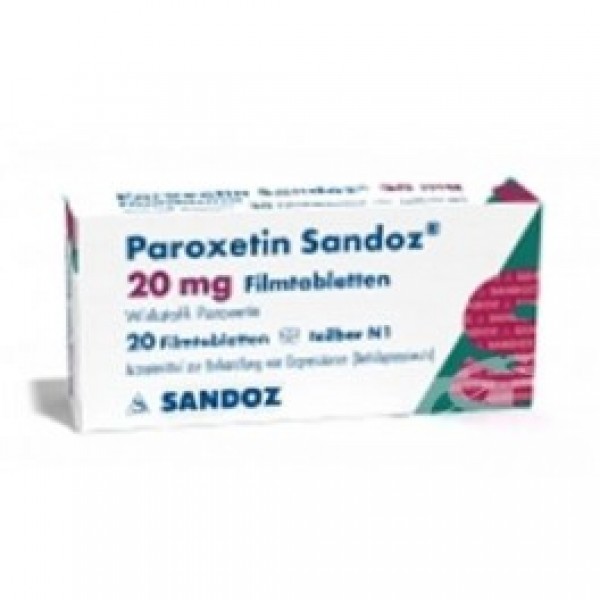
Paroxetine table . 20 mg
Product Code: Paroxetine table . 20 mg
Availability: In Stock
Product viewed: 1546


Paroxetine table. 20 mg
Qualitative and quantitative composition:
Paroxetine Sandoz 20 mg film-coated tablets containing paroxetine 20 ml / paroksetinov as hydrochloride, anhydrous 22.2 mg /
Indications
Treatment of:
Major depressive episode
OCD
Panic disorder and agoraphobia or without
Social Anxiety Disorder / Social Phobia
Generalized Anxiety
PTSD
Dosage and administration:
It is recommended that paroxetine not be used as a single daily dose in the morning with food. The tablets should be swallowed whole and not chewed.
Major depressive episode
The recommended starting dose is 20 mg daily. Improvement began after one week, but is manifested by the second week of therapy. As with all antidepressants, if needed, the dose should be reviewed and adjusted between 3-4th week after initiation of therapy and then, if necessary, according to clinical judgment. In some patients with inadequate response to 20 mg, the dose may be increased gradually by 10 mg to a maximum of 50 mg daily, depending on individual patient tolerance.
Patients with depression should be treated long enough for at least six months to complete resolution of symptoms.
Obsessive-Compulsive Disorder
The recommended dose is 40 mg daily. The starting dose is 20 mg daily and may be increased gradually by 10 mg to the recommended dose. If after several weeks of treatment with the recommended dose insufficient response is seen some patients the dose may be increased gradually to a maximum of 60 mg daily. Patients with OCD should be treated sufficiently long time until siptomatikata disappear. This period may be several months or longer.
Panic disorder:
The recommended dose is 40 mg daily. The starting dose is 10 mg daily and may be increased gradually to 10 mg, based on individual patient tolerance. A low starting dose to minimize the potential worsening of symptoms, which usually occurs early in the course of treatment. If after a few weeks with the recommended dose insufficient response is seen some patients the dose may be increased gradually to a maximum of 60 mg daily.
Patients with panic disorder should be treated sufficiently long time until symptoms disappear. This period may be several months or longer.
Social Anxiety Disorder / Social Phobia:
The recommended dose is 20 mg daily. If after a few weeks there was no satisfactory response in some patients the dose may be increased gradually by 10 mg to a maximum of 50 mg daily. Prolonged use should be regularly evaluated.
Generalized anxiety:
The recommended dose is 20 mg daily. If after a few weeks there was no satisfactory response, the dose may be increased gradually by 10 mg to a maximum of 50 mg daily. Prolonged use should be regularly evaluated.
PTSD:
The recommended dose is 20 mg daily. If after a few weeks there was no satisfactory response, the dose may be increased gradually by 10 mg to a maximum of 50 mg daily. Prolonged use should be regularly evaluated.
Contraindications:
Hypersensitivity to paroxetine or any of the excipients.
Paroxetine is contraindicated in combination with monoamine oxidase inhibitors. Treatment with paroxetine can be initiated:
Two weeks after stopping the MAOI or irreversible
At least 24 hours after discontinuation of reversible MAOIs.
Required at least one week between stopping paroxetine and initiation of therapy with an MAOI.
Paroxetine should not be used in combination with thioridazine and other drugs that inhibit hepatic enzyme CYP450 2D6, paroxetine because it may increase the plasma levels of thioridazine. Thioridazine alone can lead to a prolongation of the QT-interval with severe ventricular arythmias as torsades de pointes, and sudden death.
Paroxetine should not be used in combination with pimozide.
Paroxetine should not be used in the treatment of children and adolescents under 18 years. In clinical studies in children and adolescents often sablyudavani suicidal behavior and hostility in patients treated with paroxetine compared with placebo.
Pregnancy and lactation
Some epidemiological studies provide a slightly increased risk of cardiovascular malformations associated with the use of paroxetine during the first trimester. The mechanism is unknown. The data show that the risk for infant exposed to paroxetine during pregnancy is less than 2/100, compared with the expected frequency of 1/100 of these defects in the general population. Available data show no increase in the incidence of congenital malformations overall.
Paroxetine should not be used during pregnancy when strictly indicated. Women planning pregnancy and that pregnancy is a time of perapiya should consult with the prescriber. Abrupt discontinuation during pregnancy should be avoided.
Neonates should be observed if maternal use of paroxetine continues into the later stages of pregnancy, particularly the third trimester. In these cases can be observed the following symptoms: respiratory distress, cyanosis, apnea, seizures, temperature fluctuations, malnutrition, vomiting, constant crying, somnolence, sleep disturbances, nervousness. These symptoms may be due to either serotonergic effects or withdrawal symptoms. In most cases, complications started immediately or soon after birth.
Breastfeeding
Small amounts of paroxetine in breast milk. However, paroxetine should not be used during lactation unless the benefit outweighs the potential risk to the child.
Adverse reactions:
Blood and lymphatic system disorders:
Uncommon - bleeding, particularly of the skin and mucous membranes
Very rare - thrombocytopenia
Immune system disorders:
Very rare - allergic reactions
Endocrine disorders:
Very rare - syndrome of inappropriate antidiuretic hormone
Metabolism and nutrition disorders:
Common - decreased appetite
Rare - hyponatremia
Hyponatraemia has been reported predominantly in the elderly and in some cases due to the syndrome of inappropriate antidiuretic hormone.
Psychiatric disorders:
Common: drowsiness, insomnia, agitation
Uncommon - confusion, hallucinations
Rare - manic reactions, anxiety, panic attacks
With some frequency - have reported cases of suicidal ideation and suicidal behavior during treatment with paroxetine or soon after stopping treatment.
Nervous system disorders:
Common - dizziness, tremor
Uncommon - extrapyramidal disorder
Rare - psychomotor restlessness, seizures
Very rare - serotonin syndrome, confusion, hallucinations, myoclonus, shivering, tachycardia and tremor
Eye disorders:
Common - blurred vision
Very rare - acute glaucoma
Cardiac disorders:
Uncommon - sinus tachycardia
Rare - bradycardia
Vascular disorders:
Uncommon - transient increase or decrease in blood pressure
Changes in blood pressure were observed after treatment with paroxetine in patients with pre-existing hypertension or anxiety.
Respiratory, thoracic and mediastinal disorders:
Common - yawning
Gastrointestinal disorders:
Very common - nausea
Uncommon - constipation, diarrhea, dry mouth
Very rare - gastrointestinal bleeding
Hepatobiliary disorders:
Rare - elevated liver enzymes
Very rare - liver disorders
Skin and subcutaneous tissue disorders:
Common - increased sweating
Uncommon - rash, itching
Very rare - photosensitivity reactions
Renal and urinary disorders:
Uncommon - urinary retention
Reproductive system and breast disorders:
Very common - sexual dysfunction
Rare - hyperprolactinaemia / galactorrhoea
Very rare - priapism
Musculo-skeletal system:
Rare - arthralgia, myalgia
Write a review
Your Name:Your Review: Note: HTML is not translated!
Rating: Bad Good
Enter the code in the box below:
Related Products

REXETIN table. 20 mg. 30 tablets REXETIN WHAT IS AND WHAT IT..
27.00€