Your shopping cart is empty!
Welcome visitor you can login or create an account.
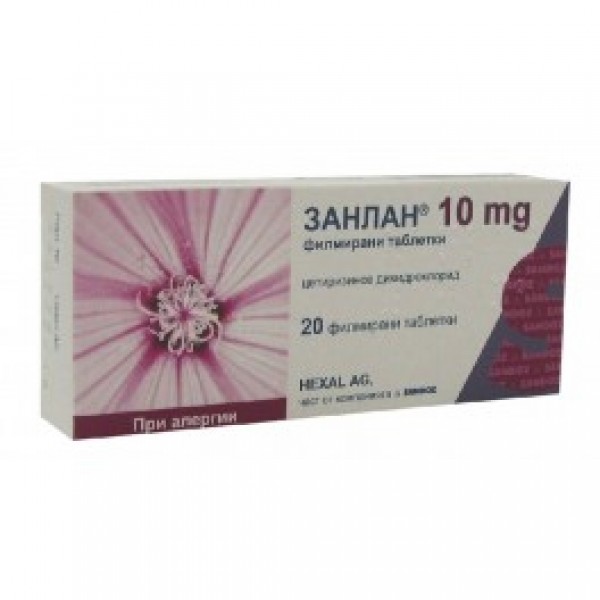
ZANLAN 10 mg. 20 tablets
Product Code: ZANLAN 10 mg. 20 tablets
Availability: In Stock
Product viewed: 1838


ZANLAN 10 mg. 20 tablets
ZANLAN WHAT IS AND WHAT IT IS USED
ZANLAN contains the active ingredient cetirizine hydrochloride.
ZANLAN is an antiallergic drug.
ZANLAN is indicated in adults and children 6 years of age:
relief of nasal and ocular symptoms of seasonal and perennial allergic rhinitis
For relief of chronic hives (urticaria)
BEFORE YOU TAKE ZANLAN
Do not take ZANLAN
If you have severe kidney disease (severe renal failure with creatinine clearance below 10 ml / min).
If you are allergic (hypersensitive) to the active substance of ZANLAN to any of the ingredients to hydroxyzine or to any piperazine derivatives (substances similar to other drugs).
Do not take ZANLAN 10 mg tablets
If you have hereditary problems of galactose intolerance, Larr lactase deficiency or glucose-galactose malabsorption
Take special care with ZANLAN
If you have kidney problems, please ask your doctor for advice, if necessary, will take a lower dose. Your doctor will determine the next dose. If you have epilepsy or risk of convulsions, you should ask your doctor for advice. At usual doses, no clinically significant interactions between cetirizine with alcohol (at a concentration of alcohol 0.5 g / l, corresponding to a glass of wine). However, as with all antihistamines, concomitant use of alcohol.
Taking other medicines
Please tell your doctor or pharmacist if you are taking or have recently taken any other medicines, including medicines obtained without a prescription. Due to the profile of cetirizine, no interactions with other medications.
Taking ZANLAN with food and drink
Food does not noticeably affect the absorption of cetirizine.
Pregnancy and lactation
Ask your doctor or pharmacist before taking any medicine. As with other drugs ZANLAN use during pregnancy should be avoided.
Occasional use by pregnant women should not produce any harmful effects on the fetus, but the use of the drug should be discontinued.
ZANLAN is contraindicated during breast-feeding because breast milk cetirizine.
Driving and operating machinery
Clinical studies have shown no disturbance in attention, alertness and ability to drive after taking ZANLAN at the recommended dose. If you intend to drive, engage in potentially hazardous activities or operate machinery should not exceed the recommended dose.
Carefully consider the effect. If you are a sensitive patient, you might find that concomitant use of alcohol or other depressant effect on the nervous system may cause additional reduction in attention and affect your ability to react.
Important information about some of the ingredients of ZANLAN
Tablets containing lactose. If your doctor has told you that you have an intolerance to some sugars, consult with him before taking this medicine.
Each tablet contains less than 0.01 carbohydrate units.
HOW TO TAKE ZANLAN
Follow the recommendations below, unless your doctor has given you other instructions for the use of ZANLAN. Follow the instructions, otherwise ZANLAN may not be fully effective. Tablets should be swallowed with a glass of liquid.
Adults and adolescents over 12 years:
10 mg once daily 1 tablet.
Children 6 - 12 years:
5 mg twice daily as a half tablet twice daily.
Patients with moderate to severe renal impairment
In patients with moderate renal impairment are recommended to take 5 mg once daily. If you feel that ZANLAN effect is too weak or too strong, please consult your doctor.
Duration of treatment:
The duration of treatment depends on the type, duration and course of your complaints and is determined by your doctor.
If you take more than the dose ZANLAN
If you think you have overdosed ZANLAN, please tell your doctor.
Your doctor will decide what action to take, if needed.
After overdose described below side effects may occur with increased frequency.
Adverse reactions:
confusion, diarrhea, dizziness, fatigue, headache, malaise, fundus, pruritus, restlessness, sedation, somnolence, stupor (stupor), abnormally rapid heartbeat, tremors, and urinary retention.
If you forget to take ZANLAN
Do not take a double dose to make up.
If you stop taking ZANLAN
If you have any further questions on the use of this product, ask your doctor or pharmacist.
POSSIBLE SIDE EFFECTS
Like all medicines, ZANLAN can cause side effects, although not everybody gets them. The following adverse reactions have been reported in post marketing experience. Frequencies are defined as: (common: 1 in 100 to 1 in 10 uncommon: 1 in 1,000 to 1 in 100, rare: 1 in 10,000 to 1 in 1000, very rare: less than 1 in 10,000).
Blood and lymphatic system disorders:
very rare: thrombocytopenia (low blood platelets)
The entire body:
Common: fatigue
Cardiac disorders:
very rare: tachycardia (rapid heartbeat)
Eye disorders:
very rare: accommodation disorder, blurred vision, oculogyration (uncontrolled eye movements)
Gastrointestinal Disorders
common: dry mouth, nausea, diarrhea
Uncommon: abdominal pain
General disorders and administration site conditions:
Uncommon: asthenia (fatigue), malaise
Rare: edema (swelling)
Immune system disorders:
Rare: allergic reactions, some severe (very rare)
Hepatobiliary disorders:
Rare: abnormal hepatic function
Investigations
Rare: weight gain
Nervous system disorders:
common: dizziness, headache
Uncommon: paraesthesia (unusual sensations on the skin)
Rare: convulsions, movement disorder
very rare: syncope, tremor (shaking), dysgeusia (altered taste)
Psychiatric disorders:
common: somnolence uncommon anxiety
Rare: aggression, confusion, depression, hallucinations, insomnia very rare tics
Renal and urinary disorders:
very rare: abnormal urine output
Respiratory system disorders:
Uncommon: pharyngitis, rhinitis
Skin and subcutaneous tissue disorders:
Uncommon: pruritus, rash
Rare: urticaria (hives);
very rare: edema, fixed drug eruption.
Tell your doctor if you have any of these side effects. At the first sign of a hypersensitivity reaction stop taking ZANLAN. Your doctor will assess the severity and decide what further steps need to be taken. If you notice any side effects not listed in this leaflet, please tell your doctor or pharmacist.
HOW TO STORE ZANLAN
Keep out of reach of children. Do not use the tablets after the expiry date stated on the blister and carton.
ADDITIONAL INFORMATION
What ZANLAN
The active substance is cetirizine dihydrochloride.
Each tablet contains 10 mg of cetirizine hydrochloride.
The other ingredients are:
Microcrystalline cellulose hipro-meloza, lactose monohydrate, macrogol 4000, magnesium stearate, silica colloidal anhydrous, color titanium dioxide (E 171).
Write a review
Your Name:Your Review: Note: HTML is not translated!
Rating: Bad Good
Enter the code in the box below:
Related Products