Your shopping cart is empty!
Welcome visitor you can login or create an account.
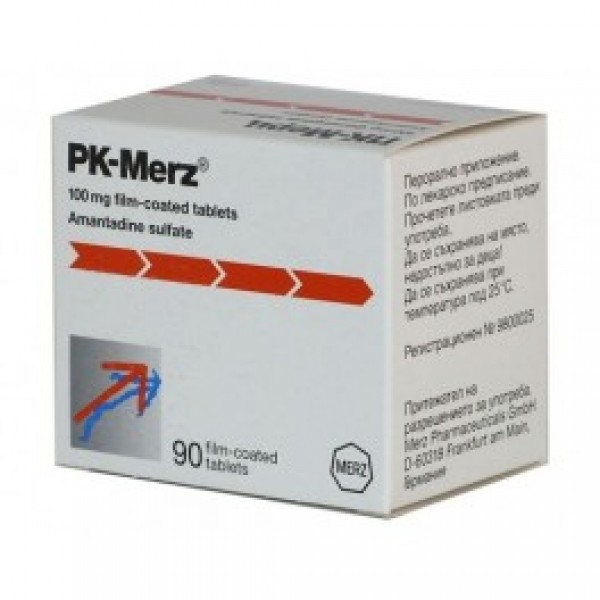
PK-Merz table. 100 mg. 90 tablets
Product Code: PK-Merz table. 100 mg. 90 tablets
Availability: In Stock
Product viewed: 1828


PK-Merz table. 100 mg. 90 tablets

Qualitative and quantitative composition
1 coated tablet contains: Amantadine sulfate 100 mg
Formulation
Coated tablets
Clinical Data
Indications
Parkinson's syndrome: treat symptoms of Parkinson's disease such as rigidity, tremor, hypokinesia and akinesia.
Extrapyramidal adverse side effects when antipsychotics and other products with a similar mode of action as early dyskinesia, akinesia and parkinsonian symptoms.
Posology and method of administration
For oral administration.
It's ECG (50 mm / s) before and 1 and 3 weeks after the initiation of therapy and manual setting Bazett rate corrected QT time (QTc). ECG should be performed before and 2 weeks after each subsequent dose increases. Further ECG controls should be conducted at least annually. Treatment should be avoided or discontinued in patients who have baseline QTc values exceeding 420 ms, QTc increased by more than 60 ms during treatment with PK-Merz 100 mg film-coated tablets, or prolonged QTc greater than 480 ms during treatment with PK-Merz 100 mg film-coated tablets, and patients are discernible U valni.Sledvayki above precautions and contraindications listed given in Section 4.3, can avoid the emergence of a very rare but life-threatening ventricular tachycardia type 'torsades de pointes "as an adverse reaction.
Treatment of patients with Parkinson's syndrome and drug-related movement disorders are usually introduced gradually as the dosage is determined by the therapeutic effect. The estimated effective dose is one to three PK-Merz 100 mg tablets twice daily (equivalent to 200-600 mg amantadine sulphate daily). The daily dose can also be divided into three separate doses.
In elderly patients, particularly those with state of excitement and confusion or delirium syndrome, treatment should be started with lower doses.
In combination with other anti-parkinsonian medication dosage should be individually adjusted.
In patients previously treated with infusion of amantadine sulphate can choose a higher starting dose.
In cases of acute exacerbation of parkinsonian symptoms in terms of akinetic crisis should be given infusion therapy with amantadine sulphate.
Dosage in patients with renal impairment:
In patients with renal impairment, dosage should be adjusted according to the degree of reduction in renal clearance (measured as the glomerular filtration rate: GFR).
PK-Merz 100 mg film-coated tablets are scored and can be divided.
Tablets taken with some liquid, preferably in the morning and afternoon. The daily dose should not be taken more than 16 hours.
The duration of treatment depends on the nature and severity of the disease course and is determined by the physician, the treatment. Patients should not unilaterally terminate treatment.
Treatment should be initiated with a dose of PK-Merz one 100 mg tablet (equivalent to 100 mg amantadine sulfate per day) once daily for the first 4 to 7 days, followed by increasing the daily dose by one tablet per week until reaching the maintenance dose .
Abrupt discontinuation of PK-Merz 100 mg film-coated tablets should be avoided because otherwise patients with Parkinson's disease may experience a severe worsening of extrapyramidal symptoms in akinetic crises and the possible emergence of effects of abrupt discontinuation of treatment, reaching to delirium.
Children
Experience with use in children is insufficient.
Contraindications
PK-Merz 100 mg tablets should not be administered to patients with:
Hypersensitivity to Amantadine, colorant E 110 (yellow-orange S) or any of the other ingredients of the product
Severe uncompensated heart failure (NYHA IV degree)
Cardiomyopathies and myocarditis
AV block II and III degree
Available bradycardia below 55 beats / minute
Known prolonged QT interval (Bazett QTc> 420 ms) or prominent U waves or congenital QT syndrome in family history
A history of serious ventricular arrhythmias, including torsades de pointes
Budipine combination therapy with other drugs that prolong the QT interval (see section 4.5)
Pregnancy
PK-Merz 100 mg film-coated tablets may be used only with caution in patients with:
Prostatic hypertrophy
Glaucoma in narrowing the angle (angle closure glaucoma)
Renal failure (of varying severity, risk of accumulation in renal filtration (see 4.3 and 4.4)
States of agitation or confusion
Delirious syndromes or exogenous psychosis in history
Combination therapy with memantine (see 4.5)
Special warnings and special precautions for use
Warnings:
It's ECG (50 mm / s) before and 1 and 3 weeks after the initiation of therapy and manual setting Bazett rate corrected QT time (QTc). ECG should be performed before and 2 weeks after each subsequent dose increases. Further ECG controls should be conducted at least annually. Treatment should be avoided or discontinued in patients who have baseline QTc values exceeding 420 ms, QTc increased by more than 60 ms during treatment with PK-Merz 100 mg tablets or increase QTc greater than 480 ms during treatment with PK-Merz 100 mg film-coated tablets, and patients are discernible U waves.
Patients at risk for electrolyte imbalance as a result of such treatment. with diuretics, often vomiting and / or diarrhea, use of insulin in an emergency, or kidney or anorectic conditions hold appropriate monitoring of laboratory parameters and appropriate electrolyte replacement, especially for potassium and magnesium.
In the event of symptoms such as palpitations, dizziness, or syncope, treatment with PK-Merz 100 mg film-coated tablets should be discontinued immediately and the patient should be checked within 24 hours for the extension of QT. If no QT prolongation, treatment with PK-Merz 100 mg film-coated tablets may be renewed, taking into account contraindications and interactions.
In patients with peyemeykar precise QT time is not possible, hence the decision to use PK-Merz 100 mg tablets be taken individually, in consultation with the patient's cardiologist.
Additional administration of amantadine for the prophylaxis and treatment of infections caused by influenza A virus is not recommended and should be avoided due to the risk of overdose.
This product contains a colorant E 110 (yellow-orange S), which in hypersensitive patients can trigger allergic reactions, including asthma. This allergy is more common in individuals who are allergic to aspirin.
Special precautions for use:
In patients concomitantly treated with neuroleptic drugs and PK-Merz 100 mg film-coated tablets are at risk of developing life-threatening neuroleptic malignant syndrome with abrupt discontinuation of PK-Merz 100 mg tablets.
In patients with renal impairment may occur intoxication.
Particular caution is advisable when prescribing PK-Merz 100 mg film-coated tablets in patients with organic brain syndrome or seizures because of the possibility of seizure or strengthening of individual symptoms (see 4.2 and 4.8).
Patients with known cardiovascular conditions must remain systematic medical monitoring during treatment with PK-Merz 100 mg tablets.
In the event of symptoms such as palpitations, dizziness or syncope, amantadine treatment should be immediately discontinued and the patient was followed for 24 hours for QT prolongation. If no QT prolongation, treatment with amantadine may be renewed, taking into account contraindications and interactions.
In patients with Parkinson's disease often symptoms of the disease such as low blood pressure, excessive salivation, sweating, increased body temperature, heat accumulation, edema, and depression. These patients should be treated taking into account side effects and interactions of PK-Merz 100 mg film-coated tabletki.Patsientite should be advised of the need to consult a doctor if they experience problems with urination.
Interactions
Concomitant use of amantadine and medicinal products known to cause QT prolongation is contraindicated. Examples are:
A class IA antiarrhythmics (eg quinidine, disopyramide, procainamide) or Class III (eg amiodarone, sotalol)
Certain antipsychotics (eg thioridazine, chlorpromazine, haloperidol, pimozide)
Certain tricyclic and tetracyclic antidepressants (eg amitriptyline)
Certain antihistamines (ie, astemizole, terfenadine)
Certain macrolide antibiotics (eg erythromycin, clarithromycin)
Specific gyrase inhibitors (eg sparfloxacin)
Azole antifungals and other drugs such as budipine, halofantrine, pentamidine, cisapride and bepridil.
This list may not be exhaustive. Before you start using any other medicine while amantadine, that SPC should be carefully examined for potential interactions between other drugs and amantadine, causing QT udalzhavane.Upotrebata of PK-Merz 100 mg tablets in combination with other anti-Parkinsonian products is possible. To avoid side effects (such as psychotic reactions) may be necessary to reduce the dosage of medication, or a combination.
There have been no specific studies on emergence of interactions after the administration of PK-Merz 100 mg tablets in combination with other anti-Parkinsonian medicinal products (ie levodopa, bromocriptine, trihexyphenidyl, etc.) or memantine (to address side effects).
Co-administration of PK-Merz 100 mg film-coated tablets and some types of medicinal products or medicinal substances listed below may result in the following interactions:
Anticholinergic:
Adverse drug reactions (confusion and hallucinations) with anticholinergics (eg trihexyphenidyl, benztropine, scopolamine, biperiden, orphenadrine, etc.) may be increased when co-administered with PK-Merz 100 mg film coated with таблетки.Симпатикомиметици Indirectly CNS: Potentiation of the central action of amantadine.
Alcohol:
Reducing alcohol tolerance. Levodopa (antiparkinsonic medicine): Mutual potentiation of therapeutic action. Therefore, levodopa can be given with PK-Merz 100 mg tablets.
Memantine:
Memantine may potentiate the effects and side effects of PK-Merz 100 mg film-coated tablets (see section 4.8).
Other medicinal products:
Simultaneous use of type triamterene / hydrochlorothiazide reduces plasma clearance of amantadine, leading to toxic plasma concentrations. Therefore, combined use should be avoided.
Pregnancy and lactation
Pregnancy
In preclinical studies in rats found that high doses of amantadine was embryotoxic and teratogenic. There was a higher incidence of bone and skeletal abnormalities. Disturbing and fertility. Studies on peri-and postnatal period are provezhdani.Opisani cases of amantadine use in pregnancy in humans, in which reports of healthy babies and pregnancy complications and malformations (cardiovascular defects, limb) .
Not to be used during pregnancy without careful evaluation of the risk / benefit lekuvashiya doctor.
Lactation:
Amantadine is excreted in breast milk. It is advisable to avoid the use of amantadine during lactation. If necessary the use of amantadine, breastfeeding should be discontinued.
Effects on ability to drive and use machines
It can not be excluded influences on vigilance (state of alertness and attention) and accommodation, particularly in relation to the effects of other drugs used to treat Parkinson's syndrome. When treatment can be further offense in the ability to drive and use machines in most cases, caused by the disease itself. This violation is further strengthened when combined with alcohol.
New (as SPC-Guideline)
Very common> 1 in 10 patients
Common <1 in 10 patients and> 1 in 100 patients
Uncommon <1 in 100 patients and> 1 in 1000 patients
Rare <1 in 1000 and> 1 of 10000
Very rare <1 in 10,000 patients and isolated
Nerves
Not often can occur restlessness and agitation. Seldom to less often manifested orthostatic dysregulation.
In rare cases provoked epileptic seizures, usually during treatment with the recommended dosage.
Blurred vision is very rare to rare. Myoclonus and symptoms of peripheral neuropathy have been reported very rarely.
Psychiatric Disorders
It is possible to trigger sleep disturbances and exogenous paranoid psychosis accompanied by hallucinations, particularly in elderly patients prone. Adverse reactions of this type may occur with greater frequency when PK-Merz 100 mg tablets given in combination with other anti-Parkinsonian medicinal products (ie levodopa, bromocriptine) ilimemantine.
Cardiac disorders
There are very rare reports of cardiac arrhythmias such as ventricular tachycardia, ventricular fibrillation, torsades de pointes and QT prolongation. Most of these cases of an overdose or in connection with certain other medicines, or risk factors for cardiac arrhythmias (see 4.3 and 4.5). Cardiac arrhythmias and tachycardia have been reported very rarely.
Vascular Disorders
Not often seen the development of livedo reticularis (characterized by blotchy skin), sometimes accompanied by swelling of the lower leg and ankle.
Digestive disorders
In rare cases there is more than nausea, dry mouth. Skin and subcutaneous tissue disorders: In rare cases reported increased photosensitivity. Color yellow orange S (E110) may cause allergic reactions.
Genitourinary System
Not often can be observed retention in connection with prostatic hypertrophy.
Visual disturbances
In very rare cases have been reported temporary loss of vision.
Overdose
The possibility of multiple toxicity should always be considered, such as ingestion of multiple tablets with suicidal ideation.
a) Symptoms of intoxication
Acute intoxication is characterized by nausea, vomiting, agitation, tremors, ataxia, blurred vision, lethargy, depression, dysarthria, and convulsions, one case was reported malignant cardiac aritmiya.Ostra toxic psychosis as a state of confusion with hallucinations to and including coma and myoclonus have been reported following concomitant administration of amantadine and other antiparkinsonian drugs.
b) Measures in case of intoxication
There is no known specific drug treatment or antidote. In case of intoxication with PK-Merz 100 mg film-coated tablets should be induced vomiting and / or gastric promivka.V case of life-threatening intoxication need intensive care. Therapeutic measures to be considered include fluid and acidification of urine for rapid excretion of the substance, and possibly sedation, anticonvulsant measures and antiarrhythmics (lidocaine iv).
For the treatment of neurotoxic symptoms (as described above) may try intravenous physostigmine, in adults at a dose of 1-2 mg every 2 hours in children 2 x 0.5 mg at intervals of 5-10 minutes to a maximum dose of 2 mg.
Due to the low dialyzability of amantadine (approximately 5%), hemodialysis is not izbor.Preporachitelno patients are monitored closely for possible QT prolongation and factors that promote the occurrence of torsades de pointes, ie electrolyte imbalance (particularly hypokalemia and hypomagnesemia) and bradycardia. The possibility of multiple intoxication should always be considered, as ingestion of more than one product with the intent suicidal.
Pharmacological properties
Pharmacodynamic properties
Pharmacotherapeutic group: Anti-Parkinson Drug (Dopaminergic agents) ATC code: N04BB01
Pharmacological properties:
With amantadine effects counteract the symptoms of Parkinson bolest.Antiparkinsonoviyat mechanism of action is complex and not yet fully understood. Recent studies confirm the mechanism of action of antagonistic action to the NMDA-ion channels in the basal ganglia. The effect of NMDA-antagonists is functionally similar to that of dopamine, which may explain the dopamine-like actions identified in studies on mechanism of drug action. Weak anticholinergic effects of amantadine also play a role.
Pharmacokinetic properties
Absorption:
Amantadine is absorbed after oral administration, rapidly and completely from the gastrointestinal tract.
Plasma concentration, elimination:
Maximum plasma concentrations are reached in about 2-8 hours (tmax) after oral administration of a single dose.
Write a review
Your Name:Your Review: Note: HTML is not translated!
Rating: Bad Good
Enter the code in the box below:
Related Products