Your shopping cart is empty!
Welcome visitor you can login or create an account.
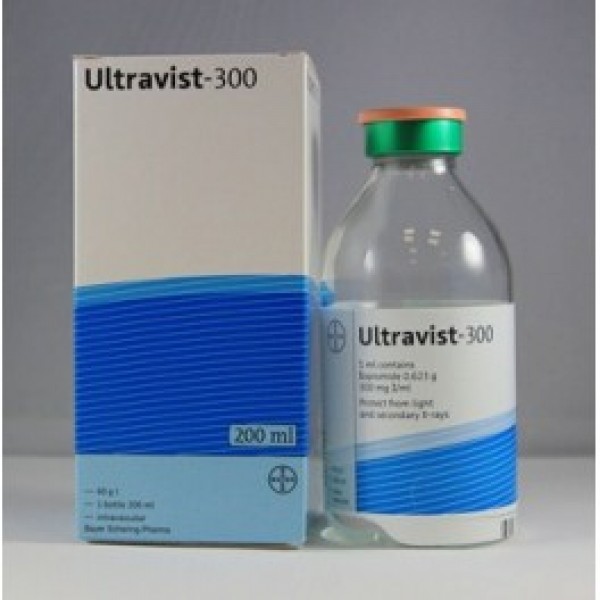
ULTRAVIST 300 mg.
Product Code: ULTRAVIST 300 mg.
Availability: In Stock
Product viewed: 1434


ULTRAVIST 300 mg.
WHAT ULTRAVIST AND WHAT IT IS USED FOR?
This medicinal product is for diagnostic use only. What Ultravist?
Ultravist containing contrast substance iopromide.
Ultravist also contains the following inactive ingredients: sodium calcium edetate, trometamol, hydrochloric acid and water for injections.
What is Ultravist?
Ultravist is a contrast medium for X-ray studies. Is provided in aqueous solution for injection.
How does Ultravist?
All injectable X-ray contrast media, including Ultravist contain iodine. X-rays can not pass the contrast, because they are absorbed by the iodine. Areas of your body where it is graded Ultravist after injection into the bloodstream or body cavities become visible on x-ray.
Why use Ultravist?
Depending on the route of administration and dosage Ultravist provides visualization of veins and arteries, to detect abnormalities in the urinary tract, kidney, brain, heart and body cavities.
2. Before USE ULTRAVIST
Do not use ULTRAVIST
- If you are allergic (hypersensitive) to iodinated contrast media to iopromide or any of the other ingredients of Ultravist. if you have had previous hypersensitivity reactions to contrast media if you are pregnant or intend to become pregnant.
- If you are breastfeeding or plan to breastfeed. You should discuss with your doctor when to pause and resume breastfeeding.
- If you suffer from allergy (eg seafood, herbs, hives) or asthma.
-if you have severely impaired renal function if you have cardiovascular disease if you have diabetes.
- If you suffer from brain conditions, accompanied by seizures or other nervous system diseases.
- If you have circulatory brain disorders or a history of stroke.
- If you have a known or suspected overactive thyroid gland.
- If you have swelling of the neck caused by enlargement of the thyroid gland (goiter).
- If you have a blood cancer (multiple myeloma), or overproduction of proteins (paraproteinaemia), autoimmune disease or condition in which the muscles weaken and get tired easily (myasthenia gravis).
- If you have a particular form of high blood pressure caused by a rare tumor of the adrenal gland (pheochromocytoma).
- If you are taking certain drugs or drink alcohol regularly.
If you experience such symptoms, your doctor will decide whether it is possible to conduct the study.
Must abstain from food intake two hours before the survey, but may take liquids as usual.
Take special care with Ultravist
Like reactions, allergic, have been observed after administration of X-ray contrast media as Ultravist (see section 4 'Possible side effects') Mild swelling of the face, lips, tongue or throat, conjunctivitis, coughing, itching, runny nose, sneezing and hives, which may occur irrespective of the intended amount. This may be the first signs of the initial stage of a severe reaction. Administration of the contrast medium must be discontinued immediately and - if necessary - given intravenously special medication.
The study of the pancreas and bile ducts can increase the risk of reactions available inflammation.
Taking other medicines
Please tell your doctor if you are taking or have recently taken any other medicines, including medicines obtained without a prescription.
Some medications may affect the operation of Ultravist. These include: beta-blockers - drugs used to treat high blood pressure or other cardiac diseases
- Biguanides - drugs used in diabetes
- Neuroleptics, antidepressants
- interleukins
- Radioactive substances for the thyroid gland.
Your doctor will advise you how to take these drugs before the study.
Pregnancy and lactation
Ask your doctor or pharmacist before taking any medicine.
• Pregnancy
Adequate and well-controlled studies in pregnant women have not been conducted. There is no satisfactory evidence of the safety of non-ionic contrast media use in pregnant patients. Therefore, whenever possible, radiation exposure should be avoided during pregnancy, the benefits of any X-ray examination, with or without contrast media must be carefully weighed against the possible risk.
• Breastfeeding
Safety Ultravist not been studied in infants. Contrast media are excreted in very small quantities in breast milk. Harm to the infant is unlikely.
Driving and using machines
May appear delayed reactions (see section 4 'Possible side effects'). In these cases Ultravist may prevent safe your driving and handling equipment.
3. HOW TO USE ULTRAVIST?
Ultravist is injected by a doctor via a small needle into a blood vessel, usually on the back of the hand or on the inside of the forearm.
Ultravist can also be administered into a body cavity. Apply just before X-ray.
Right dose for you Ultravist will be calculated by your doctor and will depend on your age, your weight and the type of X-rays used. The rate at which injected Ultravist and duration of the X-ray also depend on the type of X-ray used. For most x-rays is sufficient only a single dose Ultravist.
Because of possible serious reactions You will be observed in case there might be some initial side effects of the application of Ultravist.
Special information for the doctor or health professional.
Ultravist should be warmed to body temperature before use.
Contrast media should be visually inspected before use and should not be used if discolored or in a case of insoluble particles (including crystals) or defective packaging. Since Ultravist is a highly concentrated solution, very rarely may occur crystallization (milky white appearance of turbidity and / or sediment on the bottom or floating crystals).
• ampoules / vials
Contrast medium not used in one study, discarded.
• Packages with larger volumes
Contrast media should not be administered with an autoinjector or through another procedure ensuring sterility of the contrast medium.
The instructions of the manufacturer of the device must be observed.
Ten hours after opening the bottle remaining unused Ultravist should be discarded.
If you use more than the amount of Ultravist
Overdose is unlikely. If this happens, the doctor will treat symptoms appeared.
4. POSSIBLE SIDE EFFECTS
Like all medicines, Ultravist can cause side effects, although not everybody gets them.
Adverse reactions to Ultravist dependent on the indication.
Below we list possible side effects by frequency.
The term "common" means that more than 1 in every 100 people may occur.
"Uncommon" means in less than one in 100, and the "rare" - at less than 1 in 1,000.
Adverse reactions related to the use of iodinated contrast media are usually mild to moderate and transient expressed. However, there are reports of severe and life-threatening reactions and deaths.
Nausea, vomiting, pain perception, and a general feeling of heat are the most commonly reported effects.
Uncommon side effects
Allergic-like reactions, dizziness, anxiety, blurred / abnormal vision, change in heart rhythm, warm feeling (vasodilatation), sneezing, coughing, vomiting, taste disturbances, urticaria, pruritus, rash, redness of the skin, kidney disease Total malaise, chills, sweating, impotence.
Rare side effects
Allergic-like reactions with dangerous drop in blood pressure (shock) (including fatal), overactive thyroid gland (hyperthyroidism, thyrotoxic crisis), underactive thyroid gland (hypothyroidism) Tingling or numbness of the hands or feet / decreased sensation, confusion, anxiety, agitation, memory loss, speech disorders, somnolence, insomnia, coma, tremors, convulsions, weakness, leading to
immobilization / paralysis, reduced blood flow to parts of the brain, stroke, transient slepotaa,
Conjunctivitis, lacrimation, hearing disorders, fast or irregular heartbeats (palpitations), chest pain / tightness, slow heart rate, rapid heartbeat,
Heart attack, heart disease, blue lips, low blood pressure, high blood pressure, dangerously low blood pressure (shock), spasm of blood vessels
Blockage of blood vessels by a blood clot, fever, Shortness of breath, respiratory disorders frequency, mucosal edema, asthma, hoarseness, swelling of the face, tongue or throat, difficulty breathing (bronchospasm, laryngeal / pharyngeal spasm), fluid in the lungs
lungs, respiratory arrest, sore throat, difficulty swallowing, swelling of the salivary glands, stomach pain, diarrhea, swelling of the tongue, face, lips or throat Severe skin diseases (pain, redness, large blisters, dropping the layers of the skin, bleeding lips, eyes, etc.), severe kidney disease, pallor, changes in body temperature, Leather edema
If contrast material is not injected into a blood vessel: local pain, swelling and slight warming, inflammation and tissue damage
The frequency is based on the data received from the pre-market research with more than 3900 patients and post-marketing with more than 74 000 patients as well as from the literature data and spontaneous messages. (Assessment of frequency is mainly done in intravascular administration)
Study of the pancreas (ERCP):
In addition to the adverse reactions listed above, the following adverse reactions may occur during ERCP: elevated pancreatic enzyme levels (often), inflammation of the pancreas (rare).
If any of the side effects gets serious, or you notice other effects not listed in this leaflet, please tell your doctor.
5. HOW TO STORE ULTRAVIST?
Radiology department will store Ultravist under conditions recommended by the manufacturer.
6. FURTHER INFORMATION
What ULTRAVIST?
The active substance is iopromide.
The other ingredients are sodium calcium edetate, trometamol, hydrochloric acid and water for injections ..
ULTRAVIST looks like and contents of the pack?
Ultravist is supplied ready to use as a clear, colorless to pale yellow solution.
Write a review
Your Name:Your Review: Note: HTML is not translated!
Rating: Bad Good
Enter the code in the box below:
Related Products